Table of Contents >> Show >> Hide
- What does the second house mean in astrology?
- Why is the second house associated with Taurus and Venus?
- What the second house is not
- How to read the second house in your birth chart
- The second house vs. the eighth house
- Common second-house myths
- Why the second house matters in everyday life
- Experiences related to the second house in astrology
- Final thoughts
If your birth chart were a mansion, the second house would be the room with the safe, the closet, the savings app, the favorite sweater you refuse to throw away, and the little voice in your head that asks, “Do I actually value this?” In astrology, the second house is often called the House of Possessions or the House of Income, but that label only tells half the story. Yes, it has a lot to say about money. But it also speaks to self-worth, personal values, natural talents, comfort, and the resources you rely on to build a stable life.
In plain English, the second house is where astrology explores what you own, what you earn, what you need, and what helps you feel secure. It is about the material world, but it is not shallow. In fact, it asks one of the most uncomfortable and useful questions in any birth chart: What do you believe you are worth? That question can shape your paycheck, your standards, your shopping cart, your side hustle, and the way you hold onto or let go of things.
So if you have ever wondered why one person treats budgeting like a spiritual practice while another buys a velvet chair because “it spoke to them,” the second house is a good place to start.
What does the second house mean in astrology?
The second house covers your personal resources. That includes obvious things like income, cash flow, savings habits, possessions, and financial priorities. It also includes less obvious but equally important things like self-esteem, values, talents, and the skills you can turn into something useful or profitable.
Think of the first house as who you are and the second house as what supports you. It describes what helps you survive, thrive, and feel grounded in the physical world. This is why many astrologers connect the second house not only to money, but also to security, pleasure, consistency, and your relationship with comfort.
When people talk about the second house, they are usually talking about these core themes:
- Money and income: how you earn, spend, save, and define financial stability
- Possessions: what you own and how attached you are to material things
- Values: what matters to you, what you prioritize, and what you refuse to compromise on
- Self-worth: how much value you place on yourself and your abilities
- Talents and skills: gifts you can develop into resources
- Security: what helps you feel safe, settled, and supported
That is why the second house can show up in places you would not expect. It can describe your pricing strategy if you freelance, your attachment to luxury or simplicity, your comfort with asking for a raise, your instinct to save every receipt, or your tendency to keep ten backup chargers “just in case.” Very glamorous. Very second house.
Why is the second house associated with Taurus and Venus?
In modern astrology, the second house is naturally linked with Taurus, the fixed earth sign known for stability, patience, sensuality, and a strong relationship with the material world. Taurus is ruled by Venus, the planet associated with attraction, pleasure, beauty, values, and what we appreciate.
That pairing helps explain the vibe of the second house. This house is not just about stacking money like a dragon on a treasure pile. It is also about deciding what is worth keeping, cultivating, enjoying, and protecting. Venus gives the second house its sense of taste and value. Taurus gives it staying power.
That is why the second house often shows a person’s approach to quality over quantity, comfort over chaos, and long-term stability over flashy but short-lived wins. Not always, of course. A fiery or airy sign on the second house can change the flavor. But the house itself still asks questions about security, worth, and resources.
What the second house is not
One of the biggest mistakes people make is assuming the second house is just a money box. It is not. If you reduce it to “rich or broke,” you miss most of the meaning.
The second house is also not a guaranteed measure of wealth. It can describe your relationship to earning and value, but it does not function like a cosmic ATM receipt. A strong second house may show financial awareness, skill, or focus, but other parts of the chart matter too, especially the eighth house, sixth house, tenth house, Venus, Jupiter, Saturn, and the ruler of the second house.
And if your second house is empty, that does not mean money is cursed, missing, or hiding under the bed. An empty house simply means there are no natal planets placed there. You still read the sign on the cusp and the ruler of that sign to understand how the house operates.
How to read the second house in your birth chart
1. Start with the sign on the second-house cusp
The zodiac sign on your second-house cusp shows the style, attitude, and tone you bring to second-house matters. In other words, it reveals how you approach money, value, possessions, and security.
- Aries: bold, fast-moving, independent earning style; may spend quickly and act on impulse
- Taurus: practical, steady, comfort-loving; prefers stability, quality, and long-term value
- Gemini: curious, adaptable, multi-stream income energy; may juggle side hustles or flexible work
- Cancer: security-minded, protective, emotionally tied to comfort and savings
- Leo: generous, proud, expressive; may value luxury, visibility, and earning through creativity
- Virgo: careful, analytical, detail-oriented; excellent for budgeting, planning, and refining skills
- Libra: values beauty, fairness, and balance; may spend on aesthetics, relationships, or harmony
- Scorpio: intense and strategic; can be private, all-or-nothing, and highly focused on control
- Sagittarius: optimistic, adventurous, sometimes risk-friendly; may spend on travel, learning, or freedom
- Capricorn: disciplined, ambitious, patient; often serious about building long-term security
- Aquarius: unconventional, independent, future-focused; may value freedom over traditional status symbols
- Pisces: intuitive, porous, imaginative; may have a fluid relationship with money and need firmer boundaries
2. Look at any planets in the second house
Planets in the second house describe what is happening in this area of life and what kind of energy is concentrated there.
- Sun in the second house: identity is tied to competence, earning, or building stability
- Moon: emotional security is closely linked to money, comfort, and consistency
- Mercury: income through communication, teaching, writing, sales, or analysis
- Venus: talent for attracting resources, beauty, pleasure, design, or diplomacy
- Mars: strong drive to earn and protect resources, though spending can be impulsive
- Jupiter: abundance mindset, generosity, growth potential, sometimes excess
- Saturn: caution, responsibility, delayed rewards, and lessons around scarcity or self-worth
- Uranus: unusual income patterns, instability, innovation, or independence
- Neptune: inspiration and idealism around value, but sometimes confusion or weak boundaries
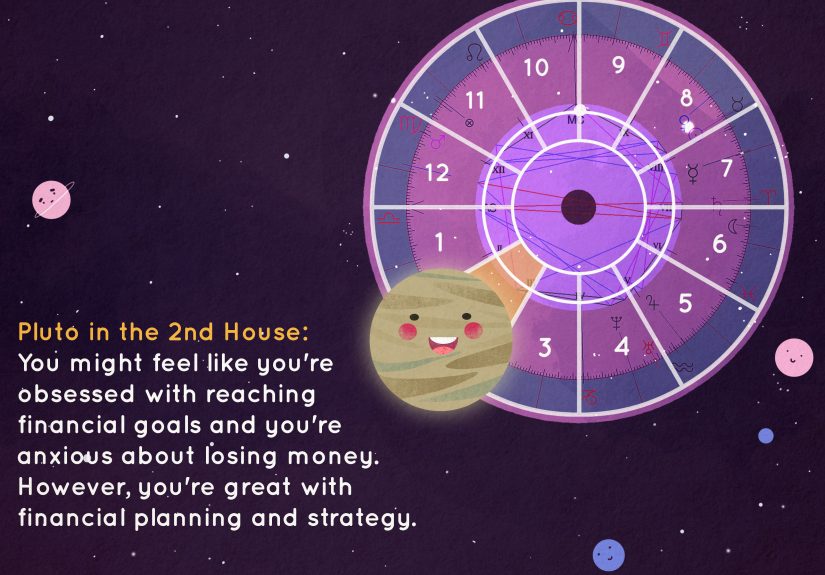
- Pluto: intense transformations around money, power, attachment, and self-worth
3. Find the ruler of your second house
This is where astrology gets spicy in a nerdy way. The ruler of your second house is the planet that rules the sign on the cusp of that house. Its placement by sign and house gives extra detail about where your second-house story plays out.
For example, if Gemini is on your second-house cusp, Mercury rules your second house. If Mercury is in the tenth house, your money story may connect strongly to career, visibility, leadership, or public work. If Mercury is in the third house, income may come through communication, writing, sales, or local networks.
So the formula is simple:
Second-house sign = your style
Planets in the second house = what is happening there
Ruler of the second house = where the story develops
4. Consider transits and timing
When a transit activates your second house, second-house topics come into focus. You might rethink your spending, negotiate pay, start a side business, confront scarcity fears, declutter, or redefine what “enough” means.
For instance, Jupiter moving through the second house can bring expansion, confidence, or financial opportunity, though it can also tempt overspending. Saturn in the second house may demand discipline, patience, and a more mature relationship with resources. Venus transiting the second house can highlight income, pleasure, beauty purchases, or a stronger desire for comfort.
Also worth noting: your house placement can vary depending on the house system used, such as Whole Sign or Placidus. That does not mean one chart is fake and the other is plotting against you. It simply means astrologers may use different frameworks to interpret the same birth data.
The second house vs. the eighth house
A useful way to understand the second house is to compare it with its opposite: the eighth house. The second house deals with your money, your possessions, your values, and your self-worth. The eighth house deals with shared resources, debts, taxes, inheritances, mergers, and the emotional intensity that comes from entanglement.
If the second house is your wallet, the eighth house is the joint bank account. If the second house asks, “What do I have?” the eighth asks, “What is exchanged, shared, owed, or transformed?”
That contrast matters because second-house work is often about building internal stability before life asks you to share, merge, or risk. In that sense, the second house is deeply personal. It is where you learn to stand on your own feet before negotiating what belongs to everyone else.
Common second-house myths
“The second house only means money.”
Nope. It also rules values, talents, possessions, and self-worth. Money is only one expression of the house.
“An empty second house means financial problems.”
Also no. An empty second house just means you need to read the sign on the cusp and the ruler of that house. Empty does not mean unimportant.
“A Taurus-like second house guarantees wealth.”
Nice dream, but not exactly. Taurus or Venus themes can support steadiness, attraction, and appreciation for quality, but the whole chart matters. Also, a person can love luxury and still side-eye their bank account at 2 a.m.
“The second house is shallow or materialistic.”
Not at all. The second house can be one of the most psychologically revealing parts of a chart because it shows what you need in order to feel safe and what you believe you deserve.
Why the second house matters in everyday life
The second house matters because nearly everyone wrestles with its themes. You do not need to be a full-time astrologer, a hedge fund manager, or someone who alphabetizes receipts for fun. You just need to live in the real world.
This house can show up when you are pricing your work, deciding whether to stay in a stable job, building a savings plan, buying furniture that will last, learning a new skill, or asking yourself why you feel guilty spending money on things that actually support your life.
It can also reveal whether you chase security through numbers, quality, minimalism, status, freedom, or emotional comfort. Some people want a large savings cushion. Some want beautiful surroundings. Some want six income streams. Some just want enough money to stop flinching every time their car makes a new sound.
That is second-house territory too.
Experiences related to the second house in astrology
Many people first notice second-house themes not in an astrology book, but in ordinary life. A person with strong second-house energy may realize that every major decision somehow circles back to security. They may not say, “Ah yes, my natal house placements are speaking.” They may simply notice that they cannot relax until the rent is paid, the pantry is stocked, and the emergency fund exists. For them, peace is not abstract. Peace has a password-protected savings account and maybe a backup charger.
Another common experience is discovering that self-worth and net worth get tangled together. Someone may work hard, get praise, even earn well, yet still feel uneasy asking for more. They know they are capable, but somewhere deep down, they are still negotiating their value. This is one of the most revealing second-house lessons: financial behavior is often emotional behavior wearing business casual. A person can undercharge, overspend, hoard, or overwork not because they are bad with money, but because they are still learning what they deserve.
There are also people who experience the second house through talent. Maybe they are great at design, cooking, organizing, repairing things, teaching, or making everyone’s chaotic spreadsheet suddenly make sense. At first, that skill feels ordinary to them because it comes naturally. Then one day, someone says, “You know people would pay for that, right?” That moment is pure second-house magic. It is the point where a personal gift becomes a practical resource. The second house loves that intersection between ability and usefulness.
For some, second-house experiences show up through possessions and the meaning attached to them. One person feels safer in a simple, uncluttered space with only the essentials. Another feels grounded by well-made furniture, quality clothes, favorite scents, and objects that create beauty and comfort. Neither approach is wrong. The second house is not judging whether you own three ceramic mugs or thirty-seven. It is asking why those things matter to you and whether they support your life or quietly run it.
Second-house growth can also happen during financial turning points. A person may lose a job and discover that their real security was never the title, but the adaptable skills they built over time. Another may get a raise and realize the extra money changes less than expected because the deeper lesson is learning to feel worthy of stability. Someone else may begin budgeting for the first time and find that it is not restrictive at all. It actually feels calming, empowering, and oddly adult in the best way.
Even relationships can highlight second-house themes. You may notice who pays for what, who values generosity, who wants financial independence, and who equates love with tangible support. These patterns are not just about money. They are about values, trust, and the ways people seek safety in the material world.
In real life, the second house is rarely dramatic in a movie-trailer way. It is quieter than that. It lives in your standards, your habits, your possessions, your paycheck, your craft, your boundaries, and your definition of enough. And honestly, “enough” might be the most second-house word of all.
Final thoughts
So, what is the second house in astrology? It is the part of the birth chart that deals with your personal resources, income, possessions, values, talents, and self-worth. It shows how you create stability and what helps you feel secure in the physical world. It is linked with Taurus and Venus, but your unique second-house story depends on the sign on the cusp, any planets placed there, and the ruler of that house.
Most importantly, the second house reminds us that value is never just about price. It is about priorities. It is about what you build, what you protect, what you believe you deserve, and how you support your own life. In that way, the second house is not merely about money. It is about meaning with a receipt attached.