Table of Contents >> Show >> Hide
The Porsche 935 K3 looks like a Porsche 911 that escaped from a laboratory after eating several turbochargers, an aerodynamic textbook, and possibly one unfortunate wind tunnel technician. Beneath the cartoonishly wide bodywork, enormous rear wing, and unapologetic air intakes, however, sat one of the most effective production-based racing cars ever built.
Developed by Kremer Racing from Porsche’s already formidable 935, the K3 became an endurance-racing legend when it won the 1979 24 Hours of Le Mans outright. It defeated purpose-built prototypes, survived relentless rain, and proved that a highly motivated private team could outthink and outlast the biggest factory operations in motorsport.
The complete Porsche 935 story is one of clever rule interpretation, turbocharged experimentation, privateer ingenuity, and drivers brave enough to control approximately 800 horsepower without modern electronic assistance. The Porsche 935 K3 was the chapter in which all those ingredients came together perfectly.
The Porsche 935 Story Begins With the 911 Turbo
The original Porsche 935 appeared in 1976 as Porsche’s weapon for the FIA Group 5 category. Although it was officially based on the Porsche 911 Turbo, known internally as the Type 930, the connection became increasingly theoretical once Porsche’s engineers started exploring the regulations.
Group 5 was often described as a silhouette formula. A competing car had to retain recognizable elements of its production-based ancestor, but manufacturers received enormous freedom to modify aerodynamics, suspension, engines, body panels, and track width. The basic roofline and doors helped identify the 935 as a relative of the 911. Almost everything surrounding them appeared to have been designed during a meeting where somebody repeatedly shouted, “Wider!”
Turning the 911 Into a Group 5 Weapon
Porsche lowered the nose, widened the wheel arches, improved cooling, and developed increasingly aggressive turbocharged flat-six engines. The familiar round headlights migrated from their traditional upright positions into the front bumper, allowing the front fenders to be reshaped for cleaner airflow.
The result was lower, longer, and considerably more intimidating than a road-going 911 Turbo. Early versions used a large single turbocharger, producing tremendous power but also substantial turbo lag. Press the accelerator, wait briefly for the machinery to consider your request, and then receive nearly all the horsepower at once.
Later twin-turbo systems improved response and made the power more manageable. “Manageable,” of course, is a relative term when discussing a lightweight rear-engine racing car with no traction control and enough power to rearrange the scenery.
Rapid Factory Evolution
Porsche refined the 935 almost continuously. The 935/77 introduced mechanical and aerodynamic improvements, while the extreme 935/78 became famous as “Moby Dick.” Its elongated body, partially water-cooled engine, and extraordinary straight-line speed represented the factory concept at its most radical.
At the same time, Porsche supplied customer cars to private racing teams. Those independent organizations did not simply purchase the cars and polish them lovingly between events. Several began creating their own developments, and none pursued that opportunity more aggressively than Kremer Racing.
Kremer Racing Creates the Porsche 935 K3
Brothers Erwin and Manfred Kremer operated their racing organization and Porsche workshop in Cologne, Germany. They had extensive experience preparing Porsche competition cars and were respected for finding practical improvements that worked outside a factory laboratory.
The brothers developed a sequence of modified 935s designated K1, K2, K3, and eventually K4. The “K” represented Kremer, while the number identified the development stage. Introduced for the 1979 season, the K3 was their third major interpretation of the 935 formula and by far the most successful.
Why the K3 Was More Than a Modified Customer Car
Kremer Racing did not merely install a larger turbocharger and declare victory. The K3 featured comprehensively revised bodywork, improved airflow management, reduced weight, and a more efficient approach to cooling.
One important change involved the intercooling system. Factory developments had experimented with water-based cooling arrangements, but the K3 adopted an effective air-to-air system. This reduced complexity and helped the car remain competitive over long-distance races, where a theoretically brilliant component becomes considerably less impressive if it turns into expensive steam at three in the morning.
The K3’s rear bodywork, side panels, underbody treatment, and enormous wing were designed to generate useful downforce without creating excessive drag. Its shape exploited the growing understanding of ground effects, directing air around and beneath the car to improve stability.
Porsche 935 K3 Engine and Performance
Specifications varied according to chassis, race, turbo boost, and series regulations, but a typical European Porsche 935 K3 used a twin-turbocharged 3.2-liter flat-six engine. In qualifying trim, output could approach 800 horsepower. Endurance settings were often less aggressive to protect the engine, gearbox, and fuel consumption.
That power reached the rear wheels through a four-speed manual transmission. The car weighed approximately 2,260 pounds, or about 1,025 kilograms, depending on configuration. Combining that low weight with roughly 750 to 800 horsepower produced a power-to-weight ratio that remains dramatic even by modern supercar standards.
There was no computerized stability system waiting patiently to correct a careless throttle input. Drivers managed boost, tire grip, braking, traffic, weather, and mechanical sympathy themselves. Their most advanced driver-assistance technology was usually a pit board held by somebody standing dangerously close to the track.
The 1979 24 Hours of Le Mans
The defining chapter of the Porsche 935 K3 story arrived at the 1979 24 Hours of Le Mans. Kremer Racing entered the white No. 41 K3 for Klaus Ludwig and American brothers Bill and Don Whittington.
The 935s faced a mixed field that included Porsche 936 prototypes, Mirage-Ford entries, and numerous other Group 5 machines. On paper, the dedicated prototypes should have held the advantage. They were designed specifically for top-level endurance racing rather than being loosely descended from a production sports car.
Le Mans, however, is rarely won on paper. Paper does not experience turbo failure, electrical trouble, rainwater, missed shifts, damaged bodywork, or the special sort of mechanical rebellion that traditionally occurs just after a team begins feeling confident.
A Race Defined by Rain and Survival
Heavy rain transformed much of the race into a test of judgment. Standing water reduced visibility, increased the risk of aquaplaning, and made the high-powered 935 difficult to control. Drivers also had to pass slower traffic while maintaining enough speed to remain competitive.
Klaus Ludwig was particularly effective in the miserable conditions. His speed, consistency, and ability to preserve the car became central to Kremer’s challenge. Bill and Don Whittington contributed essential stints while the crew managed fuel, tires, maintenance, and the endless strategic calculations required during a 24-hour contest.
As leading prototypes encountered problems, the K3 moved into a stronger position. It was not simply waiting for everyone else to fail. The Porsche maintained a serious pace while avoiding the kind of mistakes and mechanical damage that eliminated faster-looking rivals.
An Eight-Lap Victory
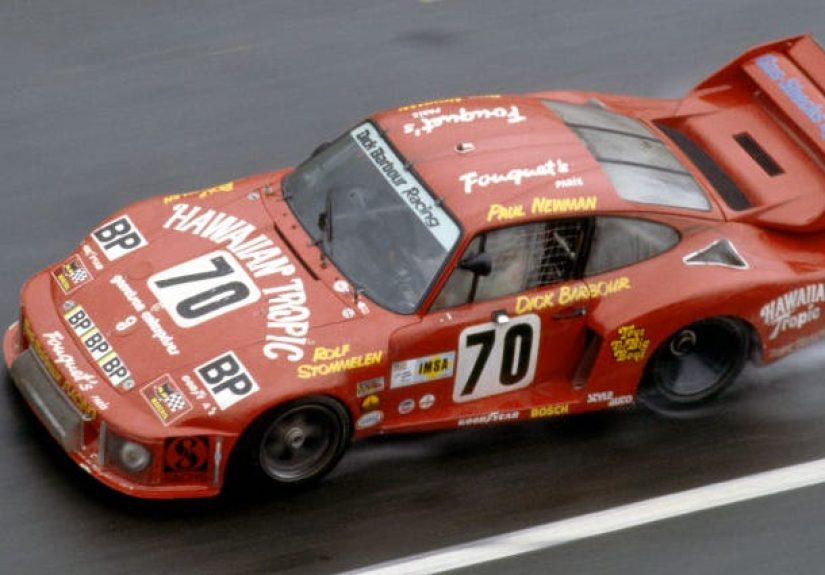
After 24 hours, the No. 41 Porsche 935 K3 crossed the finish line eight laps ahead of the second-place car. That runner-up was another Porsche 935, entered by Dick Barbour Racing and driven by Rolf Stommelen, Dick Barbour, and actor and accomplished racer Paul Newman.
A second Kremer-prepared 935 finished third, contributing to an extraordinary Porsche sweep at the front. The result demonstrated both the quality of the original 935 platform and the strength of independent Porsche racing operations.
The winning K3 became the first customer-team Porsche to claim an overall Le Mans victory. It was also the first rear-engine racing car to win the event overall and remains the only rear-engine car to have achieved that distinction. For a machine still technically connected to the 911 Turbo, beating specialized prototypes was an astonishing accomplishment.
Why the 935 K3 Victory Mattered
Kremer Racing’s success was not merely another Porsche victory to be added to a long trophy list. It represented a rare triumph for a private organization operating with intelligence, experience, and determination rather than unlimited factory resources.
A Privateer Defeats the Prototypes
Private teams were essential to endurance racing during the Group 5 era. Manufacturers supplied cars, components, technical knowledge, and occasionally drivers, while independent entrants expanded the competition across Europe and North America.
The K3 showed what could happen when a private team became a genuine engineering force. Kremer Racing studied the factory car, identified areas for improvement, and created a version suited to the realities of customer racing. Reliability, accessibility, cooling, and aerodynamic efficiency mattered as much as a spectacular peak-horsepower figure.
The resulting car was fast enough to challenge prototypes and dependable enough to continue doing so through darkness, rain, and repeated pit stops. It was engineering with its sleeves rolled up.
The Height of Group 5 Creativity
The Porsche 935 K3 also captured everything enthusiasts remember about Group 5 racing. The cars remained visually connected to showroom models, but only in the same way a movie monster might remain connected to the mild-mannered scientist it had once been.
Group 5 encouraged enormous fenders, deep front spoilers, exposed cooling ducts, huge wings, and engines with increasingly ambitious turbo boost. BMW, Ford, Lancia, Nissan, and other manufacturers created memorable machines, but the Porsche 935 became the category’s defining competitor.
The rules rewarded creative interpretation, and the K3 may have been the most successful private interpretation of them all.
Life After Le Mans
The K3’s influence continued well beyond its 1979 victory. Examples competed throughout Europe and North America, appearing in the Deutsche Rennsport Meisterschaft, the World Championship for Makes, and IMSA racing.
The broader Porsche 935 family became especially dominant at major American endurance events. Porsche 935 derivatives won the 24 Hours of Daytona repeatedly from the late 1970s into the early 1980s. A K3 won Daytona overall in 1981, further confirming that the Kremer design was not a one-race wonder.
The Famous Apple Porsche 935 K3
One of the best-known later K3s wore Apple Computer sponsorship during the 1980 season. Entered by Dick Barbour Racing, the car featured colorful rainbow graphics from Apple’s early corporate identity.
The Apple Porsche did not equal the 1979 K3’s Le Mans victory, but its striking livery became a cultural icon. Decades later, photographs, scale models, restorations, and tribute liveries helped introduce the 935 K3 to audiences who might never voluntarily read a 400-page book about Group 5 regulations.
A Lasting Porsche Motorsport Legacy
The original Porsche 935 competed internationally from 1976 into the mid-1980s and helped Porsche collect championships and major endurance victories. Its success also strengthened the customer-racing model that later became a central part of Porsche Motorsport.
Porsche eventually revived the 935 name for a limited-production track car based on the modern 911 GT2 RS. That machine was not built for the original Group 5 rulebook, but its long bodywork, covered wheels, extended tail, and visual references to Moby Dick acknowledged the enormous reputation of the historic 935 family.
The Le Mans-winning K3 itself has been carefully preserved and displayed as an important piece of racing history. It is not merely a valuable old Porsche. It represents the moment when a Cologne privateer team, three determined drivers, and a heavily modified 911 Turbo defeated the world at Le Mans.
Experiencing the Porsche 935 K3 Up Close
Encountering a Porsche 935 K3 at a museum, concours, or historic racing event changes the way the car appears in photographs. Images emphasize the wide body and rear wing, but they rarely communicate the K3’s physical presence. It sits low and broad, with rear tires that seem large enough to support a small office building.
The Bodywork Tells the Engineering Story
Begin at the front and notice how little the car resembles an ordinary late-1970s 911 below the windshield. The traditional headlights have disappeared from the fenders, replaced by lamps mounted lower in the nose. Wide openings feed air toward radiators, brakes, and other heat-sensitive components.
Walk along the side and the swollen wheel arches dominate the view. The doors and roof preserve a trace of the production 911, but the surrounding panels stretch outward into a purpose-built racing shape. Cooling ducts and vents reveal how much of the K3’s design was devoted to controlling temperature. Turbocharged endurance cars generate wonderful speed and equally enthusiastic quantities of heat.
At the rear, the wing looks less like an accessory and more like a piece of municipal infrastructure. Beneath it, the bodywork manages airflow around the engine compartment while accommodating exhausts, turbochargers, intercooler plumbing, and enormous rear wheels.
The Sound Is Mechanical Theater
A static display is impressive, but a running K3 delivers the full experience. At idle, the flat-six produces a hard, uneven mechanical rhythm. The engine note sharpens as the revs rise, accompanied by gear noise, exhaust pulses, and the hiss of forced induction.
When the driver opens the throttle, the sound develops in stages. The engine responds first, followed by the rising whistle of the turbochargers. Then the boost arrives and the car accelerates with startling violence. On a straight, the exhaust and induction noise combine into the unmistakable soundtrack of an unrestricted racing machine from an era before noise limits became socially acquainted with racetracks.
During braking, flames or sharp exhaust reports may appear as the driver downshifts. The four-speed gearbox demands deliberate movements, and every change reminds the observer that the K3 requires physical participation. The driver is not selecting a performance mode from a screen. The driver is negotiating with machinery.
Understanding the Driver’s Workload
Looking inside the cockpit makes the 1979 Le Mans achievement even more remarkable. The cabin is cramped, functional, and filled with exposed structures, switches, gauges, and safety equipment appropriate to its period.
Drivers monitored oil pressure, temperature, fuel, boost, and warning lights while traveling at extreme speed. They also coped with heavy steering, substantial pedal effort, turbo lag, rearward weight distribution, poor wet-weather visibility, and faster or slower traffic.
At Le Mans, these demands continued through long stints in darkness and torrential rain. There was no modern telemetry system instantly transmitting every detail to a group of engineers. Communication depended heavily on pit boards, scheduled stops, driver feedback, and the crew’s ability to inspect the car quickly.
The Best Way to Appreciate the K3
When watching a K3 in historic competition, resist the temptation to judge it only by lap times. Modern racing cars are safer, more aerodynamically sophisticated, and electronically controlled. The K3’s appeal comes from seeing how much performance engineers extracted with comparatively limited tools.
Watch the car under acceleration and notice the driver correcting the steering as boost builds. Observe how carefully it is positioned before a corner and how early the driver prepares for braking. Listen for the pause between gear changes and the surge when power returns.
The Porsche 935 K3 is exciting because it never makes speed look effortless. The car appears alive, demanding, and slightly argumentative. Its 1979 Le Mans victory was therefore more than a statistical result. It was the product of drivers, mechanics, and engineers continuously managing a machine that could reward precision or punish carelessness.
That human element explains why the Porsche 935 K3 remains unforgettable. It combined the recognizable DNA of the 911 with outrageous Group 5 engineering, privateer ambition, and one of the greatest endurance-racing victories ever achieved. Plenty of racing cars have been faster. Very few have told a better story.