Table of Contents >> Show >> Hide
Some mysteries age like fine wine. Others age like milk left in a history classroom. The Lost Colony of Roanoke somehow does both. For more than four centuries, Americans have argued about what happened to the English settlers who vanished from Roanoke Island in the late 1500s. Were they killed? Did they starve? Did they move? Did they blend into neighboring Indigenous communities? Or did history simply leave the room without saying goodbye?
Now, a 400-year-old clue hidden on a map has pushed this old mystery back into the spotlight. And for once, the explanation getting the most traction is not spooky, sensational, or soaked in conspiracy. It is more grounded than that. More human, too. The latest evidence suggests that at least some of the colonists may not have “disappeared” in the dramatic, snap-your-fingers sense at all. They may have relocated, split into smaller groups, and tried to survive with the help of Native communities inland and on Croatoan, now Hatteras Island.
That does not make the story less fascinating. If anything, it makes it richer. Roanoke may not be a ghost story. It may be a survival story written in fragments: a carved word, a patched map, a few pieces of pottery, and a whole lot of stubborn detective work.
The mystery, in plain English
Here is the short version. In 1587, more than 100 English colonists led by Governor John White arrived in what is now coastal North Carolina. Their original destination was farther north, but they ended up on Roanoke Island instead. The colony included men, women, and children, which matters because this was not just a military outpost or a scouting party. This was a settlement meant to stay put, plant roots, and become England’s foothold in the New World.
Then things immediately got messy. White sailed back to England for supplies, but war with Spain delayed his return far longer than expected. By the time he made it back to Roanoke in 1590, the settlement was deserted. Houses had been dismantled. There were no bodies. No obvious signs of a massacre. No dramatic last stand. The main clue was the word CROATOAN carved into a post, along with CRO cut into a tree.
That single word has haunted American history ever since. Croatoan was both a place and a people. It referred to Hatteras Island and to the Indigenous community living there. White seems to have believed the message meant the settlers had moved voluntarily rather than under attack. In other words, the first big clue in the case was never “they vanished into thin air.” It was closer to “we left, and here’s where we may have gone.”
Why the 400-year-old clue matters so much
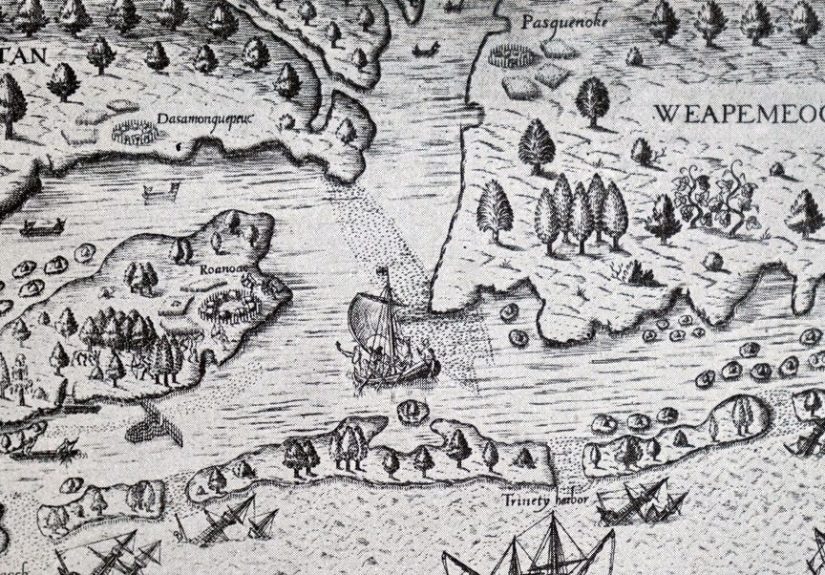
The fresh excitement comes from John White’s map, La Virginea Pars, a beautifully detailed Elizabethan map of the Carolina and Virginia coast. For a long time, it was admired mostly as a historical artifact. Then researchers noticed something odd: patches had been placed over parts of the map. That is when the story got deliciously weird in the best possible way.
A patch, a hidden symbol, and a possible fort
When the British Museum examined the original map more closely, researchers found that one patch appeared to conceal a fort-like symbol inland near the head of the Albemarle Sound, in what is now Bertie County, North Carolina. That mattered because White had previously indicated that colonists might move about 50 miles inland if necessary. Suddenly, the map was not just artwork. It looked more like a breadcrumb trail.
This is the clue that has made historians and archaeologists sit up a little straighter. If the hidden symbol represented a planned fallback location, then Roanoke was never meant to be the end of the story. It may have been the first chapter. The patched map suggests that Raleigh’s backers and White himself may have considered an inland refuge all along. And if that is true, the mystery changes shape. The question becomes less “How did they vanish?” and more “Where did they go after leaving Roanoke?”
That is a very different puzzle. It is also a more solvable one.
What archaeologists have found on the ground
A clue on paper is exciting, but archaeology is where theory either grows legs or falls flat on its powdered Elizabethan face. The most talked-about digs connected to this map are in Bertie County, especially at places known as Site X and Site Y near Salmon Creek.
Site X and the pottery that changed the conversation
Archaeologists working near Salmon Creek found pieces of early English pottery, including Border ware, in an area close to a Native village called Mettaquem. That may sound modest, but pottery can be a loud witness. Certain ceramic styles are closely associated with the earliest English settlements, and these fragments looked old enough to matter. Researchers argued that the finds suggested a small group of colonists may have moved inland and lived there for at least some period of time.
Later work at Site Y added more intrigue. Supporters of the inland-settlement theory argue that the pattern of finds, the map evidence, and later documentary clues all point in the same direction: some Roanoke survivors likely relocated to the Albemarle-Chowan-Salmon Creek region. That does not mean every colonist ended up there. In fact, one of the strongest modern theories is that the group split up because a single Native community probably could not support more than 100 hungry newcomers during a brutal period of scarcity.
That theory has a certain tragic logic to it. If you are stranded, undersupplied, and waiting for help that never shows up, you do not stay packed together and hope for magic. You spread out, make alliances, and try not to die. History is often less theatrical than movies and far more practical.
Croatoan still refuses to leave the room
The inland theory is not the only serious one. Hatteras Island remains central to the discussion because White’s carved message pointed there directly, and excavations over the years have uncovered a mix of Native and European artifacts that suggest some kind of contact or shared life. Many historians think at least part of the colony likely went to Croatoan and was absorbed into local society.
That possibility is not a footnote. It may be the core of the answer. If some settlers moved to Croatoan while others pushed inland, the old debate between “they went south” and “they went inland” may be asking the wrong question. Both could be true. Roanoke’s fate may not be one clean ending but several overlapping ones.
Why the mystery is still not officially “solved”
This is where responsible history has to put on its reading glasses and slow down. The evidence is exciting, but it is not a signed confession. Archaeologists have found suggestive artifacts, not a brass plaque that says, “Congratulations, you found the lost colonists.” No graves have decisively settled the matter. No intact village has been uncovered with everyone conveniently labeled.
There are also real complications. Some English artifacts could have reached inland Native communities through trade. Some finds may relate to the earlier 1585 English presence rather than the 1587 family colony. Later English settlement in the broader region muddies the archaeological picture as well. Scholars who support the Site X and Site Y findings argue that the dating and distribution of the artifacts make the Roanoke connection highly plausible. Skeptics respond that plausible is not the same as proven.
That may sound frustrating, but it is actually a sign the field is doing its job. Good archaeology is cautious. Good history is allergic to easy endings. When people say the map clue may solve the mystery, the key word is may. This is not a Hollywood reveal. It is a slow accumulation of evidence pointing toward a more believable explanation than the old myths.
The best explanation right now
If you line up the strongest clues, a picture starts to emerge. The carved word CROATOAN suggests at least some colonists intended to move south to Hatteras Island. The hidden symbol on White’s map suggests an inland destination may also have been planned. Archaeological finds in Bertie County indicate that English people from the right era may have been present there. Finds on Hatteras strengthen the idea of contact and possible assimilation there as well. Add in the severe regional drought of the late 1580s, and the survival pressure becomes impossible to ignore.
So what is the most convincing version of events? Not massacre. Not vanishing. Not extraterrestrials, sorry to the UFO crowd. The likeliest explanation is that the colonists dispersed. Some probably went to Croatoan. Some may have moved inland toward the Albemarle Sound and Salmon Creek. Some may have died from hunger, disease, exposure, or conflict along the way. And over time, survivors may have been absorbed into Indigenous communities, leaving behind a faint but very real archaeological fingerprint.
That theory is compelling precisely because it sounds ordinary in the harshest possible way. Colonization was fragile. Food was scarce. Alliances mattered. Geography mattered. Weather mattered. Survival was not a speech. It was logistics.
Why Americans cannot stop thinking about Roanoke
Part of Roanoke’s power is timing. This was supposed to be the beginning of England’s long American story, and instead it became a blank page. Americans tend to get twitchy around blank pages. We like our national myths tidy. Founding stories are supposed to march forward with flags, maps, and dramatic music. Roanoke does the opposite. It shrugs, points at a tree, and disappears into uncertainty.
It also sits at the crossroads of several bigger themes: colonial ambition, Indigenous diplomacy, environmental hardship, and the limits of written history. Roanoke reminds us that the early American past was not inevitable. It was improvised, fragile, and often misunderstood by the people living it.
That may be why each new pottery shard, copper fragment, or map detail gets so much attention. People are not just chasing lost settlers. They are chasing the moment before the story of English America hardened into something more familiar. Roanoke is the road not taken, the colony that slipped sideways out of the record, leaving future generations to play detective.
What it feels like to follow the mystery today
One reason the Roanoke mystery refuses to die is that it still feels physical. This is not one of those historical riddles trapped entirely in dusty documents and footnotes. You can stand in the Outer Banks wind, look across the water, and understand in your bones how vulnerable those settlers were. The landscape does half the storytelling before a guide says a single word.
Visit Fort Raleigh or the surrounding areas, and the experience is strange in the best way. Everything looks open, beautiful, and breathable. Then you remember that beauty is not the same thing as mercy. Coastal ground shifts. Storms move in fast. Supply lines fail. Distances that look manageable on a map become punishing when food is short and nobody is exactly rolling around with GPS and trail mix.
The modern search for Roanoke also has a wonderfully unglamorous side. People tend to imagine historical breakthroughs arriving with a trumpet blast. In reality, they often arrive as someone squinting at discoloration on a centuries-old map or brushing dirt off a ceramic fragment the size of a cookie crumb. That is part of the charm. Roanoke is a giant mystery solved, if at all, by tiny things.
There is also an emotional pull that is hard to ignore. John White was not just a governor returning to a failed outpost. He was a father and grandfather coming back for his family. That detail gives the whole story a pulse. Suddenly the mystery is not abstract. It is intimate. Every clue becomes personal. Every false lead stings a little more. Every promising artifact carries the hope that maybe, just maybe, someone survived longer than history once assumed.
For travelers, readers, and history lovers, that creates a rare kind of experience. You are not just learning dates. You are entering an argument that is still alive. One historian leans toward Croatoan. Another thinks inland relocation explains more. Archaeologists compare ceramics, soils, trade patterns, and settlement logic. Indigenous history changes the framework again, reminding us that the English were never alone on this landscape and that Native communities were not background scenery in somebody else’s drama. They were central actors in the story from the beginning.
And then there is the atmosphere. Roanoke has atmosphere for days. The very words Lost Colony do a lot of heavy lifting. They sound like a chapter title in a novel you should not read before bed. But what keeps people interested is not just the eerie branding. It is the sense that the truth, whatever shape it finally takes, is close enough to touch but never quite close enough to hold. That tension is catnip for anyone who loves history.
In that way, the experience of following Roanoke mirrors the mystery itself. You gather fragments. You test assumptions. You double back. You realize the old dramatic explanation may be weaker than the quieter one. And slowly, the colonists stop looking like people who vanished and start looking like people who adapted, negotiated, split up, and tried to live. That shift changes everything. It turns Roanoke from a legend about disappearance into a story about human endurance in a place that demanded it.
Conclusion
So, can a 400-year-old clue solve one of America’s greatest mysteries? Maybe not with a neat bow and a triumphant soundtrack. But it may do something better. It may replace a centuries-old myth of total disappearance with a more believable account of movement, survival, and assimilation.
The hidden symbol on John White’s map did not magically close the case. What it did do was sharpen the search. It gave archaeologists a direction, historians a stronger framework, and the rest of us a reminder that history often survives in fragments too stubborn to stay buried. Roanoke may never offer a single final answer. But the old mystery is no longer a black hole. It is becoming a map.