Table of Contents >> Show >> Hide
- From MTV Couch Potatoes to Comic Shop Headliners
- The Marvel Deal: A Licensing Frenzy with a Dumb Grin
- Issue #1: Yams, Teeth, and a Surprisingly Smart Dumb Comic
- The Comics Code Problem: Too Many Butts, Not Enough Approval
- A Monster Hit Hiding in the Back-Issue Bin
- Why Rick Parker’s Art Made the Comic Work
- Mike Judge’s Shadow Over the Comic
- Marvel Absurd, Marvel Humor, and the Weird Branding of the Run
- Memorable Stories and Running Gags
- Why the Comic Ended
- Legacy: More Than a Dumb Joke
- Experience Section: Reading Beavis and Butt-Head’s Marvel Comic Today
- Conclusion
Some comic book ideas sound like they were invented by a bored teenager standing too close to a convenience-store nacho machine. Beavis and Butt-Head at Marvel Comics is one of them. Yet in the mid-1990s, when MTV’s most proudly underachieving duo had already conquered television, T-shirts, catchphrases, and parental panic, Marvel gave them their own comic book series. Not a one-shot. Not a novelty insert. A full monthly run.
The result was one of the strangest licensed comics of the decade: a crude, fast-moving, sight-gag-packed translation of Mike Judge’s animated slackers into the world of panels, gutters, splash pages, and superhero parody. It was dumb on purpose, which is much harder to pull off than it sounds. Anyone can write nonsense. Making nonsense behave like comedy requires timing, rhythm, and a suspiciously high amount of craft. Beavis and Butt-Head would probably call that “work,” then immediately avoid it.
Marvel’s Beavis and Butt-Head comic ran from 1994 to 1996, landing right in the wildest stretch of the 1990s comics boom. It arrived during a moment when publishers chased licenses, collectors bought first issues by the armload, and pop culture had discovered that two animated idiots on a couch could become a national phenomenon. The comic was not simply a printed version of the MTV show. It was a very Marvel kind of accident: part licensed product, part underground humor magazine, part spoof machine, and part proof that the comic shop could be just as weird as basic cable.
From MTV Couch Potatoes to Comic Shop Headliners
To understand why Marvel wanted Beavis and Butt-Head, it helps to remember how loud the show was in the culture. The animated series premiered on MTV in 1993 and quickly became one of the network’s defining programs. The basic formula was beautifully primitive: two teenage metalheads wandered through suburban boredom, misunderstood nearly everything, laughed at the wrong things, watched music videos, and treated common sense like an optional subscription service.
Mike Judge created the characters and voiced both of them, giving Beavis a frantic, nasal energy and Butt-Head a slow, smug drawl that sounded like a lawn chair learning sarcasm. Their world was small: school, Burger World, the couch, the convenience store, the sidewalk, the occasional disastrous field trip. But the satire was bigger than it looked. The show mocked TV addiction, adolescent stupidity, consumer culture, music-video clichés, and the moral panic that followed youth entertainment like a nervous chaperone.
That combination made the property irresistible to licensors. By the time Marvel stepped in, Beavis and Butt-Head were not just characters; they were a brand, a controversy, and a punchline with legs. Marvel had already found success with humor and licensed titles, and the MTV duo fit the era’s appetite for edgy, youth-driven material. If comic stores could sell capes, mutants, chromium covers, and talking animals, why not sell two boys who could barely operate a sentence?
The Marvel Deal: A Licensing Frenzy with a Dumb Grin
The comic emerged during Marvel’s mid-1990s push into licensed humor properties. The company was already handling offbeat titles, including work connected to Nickelodeon and other youth-culture brands. Beavis and Butt-Head made commercial sense because the show had heat. It also created a creative problem: how do you turn a cartoon about two characters doing almost nothing into a monthly comic book where something has to happen every few pages?
That question landed on the desks of editor Glenn Herdling, writer Mike Lackey, and artist Rick Parker. Their challenge was not simply to imitate Mike Judge’s voices. The comic had to move. It needed plots, supporting bits, fake ads, activity pages, parodies, and visual jokes that rewarded readers who actually looked at the page instead of just hearing the characters in their heads.
Rick Parker became the visual anchor of the series. Before drawing Beavis and Butt-Head, he had worked at Marvel as a letterer and cartoonist, and his background made him unusually well suited to the job. The comic needed more than clean character likenesses. It needed rubbery expressions, ugly-beautiful body language, crowded backgrounds, throwaway jokes, and the kind of tiny visual insults that make a reader pause and think, “Wait, did that sign really say that?” Parker’s style gave the book the busy, prankish energy of a humor magazine wearing a Marvel jacket two sizes too big.
Issue #1: Yams, Teeth, and a Surprisingly Smart Dumb Comic
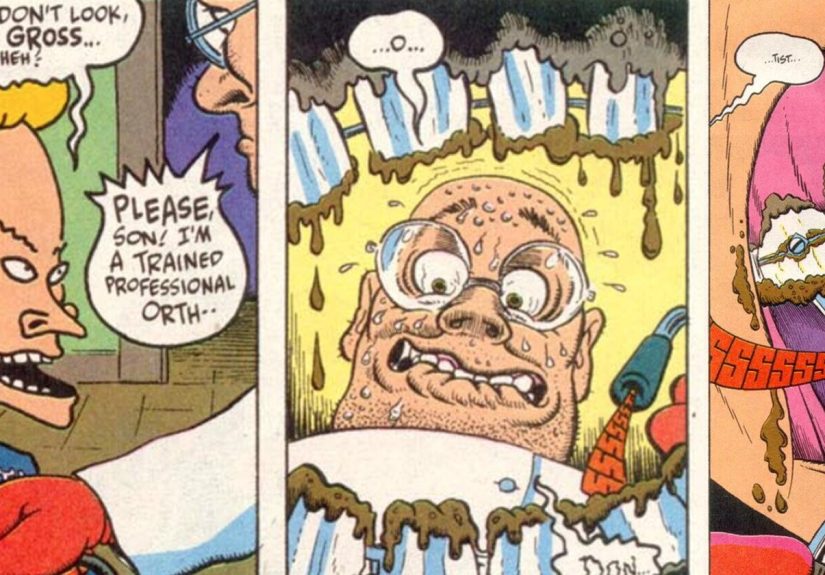
The first issue set the tone with exactly the kind of premise that sounds ridiculous until it starts working: Beavis and Butt-Head visit a Maxi-Mart stuffed with yams, get into trouble, and somehow stumble into a dental disaster. The yam joke became a recurring piece of absurdity, which is very on-brand for a series built around characters who could turn any object into a reason to snicker.
What made the debut clever was not just the plot. It was the format. The comic used short stories, fake features, activity pages, and Marvel-flavored parodies to create a reading experience that felt restless in the right way. Beavis and Butt-Head were not built for long, elegant arcs. They were built for bursts: a bad decision, a worse interpretation, a loud laugh, and consequences that somehow taught them nothing.
One of the sharpest moves was letting the duo collide with Marvel itself. Early issues included parodies and appearances built around familiar Marvel material, including riffs on characters such as the Punisher and Devil Dinosaur. The joke was not that Beavis and Butt-Head suddenly belonged in superhero continuity. The joke was that superhero seriousness looked especially funny when filtered through two boys who treated everything like a dirty word puzzle.
This was where the comic found its secret engine. It did not need Beavis and Butt-Head to grow, learn, or become heroic. In fact, that would have ruined them. Instead, it treated them as chaos agents dropped into comic book language. Thought balloons, captions, dramatic poses, heroic splash pages, and melodramatic villainy all became toys for the series to break.
The Comics Code Problem: Too Many Butts, Not Enough Approval
A Beavis and Butt-Head comic also had to deal with a very 1990s contradiction: it was a mass-market comic based on a TV show famous for making adults nervous. The material leaned into bathroom humor, sexual misunderstanding, stupidity, insults, and general anti-role-model behavior. That was the point. But comics still carried the shadow of respectability battles, including the lingering influence of the Comics Code Authority.
The first issue reportedly ran into approval concerns because nearly every page contained something objectionable to someone. That, honestly, may be the most Beavis and Butt-Head achievement possible. A superhero can save the universe; Beavis and Butt-Head can make a standards board sigh deeply on every page.
Marvel ultimately positioned the book in a way that acknowledged the problem without sanding off all the edges. The early issue packaging famously played with warnings and immature-reader language, signaling that this was not a wholesome Saturday-morning adventure. It was licensed misbehavior. That made the book feel less like an awkward adaptation and more like an artifact from the exact cultural moment that produced it.
A Monster Hit Hiding in the Back-Issue Bin
The first issue was not a quiet curiosity. It was a massive seller, reportedly moving hundreds of thousands of copies and surprising people inside Marvel who were more accustomed to superheroes dominating the charts. For a brief moment, two cartoon morons with bad posture and worse judgment were competing with the heavyweights of the comics rack.
That success reflected several overlapping forces. Beavis and Butt-Head were already pop-culture celebrities. The 1990s comics market rewarded first issues and collectible launches. MTV’s audience overlapped with comic-shop youth culture. And the cover itself looked like something fans wanted to own even if they did not plan to file it carefully between X-Men and Spider-Man.
Of course, the first-issue boom could not last forever. Sales declined after the initial blast, as was common for many 1990s launches. But the series still ran for 28 issues, which is a respectable stretch for a licensed humor comic based on characters whose main ambition was to avoid effort. The book also produced collections and overseas reprints, giving it a life beyond the American monthly rack.
Why Rick Parker’s Art Made the Comic Work
Beavis and Butt-Head look simple, but drawing them well is deceptively difficult. Their faces are built from awkward shapes, their bodies slouch in very specific ways, and their expressions have to land between stupid, vacant, excited, and aggressively stupid. Too polished, and they stop being funny. Too sloppy, and the page becomes noise.
Parker’s art understood that the comic had to feel messy without being unreadable. His pages often packed in background jokes, exaggerated reactions, and side details that gave the book reread value. This mattered because television supplied the voices and timing automatically. On paper, the artist had to create timing through panel size, expressions, lettering, and the visual rhythm of stupidity unfolding one bad idea at a time.
The lettering was especially important. Beavis and Butt-Head are voice-driven characters. Their speech patterns, pauses, laughs, and half-formed thoughts are part of the comedy. Parker’s lettering background helped the comic feel noisy in a controlled way. You could almost hear the “heh heh” and “uh-huh-huh” bouncing around the panels, which is either a compliment or a medical symptom.
Mike Judge’s Shadow Over the Comic
The comic existed because of Mike Judge’s creation, but it was not a Mike Judge comic in the pure auteur sense. Marvel’s team handled the monthly grind, and the book developed its own personality. That distance is one reason the series is fascinating today. It shows what happens when a highly specific comedic voice becomes a licensed property and other creators have to interpret it under deadlines.
Judge’s original show was often quieter and sharper than people gave it credit for. The stupidity had negative space around it. The boys could sit on a couch, misunderstand a music video, and reveal an entire worldview by accident. Comics, by contrast, tend to demand more visible action. The Marvel version leaned into bigger gags, busier pages, and broader situations. It was less minimalist and more carnival booth.
That difference may explain why some purists view the comic as a strange side object rather than a central chapter. But that is also what makes it valuable. The Marvel series captures how Beavis and Butt-Head looked when filtered through another pop-culture machine. The show mocked media consumption; the comic became media consumption. There is something beautifully ridiculous about that loop.
Marvel Absurd, Marvel Humor, and the Weird Branding of the Run
The series is often associated with Marvel’s offbeat humor branding, including the Marvel Humor and Marvel Absurd labels that appeared during parts of the run. Those imprints fit the book’s personality. This was not a superhero title with occasional jokes. It was a licensed comedy comic that treated plot as a delivery device for humiliation, parody, and dumb misunderstandings.
Marvel Absurd was a short-lived experiment, but its name feels almost too perfect here. Beavis and Butt-Head were absurd by design. Their adventures did not need moral development or continuity significance. They needed the freedom to wander into a situation, misread it completely, and leave behind a small crater of idiocy.
The branding also reminds readers how experimental mainstream comics could be in the 1990s. For every grim antihero and foil-enhanced collector’s item, there were odd licensed titles trying to turn television energy into monthly print entertainment. Some were forgettable. Some were cash-ins. This one was a cash-in with real cartooning muscle, which is why people still talk about it.
Memorable Stories and Running Gags
Several pieces of the run stand out because they show how flexible the premise could be. The early yam material gave the series a proudly stupid recurring joke. The Marvel parodies let Beavis and Butt-Head bounce off superhero seriousness. Later stories pushed them into situations that practically wrote their own misunderstandings, including school events, holidays, road trips, and small-town disasters.
One remembered story sent the duo into Amish country in Intercourse, Pennsylvania, a setup so perfectly Beavis and Butt-Head that the title alone could make them laugh for three uninterrupted school periods. Another issue played with the idea of Model U.N., building its joke on the boys misunderstanding “model” in the most predictable and therefore correct way. The Christmas material also gave the series room to combine holiday sentiment with the exact opposite of dignity.
The supporting cast helped. Daria, Mr. Van Driessen, Coach Buzzcut, Stewart, Todd, Principal McVicker, and Tom Anderson gave the boys different kinds of resistance. Beavis and Butt-Head are funniest when the world reacts to them with irritation, confusion, or doomed optimism. A teacher believes he can guide them. A neighbor believes rules matter. A bully believes they are useful targets. Everyone is wrong, but in different ways.
Why the Comic Ended
By 1996, the series had run its course. The original boom had cooled, staff and editorial circumstances had changed, and the larger comics market was becoming less forgiving. The title ended with issue #28, leaving behind a compact but surprisingly rich run. That ending feels appropriate. Beavis and Butt-Head were never meant to age gracefully through a hundred issues of character development. They were meant to show up, ruin something, laugh, and leave.
The comic also arrived just before the franchise shifted again. Beavis and Butt-Head Do America brought the duo to movie theaters in 1996, proving that the characters could survive beyond short TV segments. Later revivals would bring them into new decades, streaming platforms, and updated cultural targets. But the Marvel comic remains a very specific time capsule: MTV attitude printed on cheap paper during the comic industry’s loudest decade.
Legacy: More Than a Dumb Joke
Today, Marvel’s Beavis and Butt-Head is a cult curiosity, but it deserves more than a shrug from the dollar-bin archaeologist. It is a record of how wide the Beavis and Butt-Head phenomenon became. It is also a case study in adaptation. The comic did not simply screenshot the show. It rebuilt the humor using the tools of comics: page turns, background gags, lettering, fake departments, parody panels, and visual escalation.
For collectors, the first issue remains the obvious entry point, especially because it represents the duo’s arrival in standard comic book form and includes early appearances of familiar supporting characters. But the later issues may be more fun for readers who want to see the creative team stretch. The run becomes looser, stranger, and more confident once it stops behaving like a launch event and starts behaving like a monthly prank.
The best way to appreciate the series is not to ask whether it is “important” in the traditional Marvel sense. It is not important because it changed superhero continuity. It is important because it shows Marvel participating in a wider pop-culture conversation. In the 1990s, comics were not sealed off from TV, music, fast food, animation, or teen sarcasm. They were swimming in the same neon-colored soup.
Experience Section: Reading Beavis and Butt-Head’s Marvel Comic Today
Reading the Marvel Beavis and Butt-Head comic today feels like opening a time capsule that smells faintly of newsprint, mall food court pizza, and whatever was happening near the arcade carpet. The first experience is visual. Before the jokes even land, the pages announce themselves as 1990s objects. The ads, the colors, the paper texture, the exaggerated logos, and the slightly chaotic layouts all create the feeling of a comic that expects to be read between a soda machine and a rack of trading cards.
The second experience is hearing the voices in your head. This is unavoidable. You do not read Beavis saying something stupid in a neutral tone. Your brain supplies the laugh. Butt-Head’s slow “uh-huh-huh” arrives whether invited or not. That built-in audio track is one reason the comic still works for fans of the show. The dialogue can be simple because readers bring the performance with them. It is like karaoke for bad decisions.
What stands out most, though, is how physical the comedy feels on the page. The show often relied on stillness: two boys on a couch, barely moving, judging music videos with the confidence of philosophers who failed gym. The comic has to replace that stillness with motion. So the pages become crowded with trips, impacts, background nonsense, signs, labels, reaction shots, and fake educational material. The humor becomes less deadpan and more slapstick. That shift may surprise viewers who remember the show as mostly voices and pauses.
There is also a collector’s pleasure in seeing Marvel’s universe and house style get dragged into Beavis and Butt-Head’s orbit. When the comic parodies characters like the Punisher or Devil Dinosaur, it feels like Marvel is making fun of its own seriousness. That is part of the charm. Superhero comics often ask readers to believe in fate, honor, trauma, legacy, and cosmic responsibility. Beavis and Butt-Head ask whether something looks like a butt. Somehow, both modes fit inside the same company catalog.
For modern readers, the comic may also feel freer than expected. It belongs to a pre-streaming, pre-social-media version of fandom, when a TV hit could spill into comics, paperbacks, soundtrack albums, toys, and fast-food promotions without everything feeling perfectly brand-managed. The Marvel book is messy in a way that feels human. It has the energy of creators solving a weird assignment in real time: make these two couch goblins funny without sound, without animation, and without letting the whole thing collapse into one long laugh syllable.
The best reading experience is not to binge the whole run like homework. Beavis and Butt-Head would hate homework, and for once they would be right. Read a few issues at a time. Notice the gags hiding in the corners. Watch how Parker stages the boys’ blank expressions against a world that keeps expecting them to function. Enjoy the fact that this comic exists at all. In a sane universe, it might not. Fortunately, the 1990s were not a sane universe. They were a universe where Marvel could publish a monthly comic starring two MTV teenagers who thought “Nachos” was practically a belief system.
Conclusion
Beavis and Butt-Head Do Marvel remains one of the funniest oddities of 1990s licensed comics because it turned a seemingly impossible assignment into a surprisingly readable artifact. The MTV show was built on voice, timing, music-video commentary, and anti-ambition. Marvel’s comic had to rebuild that formula with ink, lettering, panels, parody, and background chaos. Against all logic, it worked.
The series succeeded because it understood the most important rule of Beavis and Butt-Head: they should never become smarter than the joke. Marvel gave them room to be stupid, but the creators behind the comic were anything but. Rick Parker’s expressive art, Mike Lackey’s early absurd setups, Glenn Herdling’s editorial guidance, and the broader Marvel humor machine turned a TV phenomenon into a comic that still rewards curious readers today.
It may not be the most famous Marvel series of the decade, but it is one of the most perfectly strange. In a world crowded with multiverses, grim reboots, and continuity charts, there is something refreshing about a comic whose legacy can be summarized like this: two idiots wandered into Marvel, made a mess, sold a shocking number of copies, and somehow became back-issue-bin legends. Heh heh. Not bad.