Table of Contents >> Show >> Hide
- Quick Answer: How Long Does Ring Resizing Take?
- How Much Does It Cost to Resize a Ring?
- Why Some Ring Resizing Jobs Are Fast and Others Take Forever
- How Jewelers Resize a Ring
- Can Every Ring Be Resized?
- How to Know If Your Ring Needs Resizing
- Best Time to Get Your Finger Measured
- Should You Use the Original Jeweler?
- Questions to Ask Before Approving Ring Resizing
- Can You Resize a Ring at Home?
- How to Save Money on Ring Resizing
- Real-World Examples of Ring Resizing Timelines and Costs
- Extra Experience-Based Tips: What People Often Learn the Hard Way
- Conclusion
Your ring should feel like romance, not a medieval finger trap. If it spins like a tiny hula hoop or refuses to come off after one salty dinner, resizing may be the hero of the story. The good news: most rings can be resized. The slightly less glamorous news: timing and price depend on the ring’s metal, design, stones, size change, jeweler workload, and whether your ring needs a simple adjustment or a full-on jewelry spa weekend.
So, how long does it take to get a ring resized? In many cases, a simple ring resizing takes a few days to two weeks. Some jewelers with in-house bench jewelers can finish straightforward jobs the same day or within several business days. More complex rings, online retailer returns, platinum work, engraved bands, pavé settings, eternity bands, antique rings, or repairs bundled with resizing can take several weeks. In rare cases, especially when a ring must be remade or sent to a manufacturer, the wait can stretch longer.
This guide breaks down the realistic timeline, common ring resizing costs, what makes the job faster or slower, and how to avoid paying “Wait, did they resize the ring or buy a small yacht?” prices.
Quick Answer: How Long Does Ring Resizing Take?
For a standard gold, silver, or platinum ring with a simple band, expect resizing to take about 3 business days to 2 weeks. That range covers most everyday resizing situations. A local jeweler who does repairs on-site may complete a simple resize faster than a chain store or online retailer that sends work to a central repair facility.
Typical ring resizing timeline
- Same day to 48 hours: Possible for simple bands at jewelers with on-site repair services, especially when sizing down or making a minor adjustment.
- 3–7 business days: Common for straightforward resizing jobs after approval.
- 1–2 weeks: A normal estimate for many jewelry stores, especially for engagement rings, platinum, white gold replating, or rings with stones.
- 2–6 weeks: Possible for online resizing, designer settings, custom rings, vintage pieces, warranty processing, or busy seasons.
- Several weeks or longer: Possible if the ring needs major reconstruction, manufacturer service, stone resetting, engraving repair, or a remake.
The resizing itself is not always what takes the longest. Much of the wait comes from intake, inspection, quote approval, repair queue, shipping, quality control, polishing, rhodium plating for white gold, and final pickup scheduling. In other words, your ring may spend more time waiting politely in line than actually under a jeweler’s torch.
How Much Does It Cost to Resize a Ring?
Most ring resizing costs fall somewhere between $25 and $250+, depending on complexity. A very simple sizing down may be inexpensive. A platinum ring with diamonds around the band, a wide shank, or a large size increase can cost much more. Some retailers offer one complimentary resize within a set period after purchase, commonly 60 days, 90 days, or one year, depending on the store policy and ring eligibility.
Average ring resizing price ranges
| Type of Resize | Typical Cost Range | Why It Costs That Much |
|---|---|---|
| Simple sizing down | $25–$100 | The jeweler removes a small piece of metal, reshapes, solders, polishes, and checks the finish. |
| Simple sizing up | $50–$150+ | Going larger may require adding matching metal, which adds material and labor cost. |
| Platinum resizing | $75–$250+ | Platinum requires specialized handling and often costs more than gold. |
| Wide band resizing | $100–$300+ | More metal and more surface area mean more labor and finishing. |
| Ring with side stones or pavé | $100–$300+ | Stones may loosen during resizing and need inspection, tightening, or resetting. |
| Custom, antique, or designer ring | $150–$500+ | Special workmanship, fragile settings, engraving, or manufacturer service can raise the price. |
If your quote seems high, ask what is included. A fair estimate may cover resizing, soldering, polishing, stone tightening, cleaning, inspection, rhodium plating, warranty documentation, and quality control. A suspiciously cheap quote may not include the finishing work that makes the ring look untouched afterward. Jewelry repair is tiny work with expensive consequences, so this is one place where “my cousin has a torch” is not a savings strategy.
Why Some Ring Resizing Jobs Are Fast and Others Take Forever
Two rings can need the same size change and still have completely different timelines. A plain 14k yellow gold band is the easygoing friend who is ready in ten minutes. A full pavé platinum engagement ring with engraving and a fragile antique setting is the friend who needs three outfit changes, a coffee, and emotional support.
1. The ring metal matters
Gold, sterling silver, and platinum are commonly resized by professional jewelers. Yellow gold is often one of the simplest metals to work with. White gold may need rhodium plating after resizing to restore its bright white finish. Platinum is durable and beautiful, but it usually requires higher heat and more specialized tools, which can increase both price and turnaround time.
Alternative metals are trickier. Tungsten carbide, titanium, ceramic, stainless steel, and some cobalt rings often cannot be resized in the traditional way. Because these metals are extremely hard or not malleable enough, the usual cut-solder-polish process may not work. In those cases, replacement, exchange, sizing beads, or a new ring may be the better option.
2. Sizing up usually costs more than sizing down
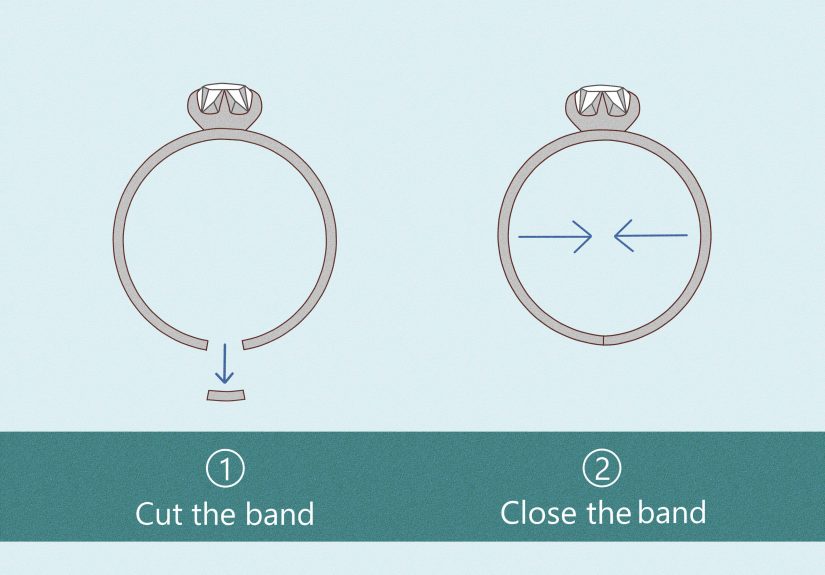
To make a ring smaller, a jeweler usually cuts out a small section of the shank, reshapes the ring, solders the ends together, and polishes the area until the seam disappears. To make a ring larger, the jeweler may stretch it slightly for a very small increase, but larger adjustments usually require cutting the band and adding matching metal. Matching metal costs money. Skilled labor costs money. Making the repair invisible costs even more skill. That is why sizing up is often more expensive than sizing down.
3. The setting can slow things down
Plain bands are usually the easiest. Rings with diamonds or gemstones along the shank require more caution because changing the ring’s curve can affect stone security. Pavé, channel-set, tension-set, and eternity bands may be difficult, risky, or impossible to resize. Full eternity rings, with stones all the way around, often cannot be resized much because there is no plain metal area to cut and rebuild.
4. The size change may be too big
Many jewelers prefer resizing within about one to two sizes. More than that can stress the metal, distort the ring’s shape, affect stone settings, or require redesigning the shank. A large adjustment may mean the ring must be remade rather than resized. That takes longer and costs more, but it may protect the ring from future damage.
5. The jeweler’s workflow matters
A local jeweler with an in-house bench may resize simple rings quickly. A retailer that sends repairs to a service center may need more time because the ring has to be packaged, shipped, logged, repaired, inspected, returned, and processed for pickup. Online retailers can be convenient, especially if free resizing is included, but shipping time should be added to the estimate.
How Jewelers Resize a Ring
Professional ring resizing is not just “squeeze it smaller and hope for the best.” A jeweler first inspects the ring, checks the stones, measures the current size, confirms the desired size, and evaluates the metal and design. Then the actual repair begins.
Making a ring smaller
For sizing down, the jeweler removes a small section from the bottom of the band. The ring is carefully rounded again, soldered or welded, cleaned, polished, and inspected. When done properly, there should be no obvious sign that the ring was cut. If the ring has engraving, the jeweler may need to preserve it, repair it, or warn you that part of it could be affected.
Making a ring larger
For a small increase, some rings can be stretched slightly. For a larger increase, the jeweler cuts the band and adds a piece of matching metal. The new metal is soldered in, shaped, polished, and finished so the ring looks continuous. If your ring is white gold, rhodium plating may be applied afterward to restore a consistent color.
Using sizing beads or inserts
If a ring is only slightly loose or spins because your knuckle is larger than the base of your finger, sizing beads may help. These are small metal beads added inside the ring to reduce the interior space without cutting the shank. A sizing bar or temporary plastic insert can also help in certain cases. These options are especially useful when the ring size fluctuates or when resizing the entire band is risky.
Can Every Ring Be Resized?
No. Many rings can be resized, but not all. The easiest candidates are plain bands or rings with a plain section of metal at the bottom of the shank. The hardest candidates are rings with stones, patterns, or design details all the way around.
Rings that are usually easier to resize
- Plain gold bands
- Plain platinum bands
- Simple solitaire engagement rings
- Three-stone rings with a plain lower shank
- Some silver rings, depending on quality and construction
Rings that may be difficult or impossible to resize
- Full eternity bands
- Tungsten carbide rings
- Titanium rings
- Ceramic rings
- Tension-set rings
- Rings with pavé or channel stones around most of the band
- Very thin or fragile antique rings
- Rings with continuous engraving or patterns
If a jeweler says your ring should not be resized, that does not mean they are being difficult. It may mean they are saving you from cracked metal, loose stones, distorted design, or a repair bill that grows fangs.
How to Know If Your Ring Needs Resizing
A properly fitted ring should slide over the knuckle with slight resistance and sit comfortably at the base of the finger. It should not cut off circulation, leave deep marks, spin constantly, or slip off when your hands are cold or wet.
Your ring may be too tight if:
- It leaves a deep indentation after normal wear.
- Your finger feels numb, swollen, or uncomfortable.
- You need soap, oil, or a dramatic negotiation to remove it.
- It cannot slide over your knuckle without pain.
Your ring may be too loose if:
- It spins constantly.
- It slips off with little resistance.
- It slides around when you wash your hands.
- The center stone keeps turning sideways.
Before resizing, wear the ring for a few days if it is safe to do so. Finger size changes with temperature, hydration, sodium intake, exercise, hormones, pregnancy, travel, and time of day. A ring that feels tight after hot yoga and tacos may fit perfectly the next morning. Your finger is not unreliable; it is simply running a tiny weather station.
Best Time to Get Your Finger Measured
For the most accurate ring size, get measured when your hands are at a normal temperature. Avoid measuring first thing in the morning, immediately after exercise, after a salty meal, or when your hands are very cold. Midday or early afternoon is often a good time. If possible, ask a jeweler to measure you with sizing rings in the same width as your actual ring. Wide bands fit more snugly than thin bands, so width matters.
If you are between sizes, ask about half sizes or quarter sizes. Many U.S. jewelers can work with small increments, and the right small adjustment can make a big difference. A half size may be the difference between “perfect” and “this ring is auditioning for escape artistry.”
Should You Use the Original Jeweler?
When possible, start with the jeweler or retailer where the ring was purchased. They know the design, warranty rules, metal specifications, and manufacturer limits. Many engagement ring retailers include one free resize within a certain period, but eligibility rules vary. Some policies cover only certain styles, certain size ranges, or rings purchased directly from that retailer.
If you cannot use the original seller, choose a reputable local jeweler with strong reviews and experience resizing rings like yours. Ask whether repairs are done on-site or sent out. Neither is automatically bad, but you should know where your ring is going, how long it will take, what is insured, and what happens if stones loosen during the process.
Questions to Ask Before Approving Ring Resizing
- Is this ring safe to resize?
- How many sizes can it go up or down without damage?
- Will the resizing affect stones, engraving, or the setting?
- Is the work done in-house or sent out?
- What is the estimated turnaround time?
- What exactly is included in the price?
- Will white gold be rhodium plated after resizing?
- Are stones checked and tightened afterward?
- Is the repair guaranteed?
- Will I receive documentation or a repair receipt?
A good jeweler will not be annoyed by these questions. They may even be relieved that you care about the details. Your ring is small, but the feelings attached to it are not.
Can You Resize a Ring at Home?
You should not permanently resize a fine ring at home. Cutting, bending, gluing, filing, heating, or hammering a ring can damage the metal, loosen stones, ruin engraving, or turn a sentimental piece into a very expensive lesson. Temporary ring size adjusters, silicone coils, plastic inserts, or ring guards can help a loose ring fit better for a short time, but they are not a substitute for professional resizing.
Temporary adjusters are useful when your finger size is changing due to weather, pregnancy, medication, weight fluctuation, or travel. They are also helpful while waiting for a jeweler appointment. Just remove and clean them regularly so moisture and debris do not build up under the band.
How to Save Money on Ring Resizing
First, check your warranty, care plan, or purchase policy. Many jewelers include a complimentary resize shortly after purchase. Second, compare quotes from reputable jewelers, especially if your ring is simple. Third, avoid repeated resizing. Each permanent adjustment adds stress to the metal, and too many changes can weaken the ring over time.
Also, do not wait until the ring is in danger of falling off. Losing a ring is significantly more expensive than resizing one. That is not a financial tip; that is just math wearing a tiny diamond hat.
Real-World Examples of Ring Resizing Timelines and Costs
Example 1: Simple yellow gold solitaire
A 14k yellow gold solitaire needs to go down half a size. The ring has a plain lower shank and no side stones. A local jeweler with in-house repair may finish it in 2–5 business days. Cost may fall around $40–$100, depending on location and finishing.
Example 2: White gold engagement ring with pavé
A white gold ring with small diamonds along the band needs to go up one size. The jeweler must add metal, check the pavé stones, polish the ring, and rhodium plate it. Timeline may be 1–3 weeks. Cost may fall around $125–$300 or more.
Example 3: Platinum wedding band
A platinum band needs a full-size increase. Because platinum is more labor-intensive and requires careful finishing, the cost may be higher than a similar gold band. Timeline may be 1–2 weeks, with pricing commonly landing around $100–$250+.
Example 4: Full eternity band
A diamond eternity band is too tight. Because stones go all the way around, traditional resizing may not be possible. The jeweler may recommend remaking the ring, exchanging it, adding a sizing solution if it is loose, or ordering a new size. Timeline and cost can vary widely.
Extra Experience-Based Tips: What People Often Learn the Hard Way
One of the most common experiences with ring resizing is realizing that the first “wrong size” panic is not always permanent. Many people try on a new engagement ring in the excitement of the proposal, notice it feels loose or tight, and immediately assume it must be resized the next morning. Sometimes that is true. Sometimes the ring was tried on after champagne, tears, summer heat, salty food, or three hours of showing it to every living relative within a five-mile radius. Hands swell and shrink. Before committing to a permanent resize, wear the ring during normal conditions and see if the fit problem repeats.
Another practical lesson: if the ring is too loose to wear safely, do not “just be careful.” Rings are famously talented at disappearing into sinks, gloves, coat pockets, gym bags, and the mysterious dimension under car seats. Until resizing is done, wear it on a chain, store it in a ring box, or use a temporary adjuster. The goal is to resize the ring, not launch a household treasure hunt starring your plumbing.
People are also often surprised by how much design affects price. A friend may have paid $45 to resize a plain gold band, while your quote is $225. That does not automatically mean you are being overcharged. Your ring may need added metal, stone tightening, rhodium plating, laser welding, engraving repair, or special handling. Ask for an itemized explanation, but compare similar jobs to similar jobs. A bicycle tune-up and a transmission repair are both “vehicle work,” but the invoices will not be twins.
If your ring has sentimental value, take photos before leaving it with a jeweler. Photograph the top, side, inside engraving, hallmark, and any distinctive inclusions or marks. Reputable jewelers often document intake carefully, but having your own photos adds peace of mind. Ask for a written receipt that describes the ring, stones, metal, and requested work. This is especially important for heirloom rings, antique rings, or engagement rings with significant value.
Many customers also learn that resizing is a good time for a full checkup. Ask the jeweler to inspect prongs, side stones, the center stone, thinning areas, cracks, and worn settings. If a stone is already loose, resizing can make the problem more obvious. Fixing it during the same service visit may save time and prevent future heartbreak. Nothing ruins a good sparkle moment like discovering your diamond has been living dangerously.
Finally, be realistic about deadlines. If you need the ring for a wedding, proposal shoot, anniversary trip, or ceremony, tell the jeweler immediately. Some can offer rush service, but not every ring should be rushed. A careful two-week repair is better than a one-day repair that leaves stones loose or the band misshapen. The best experience comes from choosing a skilled jeweler, asking clear questions, and giving the ring enough time to come back looking like nothing ever happened.
Conclusion
So, how long does it take to get a ring resized? For many rings, the answer is a few days to two weeks. Simple bands may be completed faster, while complex engagement rings, platinum settings, pavé bands, antique rings, online retailer repairs, and major size changes may take longer. Pricing usually ranges from $25 to $250+, but intricate work can cost more.
The smartest move is to have the ring evaluated by a professional jeweler, preferably the original seller if a warranty or free resizing policy applies. Ask about timing, cost, risks, stone security, plating, and whether the repair is done in-house. A good resize should make the ring feel comfortable, secure, and naturallike it was made for your finger all along. Because really, the only thing that should be dramatic about a ring is the proposal story, not the repair bill.