Table of Contents >> Show >> Hide
- What Is a Magic Mirror, Really?
- The Real History Behind the “Magic Mirror” Idea
- Why Looking Into a Mirror Feels So Intense
- What a Magic Mirror Can Reveal
- How to Use a Magic Mirror Without Turning It Into a Horror Movie
- How to Interpret What the Mirror Shows You
- Common Myths About Magic Mirrors
- Magic Mirror Questions for Different Moments in Life
- Experiences Related to “Magic Mirror: Ask a Question and See What It Reveals”
- Conclusion
There is something gloriously dramatic about asking a mirror a question. Maybe it is the fairy-tale vibe. Maybe it is the fact that mirrors never blink, never interrupt, and never say, “That’s interesting,” while clearly checking out of the conversation. A mirror simply reflects. And that is exactly why the idea of a magic mirror has lasted for centuries.
Of course, a mirror is not a tiny oracle with Wi-Fi to the universe. It does not cough up winning lottery numbers, expose your enemies on command, or whisper whether your crush will text back in twelve minutes. What it can do is something more interesting: it can sharpen attention, amplify emotion, and force you to face what your mind has been trying very hard to dodge. Ask the right question, and a mirror may not reveal the future, but it can reveal you.
That is the real fascination behind the phrase “magic mirror.” Across cultures, reflective surfaces have been used in ritual, storytelling, art, religion, and divination. In modern life, the mirror still holds power, though the magic often looks more like self-awareness than sorcery. It can reveal what you fear, what you want, what you avoid, and what you already know deep down but keep pretending is “still unclear.” Very mysterious. Very human.
What Is a Magic Mirror, Really?
In popular culture, a magic mirror is usually a supernatural object that answers questions, exposes hidden truths, or shows events beyond ordinary sight. In real historical practice, the concept is closer to mirror divination or scrying: using a reflective surface to enter a focused state and interpret images, impressions, or insights.
That reflective surface did not always look like the bathroom mirror above your sink. People have used bowls of water, polished metal, black glass, crystal, and obsidian. The method changed. The basic hope did not. Human beings have always wanted a tool that could help them peek behind the curtain of ordinary life.
Today, many people use the phrase “magic mirror” less literally and more symbolically. It can describe a mindfulness exercise, a journaling ritual, a self-reflection prompt, or a spiritual practice. In all of these versions, the mirror becomes a stage where your inner life gets better lighting.
The Real History Behind the “Magic Mirror” Idea
Reflective surfaces have been tied to divination for a very long time
The history of mirror magic is not just a fairy-tale invention. Divination through reflective surfaces has deep roots. Long before modern glass mirrors, people stared into water, polished stone, or metal and treated the resulting visions as meaningful. The practice of scrying grew from the belief that reflective surfaces could reveal hidden knowledge, distant events, or spiritual truths.
That old instinct makes perfect sense, even if you do not believe in the supernatural. A reflective surface is naturally ambiguous. It gives you just enough information to recognize a face, a shape, a shadow, or a movement, but not always enough to interpret it with certainty. That gap between seeing and knowing is where imagination rushes in wearing a cape.
Ancient mirrors were not just accessories
In ancient cultures, mirrors often carried symbolic weight far beyond grooming. In Egypt, mirrors were connected with beauty, spiritual continuity, and regeneration. In China, mirrors could carry cosmological meaning, including symbols tied to the cardinal directions and mythological creatures. In parts of the Americas, obsidian mirrors were associated with ritual power, divine imagery, and divination. This was not “just checking your hair.” This was reflection with a résumé.
One especially famous tradition comes from ancient Mexico, where polished obsidian mirrors were used in divinatory practices. Their dark surfaces were less about clear reflection and more about depth, mystery, and the sense that something might emerge if you looked long enough. That image of the black mirror later traveled into European magical traditions as well, giving the magic mirror a darker, moodier reputation.
The mirror kept its aura in later folklore
By the early modern period, mirrors had become wrapped in superstition, ritual, and folklore. They were thought to reveal truth, capture harmful energies, show omens, or expose what was hidden. Even in American history, reflective surfaces were linked with ritual and magic long before modern mirrors became common household objects.
That lingering aura explains why mirrors are everywhere in ghost stories, legends, and cautionary tales. They feel ordinary until they suddenly do not. One moment a mirror is a practical object; the next it is a symbolic portal, a witness, a judge, or a deeply unflattering truth-teller under terrible bathroom lighting.
Why Looking Into a Mirror Feels So Intense
A mirror is powerful because it does not just reflect your face. It triggers self-awareness. Human beings respond strongly to seeing themselves, and psychologists have long connected mirrors with self-recognition, identity, emotional response, and social awareness.
Even young children gradually learn to recognize themselves in a mirror, and that process is tied to developing a sense of self. In adults, mirrors can heighten self-evaluation. They can make you more aware of appearance, posture, emotion, tension, and the gap between who you believe you are and how you actually show up.
That is why asking a mirror a question can feel weirdly powerful. The question focuses attention. The reflection adds emotional pressure. Your brain begins scanning for meaning. Suddenly, a simple prompt like “What am I avoiding?” lands much harder when you are looking yourself in the eye instead of scrolling your phone like it owes you therapy.
The mirror can intensify compassion or criticism
The mirror is not always kind. For some people, it becomes a stage for self-criticism, especially in a culture obsessed with appearance. That is one reason constant self-view on video calls can feel exhausting. Too much reflection can push people toward objectifying themselves rather than understanding themselves.
At the same time, mirrors can also support self-compassion when used intentionally. Some research suggests that speaking compassionate phrases in front of a mirror can make those phrases feel more emotionally real. In other words, the mirror can either become your meanest critic or your clearest witness. The difference often lies in the question you ask and the attitude you bring with it.
What a Magic Mirror Can Reveal
If you ask a mirror a question, what can it reveal? Not magic in the movie sense. Something more grounded and, honestly, more useful.
- Your emotional state: A mirror quickly shows whether you look calm, tired, nervous, angry, or sad, even when your mouth is busy claiming, “I’m fine.”
- Your hidden priorities: The questions that make you uncomfortable often point directly to what matters most.
- Your self-talk: Notice the first thought that appears when you hold your own gaze. That voice is often the real message.
- Your contradictions: You may say you want peace while visibly carrying tension in your jaw, shoulders, and expression.
- Your desires: A mirror can reveal what lights your face up before your logical brain starts making spreadsheets about why joy is impractical.
- Your avoidance patterns: If a question makes you laugh it off, change the subject, or suddenly remember a very urgent need to clean a drawer, that is information.
In that sense, the magic mirror works because it helps move insight from the abstract to the visible. It does not invent truth. It makes truth harder to ignore.
How to Use a Magic Mirror Without Turning It Into a Horror Movie
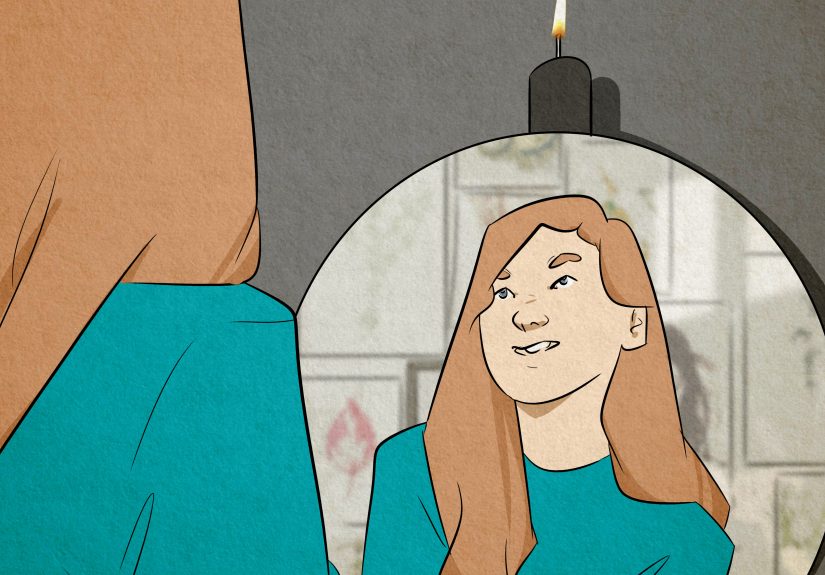
If you want to try a magic mirror exercise, keep it simple, grounded, and sane. No candlelit marathons. No dark-room staring contests with your own face. No dramatic soundtrack unless you are trying to alarm your neighbors.
A practical mirror ritual for self-reflection
- Choose a normal, well-lit room.
- Stand or sit comfortably in front of a mirror.
- Take a few slow breaths and relax your face.
- Ask one clear question out loud.
- Hold your gaze for thirty seconds to two minutes.
- Notice thoughts, emotions, body sensations, and facial reactions.
- Write down what came up before your rational mind starts editing the scene.
Good questions include:
- What am I pretending not to know?
- What do I need right now?
- What am I afraid will happen if I tell the truth?
- Where am I abandoning myself?
- What deserves my courage next?
- What version of me is trying to emerge?
The goal is not to “see visions.” The goal is to become less foggy about your own life. If something emotional comes up, pause, breathe, and write. Insight does not need jump scares.
How to Interpret What the Mirror Shows You
Interpreting a magic mirror experience is less about decoding omens and more about reading patterns.
Start with what changed
Did your expression soften when you asked one question but harden with another? Did you suddenly feel sad, defensive, relieved, embarrassed, or strangely energized? Those shifts matter. The mirror often reveals truth through reaction, not revelation.
Watch your first response
The first honest reaction is often more useful than the polished one that arrives ten seconds later wearing business casual language. If your first inner response is, “Oh no, not that question,” congratulations. That is probably the question.
Separate symbolism from panic
People love to assign cosmic meaning to every tiny thing. Sometimes that is poetic. Sometimes it is just being overtired in bad lighting. If a session feels unsettling, do not force symbolism onto it. Return to simple interpretations: What emotion appeared? What memory surfaced? What truth felt obvious for one very uncomfortable second?
Use the mirror with other tools
A mirror works best when paired with journaling, meditation, therapy, prayer, or plain old honest conversation. Reflection is powerful, but interpretation improves when it has context. A magic mirror can open a door. You still have to walk through it.
Common Myths About Magic Mirrors
Myth 1: A magic mirror predicts the future with precision
Not reliably, and definitely not in a way that should replace judgment, evidence, or common sense. Most mirror practices are better understood as tools for reflection, intuition, and symbolic thinking.
Myth 2: The stranger the experience, the more meaningful it is
Not necessarily. Under low light, long staring sessions can create visual distortions or eerie effects. Weird does not always equal wise.
Myth 3: Only mystical people can use a mirror this way
Nope. You can be spiritual, skeptical, artistic, practical, or deeply allergic to crystals and still benefit from asking yourself a real question in front of a mirror.
Myth 4: Mirrors only reveal flaws
This is one of the saddest myths of all. A mirror can reveal beauty, tenderness, grief, resilience, and sincerity. It can show not just what is “wrong,” but what is alive.
Magic Mirror Questions for Different Moments in Life
For decision-making
- Which choice brings relief in my body?
- Which choice am I making to impress other people?
- What would I choose if fear were quieter?
For relationships
- Where am I asking for less than I need?
- What am I not saying because I want to be liked?
- Am I trying to be understood, or just avoiding conflict?
For personal growth
- What part of me needs kindness, not correction?
- What lesson keeps repeating because I keep ghosting it?
- What truth would make my life simpler if I accepted it?
Experiences Related to “Magic Mirror: Ask a Question and See What It Reveals”
People often describe mirror experiences in ways that are less supernatural and more surprisingly personal. One common experience is immediate emotional honesty. A person may walk up to the mirror intending to ask a huge, dramatic question like “What is my destiny?” and instead find themselves blurting out, “Why am I so tired?” That shift matters. The mirror has a way of stripping the costume off the question. Big symbolic language can collapse into a smaller, truer issue: burnout, grief, loneliness, indecision, guilt, or the need to rest.
Another common experience is the sensation of being “seen” by your own reflection. This does not mean the mirror comes alive and starts a side hustle as an oracle. It means eye contact with yourself can feel emotionally intense. Many people realize, often uncomfortably, that they avoid their own gaze in everyday life. The moment they hold it for longer than usual, thoughts begin surfacing: memories, self-judgments, unfinished conversations, or insights they have been postponing. The mirror becomes less an object and more a pause button.
Some people report that the exercise feels peaceful. They ask a question, breathe, and notice their face softening as if their body already knows the answer. Others feel resistance first. They laugh, fidget, look away, adjust their hair for no strategic reason, and suddenly become fascinated by the sink. That resistance is often part of the experience. The mirror highlights avoidance with almost comedic efficiency.
There are also creative experiences. Writers, artists, and journalers sometimes use a mirror to break mental gridlock. Asking, “What am I really trying to say?” while looking at themselves can cut through performance and perfectionism. Instead of chasing a clever answer, they recognize the emotional core of their work. The mirror does not hand them genius on a silver platter, but it can help them stop pretending they do not know what matters.
In relationship questions, the mirror can be especially revealing. Someone may ask, “What do I need from this person?” and realize, by the look on their own face, that the real issue is not need but permission: permission to ask, to leave, to stay, to speak clearly, or to stop carrying a connection alone. That moment can feel uncannily direct, not because the mirror is magical in a paranormal sense, but because attention, emotion, and honesty finally line up at the same time.
Even skeptics often come away with something useful. They may begin the exercise half amused, fully unconvinced, and yet still discover that a mirror is a very effective nonsense detector. It reflects not only your features but your hesitation, your posture, your mood, and your willingness to tell the truth. In that way, the “revelation” is not a ghostly message. It is an encounter with yourself that is harder to edit than a thought and harder to dodge than a journal page. For many people, that is magical enough.
Conclusion
The enduring appeal of the magic mirror is not that it proves the impossible. It is that it stages a rare and honest encounter. Across history, mirrors have been treated as mystical, symbolic, artistic, spiritual, and psychological objects. That should tell us something. Human beings do not just want to see their reflection; they want to understand what it means.
So ask your question. Ask it clearly. Ask it without the performance. Then look. Maybe the mirror will not reveal your future kingdom, your secret enemy, or the exact date your life gets organized at last. Rude, honestly. But it may reveal the expression you make when truth gets close. It may show the part of you that needs courage, compassion, or action. And that kind of revelation can change a life far more effectively than any enchanted glass muttering in a castle wall.