Table of Contents >> Show >> Hide
- Why an Accomplishments Section Works
- What Counts as an Accomplishment on a Resume?
- When to Add a Separate Accomplishments Section
- How to Write Accomplishments That Do Not Sound Fluffy
- Sample Resume With a Section on Accomplishments
- Why This Resume Sample Works
- Best Types of Achievements to Include
- How Many Accomplishments Should You List?
- Tips for Making the Section ATS-Friendly
- Common Mistakes to Avoid
- How to Turn Everyday Work Into Resume Wins
- Extra Experience and Practical Advice for Job Seekers
- Conclusion
If your resume still reads like a dry list of job duties, it may be politely whispering, “I was present.” Hiring managers, however, want proof that you made things happen. That is where an accomplishments section comes in. A strong resume with accomplishments does more than name your responsibilities. It shows results, adds context, and gives your experience some muscle.
In this guide, you will learn when to use an accomplishments section, how to write one without sounding like a robot in a necktie, and what a sample resume with a section on accomplishments actually looks like. We will also walk through examples, formatting tips, and the mistakes that can quietly sabotage an otherwise solid resume.
Why an Accomplishments Section Works
A resume section focused on accomplishments helps employers quickly see the difference between what you were assigned to do and what you actually achieved. That distinction matters. Lots of people can say they “managed a team” or “handled customer service.” Fewer can say they led a six-person team that cut response time by 28% or improved customer retention over two quarters.
In other words, accomplishments turn vague experience into evidence. They make your resume more persuasive, more memorable, and more useful in both ATS scans and human review. Think of them as the highlight reel, not the blooper reel, of your professional life.
A dedicated accomplishments section is especially helpful if you are a recent graduate, a career changer, someone with standout wins across different roles, or a candidate whose best achievements do not fit neatly under one job title. It can also help when you want to spotlight awards, major projects, revenue impact, cost savings, process improvements, or leadership wins without burying them in a wall of bullets.
What Counts as an Accomplishment on a Resume?
Here is the good news: accomplishments are not limited to Nobel Prizes, Olympic medals, or inventing the next email app nobody asked for. On a resume, accomplishments can include:
- Revenue growth
- Cost reduction
- Time savings
- Process improvements
- Quality gains
- Customer satisfaction results
- Promotions, awards, and recognition
- Successful projects
- Training and mentoring results
- Academic or volunteer achievements
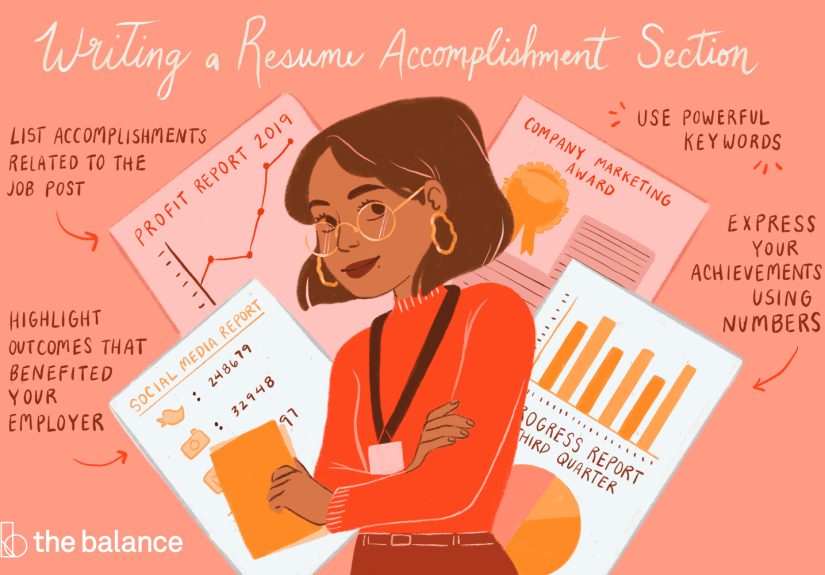
The best resume accomplishments are specific. They usually include an action, a task, and a result. If you can add numbers, percentages, timelines, or scale, even better. Numbers do not magically make weak experience strong, but they do make strong experience easier to trust.
When to Add a Separate Accomplishments Section
Not every resume needs a dedicated accomplishments section. Sometimes your wins fit perfectly under each role in your work history. But creating a separate section makes sense when your achievements deserve a spotlight of their own.
Use a dedicated section if:
- You have several measurable wins across different positions.
- You are changing careers and want to highlight transferable results.
- You have major awards, projects, or recognitions relevant to the target role.
- You want recruiters to notice impact before they read your full experience section.
- Your resume needs a stronger value proposition near the top.
This section can be called Key Accomplishments, Selected Achievements, Career Highlights, or Professional Accomplishments. Choose a clear, standard heading so both people and ATS software understand it instantly.
How to Write Accomplishments That Do Not Sound Fluffy
Great accomplishment statements usually follow one simple pattern: action + context + result. Start with a strong verb, explain what you did, and show why it mattered.
Weak bullet:
Responsible for social media marketing.
Better bullet:
Developed and managed a social media campaign that increased Instagram engagement by 42% in four months.
Even better bullet:
Launched and optimized a cross-platform social media campaign that increased Instagram engagement by 42%, drove 1,800 new email signups, and supported a 15% lift in online sales over four months.
See the difference? The third version does not just say you were busy. It says your work mattered.
Quick formula for accomplishment bullets
- Action verb: Led, built, increased, improved, streamlined, launched, trained, negotiated
- What you did: A campaign, process, system, project, team initiative, or solution
- Result: Revenue, savings, speed, quality, retention, engagement, satisfaction, recognition
Sample Resume With a Section on Accomplishments
Below is a sample resume with a section on accomplishments for a mid-level marketing professional. You can adapt this structure for sales, operations, project management, customer service, healthcare administration, education, and plenty of other fields.
Jordan Ellis
Chicago, IL | [email protected] | (555) 123-4567 | linkedin.com/in/jordanellis
Professional Summary
Results-driven marketing specialist with 6+ years of experience in digital campaigns, content strategy, and brand growth. Known for improving lead generation, boosting engagement, and building efficient campaign systems. Strong background in SEO, email marketing, analytics, and cross-functional collaboration.
Key Accomplishments
- Increased qualified inbound leads by 38% year over year through a content and SEO strategy targeting high-intent search terms.
- Reduced cost per lead by 21% after rebuilding paid campaign structure and refining audience segmentation.
- Led website content refresh that improved average session duration by 33% and lifted organic conversions by 17% in six months.
- Created an email nurture sequence that generated $145,000 in attributed pipeline within the first two quarters.
- Recognized by leadership for launching a campaign reporting dashboard that cut weekly reporting time from four hours to 45 minutes.
Professional Experience
Marketing Specialist | BrightWave Media | 2021–Present
- Develop and execute multi-channel digital marketing campaigns across email, search, and social platforms.
- Collaborate with sales and design teams to align messaging, campaign goals, and lead handoff processes.
- Improved landing page conversion rate by 19% by testing headlines, calls to action, and page layout.
- Managed editorial calendar and produced optimized blog content that increased non-branded organic traffic by 41%.
Marketing Coordinator | NorthGate Retail | 2018–2021
- Supported promotional campaigns, customer email communications, and seasonal product launches.
- Helped grow email subscriber list by 24% through lead magnets, pop-up forms, and event signups.
- Coordinated influencer outreach efforts that contributed to a 12% increase in campaign reach.
Education
B.A. in Communications, University of Illinois Chicago
Skills
SEO, Google Analytics, Google Ads, email marketing, content strategy, SEMrush, HubSpot, A/B testing, CRM reporting, copywriting
Why This Resume Sample Works
This sample resume with a section on accomplishments works because it puts impact near the top. Before a recruiter even reaches the work history, they already know the candidate can generate leads, reduce costs, improve conversions, and build reporting systems. That is a much stronger impression than a summary alone.
It also balances the dedicated accomplishments section with achievement-focused bullets under each job. That matters. The separate section gives a snapshot, while the experience section provides supporting evidence. One attracts attention. The other backs it up.
Best Types of Achievements to Include
The smartest accomplishments to include are the ones that match the job posting. Tailoring matters more than dumping every proud moment from the last decade onto one page like a confetti cannon.
Good accomplishments to prioritize:
- Achievements tied to the target role’s main responsibilities
- Results with measurable business impact
- Leadership examples that show initiative
- Projects that demonstrate relevant technical or soft skills
- Awards, honors, or certifications that strengthen credibility
Examples by category
Sales: Exceeded annual quota by 126%, closed the largest regional account of the year, improved renewal rate by 18%.
Customer service: Raised customer satisfaction score from 88% to 95%, trained new hires, resolved escalations with a high first-contact resolution rate.
Operations: Streamlined inventory process, reduced waste, shortened production cycle, improved compliance accuracy.
Education: Increased student pass rates, launched a tutoring initiative, secured grant funding, improved attendance.
Administrative work: Reorganized filing systems, improved scheduling efficiency, handled executive support across multiple departments.
How Many Accomplishments Should You List?
Enough to prove value, not enough to write your autobiography. A smart rule is to highlight the most relevant three to five accomplishments in a dedicated section, then use two to four accomplishment-focused bullets under recent roles. That gives you enough room to show impact without turning your resume into a novel nobody has time to finish.
If you are early in your career, you can use accomplishments from internships, volunteer work, student organizations, coursework, freelance projects, and academic achievements. If you are more experienced, focus on recent and relevant wins. Employers care most about what you can likely do next, not what you crushed in 2009 unless it still matters now.
Tips for Making the Section ATS-Friendly
A separate accomplishments section can absolutely be ATS-friendly, as long as you keep it simple. Use clear headings, standard fonts, and easy-to-read formatting. Avoid overdesigned layouts, decorative graphics, and clever labels that force software to guess what your section means.
ATS-friendly resume tips:
- Use standard headings like Key Accomplishments or Professional Accomplishments.
- Mirror keywords from the job description where appropriate.
- Use common job titles and relevant skill terms.
- Keep formatting clean with bullet points and consistent spacing.
- Do not hide important achievements inside text boxes or images.
And please, resist the urge to name the section “Moments of Absolute Greatness.” Funny? Yes. Helpful for ATS? Not so much.
Common Mistakes to Avoid
1. Listing duties instead of results
If the bullet could apply to almost anyone in your role, it is probably too generic.
2. Using vague claims
Words like “successful,” “dynamic,” and “hardworking” are fine in conversation, but they do not prove much on a resume unless tied to evidence.
3. Overstuffing the section
More is not always more. Pick your strongest, most relevant wins.
4. Ignoring transferable accomplishments
Volunteer leadership, academic projects, freelance work, and side projects can all count if they demonstrate relevant outcomes.
5. Forgetting to tailor
The best accomplishment on earth will not help much if it has nothing to do with the role you want.
How to Turn Everyday Work Into Resume Wins
A lot of people struggle to identify accomplishments because they think only huge, dramatic victories count. Not true. Everyday contributions can become strong accomplishment statements with the right framing.
Ask yourself:
- Did I improve a process?
- Did I save time or money?
- Did I solve a recurring problem?
- Did I help customers, coworkers, or managers succeed faster?
- Did I build, organize, train, launch, fix, or streamline something?
- Did I earn praise, recognition, or a new responsibility?
Sometimes the difference between an average resume and a strong one is not better experience. It is better translation.
Extra Experience and Practical Advice for Job Seekers
Let’s add a little real-world perspective, because writing a resume is rarely a calm, elegant process involving candlelight and perfect confidence. More often, it looks like someone staring at an old job description thinking, “Did I actually do anything besides answer emails and survive Thursdays?” The answer is almost always yes.
One of the most useful exercises is to create a private “brag list” before you write the actual resume. This document is not for employers. It is for you. Write down projects you completed, problems you fixed, compliments you received, deadlines you beat, and moments when a manager trusted you with something important. Include numbers when you can, but do not stop if you do not have them yet. You can estimate carefully, check old reports, or use scale-based language like “supported 200+ customers weekly” or “coordinated a five-person team.”
Another practical tip is to look beyond paid jobs. Maybe you organized a fundraiser, managed social media for a campus club, built a scheduling system for a family business, or trained volunteers at a nonprofit. Those experiences can absolutely belong on a resume if they show relevant skills and outcomes. Employers do not only care where you learned something. They care whether you can use it.
It also helps to think in stories. Every good accomplishment has a mini plot: there was a problem, you took action, and something improved. That is why accomplishment bullets feel stronger than task-based bullets. They show movement. “Maintained spreadsheets” is static. “Built weekly reporting spreadsheet that reduced manual reconciliation time by two hours” has motion and meaning.
If you are changing careers, an accomplishments section can be especially powerful. It lets you lead with results that transfer across industries. A teacher may have improved performance metrics, trained groups, and managed competing priorities. A retail supervisor may have led staff, reduced shrink, and improved customer satisfaction. A military veteran may have handled logistics, led teams, and executed high-stakes operations with precision. Different settings, same underlying value.
Finally, remember that confidence on a resume is not arrogance. You are not bragging for sport. You are translating your experience into language an employer can evaluate. That is the entire game. A sample resume with a section on accomplishments works because it makes that translation fast, clear, and convincing. So give your wins some airtime. You earned them.
Conclusion
A sample resume with a section on accomplishments gives job seekers a practical way to present value instead of just history. It helps recruiters see outcomes, not just activity. Whether you are a recent graduate, a career changer, or a seasoned professional, the formula is the same: choose relevant wins, write them with action and results, and place them where they are easy to find. A well-built accomplishments section will not do the interview for you, but it can absolutely get you through the door with a louder, sharper first impression.