Table of Contents >> Show >> Hide
- Why the Army Suddenly Cares So Much About Drone-Killing Lasers
- What the Army’s Laser Plan Actually Looks Like
- Why Laser Weapons Are So Tempting
- Why Lasers Are Not Magic
- The IFPC-HEL Lesson: Bigger Is Harder
- How Lasers Fit Into a Layered Counter-UAS Defense
- Specific Examples: From Fort Sill to Overseas Operations
- The Economics: Why a Cheap Drone Creates an Expensive Headache
- What Comes Next for Army Counter-Drone Lasers
- Experience-Based Reflections: What the Drone-Laser Fight Teaches Us
- Conclusion
Drones have become the mosquitoes of modern warfare: cheap, annoying, everywhere, and surprisingly good at ruining your day. A $1,000 quadcopter can spot a convoy, drop a grenade, guide artillery, or buzz around a base like it owns the airspace. That creates a very expensive problem for the U.S. Army. Shooting down a small drone with a missile can work, but it is the military equivalent of swatting a fly with a grand piano.
So yes, the Army is looking hard at laser weapons. Not cartoonish “pew-pew” space cannons, not sharks with suspiciously well-funded headgear, but real directed-energy systems designed to burn, blind, disable, or destroy small unmanned aircraft systems. The goal is simple: give soldiers a faster, cheaper, deeper-magazine way to defeat drones before those drones become battlefield gossip with propellers.
The catchy version is “frickin’ laser beams.” The real version is layered air defense, sensor fusion, power management, thermal control, acquisition reform, and a lot of soldiers asking whether the thing still works after dust, heat, vibration, bad weather, and the general personality disorder known as “field conditions.”
Why the Army Suddenly Cares So Much About Drone-Killing Lasers
Small drones changed the air-defense equation because they are inexpensive, available, and tactically useful. A hobby-style quadcopter can provide real-time surveillance. A one-way attack drone can threaten a radar, truck, fuel point, or command post. A swarm can force defenders to waste expensive interceptors, reveal their positions, or simply overload human operators.
Traditional air defense was built around aircraft, helicopters, missiles, rockets, and artillery. Those threats still matter, but the drone problem is different. Drones can be small enough to hide in clutter, slow enough to confuse systems tuned for faster aircraft, and numerous enough to make “one missile per target” feel like a financial prank.
That is where directed energy becomes attractive. A high-energy laser does not fire a bullet or missile. It sends concentrated electromagnetic energy onto a target. If the beam stays on the right spot long enough, heat can damage a wing, motor, sensor, battery, control surface, or structural component. Against small drones, that can be enough to turn a flying threat into falling evidence.
What the Army’s Laser Plan Actually Looks Like
The Army is not betting everything on one giant laser cannon. Its counter-drone plan is layered. That means different tools handle different parts of the fight: radar and electro-optical sensors to detect drones, command systems to classify and prioritize targets, electronic warfare to jam or disrupt some links, kinetic weapons for targets that need physical interception, high-power microwaves for certain swarm scenarios, and lasers for precise, low-cost engagements when the conditions are right.
In other words, lasers are not replacing missiles, guns, or electronic warfare. They are joining the band. Missiles still matter when the target is fast, distant, tough, or operating in weather that makes laser propagation difficult. Guns still matter when a quick kinetic answer is needed. Microwaves may be useful against electronics-heavy threats. Lasers fit best where precision, speed, and shot economy matter most.
DE M-SHORAD: The Stryker With a Heat Ray
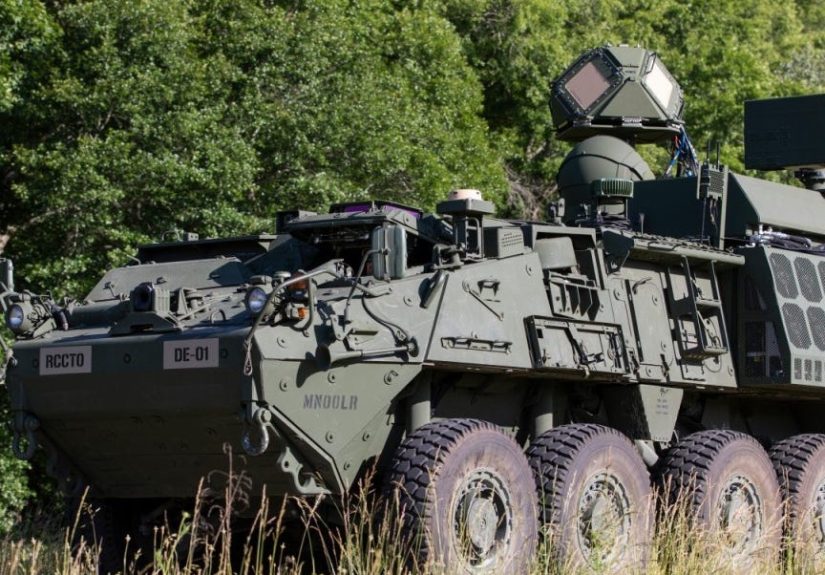
One of the Army’s best-known laser efforts is Directed Energy Maneuver-Short Range Air Defense, usually shortened to DE M-SHORAD. The concept is straightforward: mount a 50-kilowatt-class laser weapon on a Stryker armored vehicle and use it to protect maneuver forces from drones and other lower-tier aerial threats.
The Stryker platform matters because maneuver forces need protection that can move with them. A fixed base can use larger shelters, generators, towers, and sensors. A brigade combat team rolling across rough terrain needs something more mobile. A laser Stryker promises a defensive tool that can drive with the formation, plug into air-defense networks, and engage drones without burning through a truckload of missiles.
The Army delivered four DE M-SHORAD prototype systems to the 4th Battalion, 60th Air Defense Artillery Regiment at Fort Sill in 2023. Those prototypes were later sent overseas for operational support, showing how urgently the Army wanted real-world feedback. That decision also revealed the tradeoff: deploying prototypes can help soldiers learn faster, but it can interrupt controlled testing and make it harder to produce clean, laboratory-perfect data.
P-HEL and LOCUST: The Palletized Laser Approach
The Army has also used palletized laser systems such as the Palletized High Energy Laser, or P-HEL, associated with the LOCUST laser weapon family. These systems are designed for counter-small-UAS missions and can be deployed to help protect bases, infrastructure, and other fixed or semi-fixed sites.
The appeal is flexibility. A palletized system does not need to be married forever to one vehicle. It can support force protection in places where drones are a persistent nuisance and where defenders need a lower-cost shot than a missile. Contractor announcements and defense reporting have described operational employment of P-HEL systems overseas, making this one of the clearest signs that laser weapons have moved beyond PowerPoint mythology and into real defense work.
Why Laser Weapons Are So Tempting
The big selling point is cost-per-shot. A missile can cost tens of thousands, hundreds of thousands, or even millions of dollars depending on the system. A laser shot mainly consumes electricity, plus wear, maintenance, and support costs. Nobody should pretend the whole system is cheapthe laser, sensors, beam director, cooling, power, software, and integration are expensivebut once the system is in place, the marginal cost of engaging a small drone can be dramatically lower than firing a missile.
Lasers also travel at the speed of light. There is no ballistic arc to calculate in the traditional sense, no missile flight time, and no interceptor that might miss and continue somewhere inconvenient. When the beam is on target, the effect begins immediately. For small drones flying close to protected forces, that speed is a serious advantage.
Another advantage is magazine depth. A missile launcher eventually runs out of missiles. A gun runs out of ammunition. A laser can keep firing as long as it has enough power, cooling capacity, and time between shots. That does not mean infinite firing like a video game cheat code. It means the limiting factors are electricity, heat, component durability, and target conditions rather than the number of physical interceptors stacked nearby.
Why Lasers Are Not Magic
Now for the unglamorous part, because every futuristic weapon eventually meets the weather report. Lasers need line of sight. They also have to push energy through the atmosphere. Dust, smoke, fog, rain, turbulence, and humidity can reduce effectiveness. A laser may perform beautifully on a clear test range and then become less impressive when the battlefield looks like a barbecue grill inside a sandstorm.
Lasers also require dwell time. They usually need to hold energy on a vulnerable part of the drone long enough to cause damage. That means tracking has to be precise. The beam director, sensors, fire-control software, and operator interface all matter. If the target maneuvers, if the platform moves, if the air is dirty, or if several drones arrive at once, the engagement becomes more complicated.
Then there is power and cooling. A high-energy laser is not just a flashlight with confidence issues. It needs serious electrical generation and thermal management. Waste heat has to go somewhere. Components have to survive vibration, transport, temperature swings, and maintenance realities. Soldiers do not operate weapons in cleanrooms; they operate them in dust, mud, heat, cold, and long days fueled by coffee that could legally qualify as asphalt sealant.
The IFPC-HEL Lesson: Bigger Is Harder
The Army has also explored larger directed-energy systems, including the 300-kilowatt-class Indirect Fire Protection Capability-High Energy Laser, known as IFPC-HEL. The idea was to provide a more powerful laser layer against tougher threats, potentially including drones, rockets, artillery, mortars, and other aerial targets.
But bigger lasers bring bigger engineering problems. More power means more heat, heavier components, larger support requirements, and more integration complexity. Recent oversight and reporting show the Army has been reassessing how quickly some high-power laser programs should transition into formal acquisition. That does not mean the laser dream is dead. It means the Army is learning the ancient defense-acquisition proverb: “The prototype was cool, but can we maintain it on a Tuesday?”
How Lasers Fit Into a Layered Counter-UAS Defense
A successful counter-drone defense starts before the laser fires. First, the system must detect the drone. That can involve radar, radio-frequency sensors, acoustic systems, optical cameras, infrared sensors, or a combination of them. Then it must identify whether the object is hostile, friendly, civilian, a bird, a balloon, or somebody’s regrettable weekend purchase.
After detection and identification comes decision-making. Is the drone close enough to threaten the base? Is it carrying a payload? Is it above civilian airspace? Are friendly aircraft nearby? What weapon is safest and most effective? In a crowded environment, the hardest part may not be shooting. It may be knowing what not to shoot.
That is why the Army’s plan includes command-and-control networks and multiple defeat options. A laser may be the right tool for a small drone in clear air at a manageable range. Electronic warfare may be better if the drone depends on a vulnerable control link. A missile or gun may be necessary if the target is faster, larger, or outside the laser’s practical engagement window. The future is not one weapon. It is a menu.
Specific Examples: From Fort Sill to Overseas Operations
Fort Sill has become one of the Army’s important proving grounds for directed-energy air defense. Army live-fire events have integrated laser systems with traditional kinetic defenses, emphasizing that directed energy is meant to augment, not replace, existing weapons. That matters because soldiers need confidence that if the laser is limited by weather, damage, power, or target type, another layer is ready.
Overseas deployment of laser prototypes has been equally important. It is one thing to demonstrate a system on a test range. It is another to keep it working in an operational environment where drones may appear unpredictably, maintenance crews face real pressure, and commanders need systems that behave more like weapons than science projects.
The Army’s experience with systems such as DE M-SHORAD and P-HEL shows both progress and friction. Lasers can engage drones, but the Army still has to solve reliability, suitability, sustainment, training, and integration challenges. That is normal for a new class of weapon. The first tanks were awkward. Early aircraft were fragile. Early radars were mysterious. New military technology rarely arrives wearing a tuxedo.
The Economics: Why a Cheap Drone Creates an Expensive Headache
The cost problem is one of the strongest arguments for laser weapons. If an adversary can launch cheap drones in large numbers, defenders cannot rely only on expensive interceptors. That imbalance creates what defense planners call an unfavorable cost-exchange ratio. In normal-person language: you do not want to spend a sports car to destroy a lawn mower with wings.
Laser weapons aim to flip that math. The system itself may cost a lot, but each engagement can be cheaper than firing a missile. Over time, that matters for bases, ships, convoys, and critical infrastructure facing repeated drone threats. Lasers also reduce logistics pressure because electricity can be generated locally, while missiles require production, transport, storage, security, and resupply.
However, the economics only work if the laser system is reliable, maintainable, and effective against the expected threat. A cheap shot that misses, overheats, or cannot fire in common conditions is not cheap. The Army’s challenge is not simply buying lasers. It is buying lasers that soldiers can trust.
What Comes Next for Army Counter-Drone Lasers
The next stage is likely to be less cinematic and more practical. Expect competitions, operational assessments, upgraded beam directors, better sensors, improved target tracking, more rugged power systems, and tighter integration with existing air-defense networks. The Army will keep asking blunt questions: Does it work in dust? Can soldiers maintain it? How many shots before cooling becomes a problem? Can it distinguish drones from clutter? Can it operate safely near civilian airspace? Does it help commanders make faster decisions?
The best version of the Army’s laser plan is not a single spectacular weapon. It is a dependable defensive layer that makes drone attacks less effective, less affordable, and less psychologically powerful. Drones thrive when they are cheap, persistent, and annoying. Lasers are attractive because they promise to be persistent and annoying right back.
Experience-Based Reflections: What the Drone-Laser Fight Teaches Us
Anyone who has watched technology move from concept to field use knows the pattern. First comes the hype. Then comes the demo video. Then comes the uncomfortable moment when the equipment has to work after being hauled across bad roads, parked in heat, covered in dust, and operated by tired people who have other problems besides admiring the future. The Army’s laser journey fits that pattern perfectly.
The experience around drone defense shows that the real battle is not just laser versus drone. It is system versus chaos. A drone may be small, but the defensive chain is large. Someone has to detect it, classify it, pass the track, authorize an engagement, point the weapon, maintain safety, defeat the target, and confirm the result. If any link is weak, the laser becomes an expensive spotlight.
There is also a human experience here. Soldiers do not need a weapon that only impresses engineers. They need a weapon that behaves predictably. The user interface matters. Training matters. Maintenance access matters. Spare parts matter. A laser weapon may sound futuristic, but if a crew cannot troubleshoot it quickly, keep it cooled, align its sensors, and understand its limits, it becomes another complicated box in the motor pool with a dramatic brochure.
The drone threat also teaches humility. Small unmanned aircraft keep evolving. Some use commercial parts. Some fly preplanned routes. Some rely on radio links. Some are hardened. Some are cheap enough to be sacrificed just to locate defenses. That means no single countermeasure will stay dominant forever. A laser that works well against one drone may be less effective against another design, a different tactic, or bad weather. The enemy gets a vote, and annoyingly, the enemy also shops online.
From an operational perspective, the most valuable experience may be learning where lasers should not be used. That sounds odd, but it is essential. Good commanders need to know when to choose a missile, when to jam, when to use guns, when to wait, and when a laser is the safest and most efficient option. The future counter-drone crew may look less like a sci-fi gunner and more like an air-defense quarterback, selecting the right play in seconds.
Finally, the Army’s laser work is a reminder that innovation is rarely clean. DE M-SHORAD, P-HEL, LOCUST, IFPC-HEL, high-power microwaves, missiles, guns, and electronic warfare are all part of a messy but necessary adaptation. Drones made the battlefield cheaper, faster, and more crowded. The Army’s answer is to make defense cheaper, faster, and more layered. The punchline may be “frickin’ laser beams,” but the serious story is about survival, cost, and staying ahead of a threat that refuses to stop buzzing.
Conclusion
The Army’s plan to defeat drones with laser beams is real, but it is not magic. High-energy lasers offer speed-of-light engagement, low shot cost, precision, and deep magazines. They are especially promising against small drones that are too cheap and numerous to fight only with missiles. At the same time, lasers face practical limits: weather, line of sight, dwell time, power, cooling, reliability, safety, and integration with other defenses.
The smartest way to understand Army laser weapons is as one layer in a broader counter-UAS shield. When combined with sensors, electronic warfare, guns, missiles, microwaves, and trained operators, lasers can help change the economics of drone defense. They may not turn the battlefield into a sci-fi movie, but they could make life much harder for the next quadcopter trying to play villain.