Table of Contents >> Show >> Hide
- Quick Answer: Which Laser Levels Are Best in 2025?
- What Actually Matters When Buying a Laser Level in 2025
- The Best Laser Levels of 2025, Ranked by Use Case
- Bosch GLL50-20G Best Overall for Most DIYers and Serious Home Users
- SKIL LL932201 Best Value 360-Degree Laser Level
- DeWalt DW088K Best Proven Red-Beam Workhorse
- Milwaukee M12 Green 360° 3-Plane Laser Kit Best for Pros
- Klein Tools 93LCLS Best for Plumb Spots and Precision Layout
- Johnson 40-6515 Best Rotary Laser for Larger Spaces and Outdoor Projects
- Huepar DIY Models Best Budget-Friendly Green Beam Entry Point
- How to Choose the Right Laser Level for Your Projects
- Real-World Experiences: What People Learn After Actually Using Laser Levels
- Final Verdict
- SEO Tags
If you have ever tried to hang three picture frames, install shelves, line up kitchen cabinets, and keep your sanity all at once, you already know why laser levels exist. A good one turns “that looks about right” into “wow, that line is suspiciously perfect.” And in 2025, the market is full of options ranging from simple cross-line tools for weekend DIYers to pro-grade 3-plane beasts that look like they should come with their own hard hat.
The tricky part is that there is no single best laser level for every person. The best laser level for hanging curtains is not the same as the best laser level for tile, trim, drop ceilings, or outdoor layout work. So instead of pretending one model is the ruler of all straight lines, this guide focuses on what actually matters: visibility, beam type, self-leveling, durability, range, mounting options, and real-world usefulness.
After reviewing current hands-on testing, buyer guidance, and manufacturer specs, a few clear winners stand out. Some are excellent because they are simple and affordable. Others earn their keep because they save time on bigger jobs. Either way, the goal is the same: fewer crooked installations, fewer muttered regrets, and a lot less measuring twice and still somehow drilling wrong.
Quick Answer: Which Laser Levels Are Best in 2025?
- Best overall for most people: Bosch GLL50-20G
- Best value 360 laser: SKIL LL932201
- Best red-beam workhorse: DeWalt DW088K
- Best for pros: Milwaukee M12 Green 360° 3-Plane Laser Kit
- Best for precise plumb-spot work: Klein Tools 93LCLS
- Best rotary laser for larger jobs: Johnson 40-6515
- Best budget-friendly green-beam option: Huepar M-9011G / similar Huepar DIY cross-line models
That is the short version. Now let’s get into the fun part: the why.
What Actually Matters When Buying a Laser Level in 2025
1. Green vs. red beam
Green beams are the stars of the current laser-level world. They are easier to see, especially in brighter rooms and tougher lighting. If you work in spaces with lots of windows, unfinished interiors, or occasional outdoor use, green is usually worth the extra money. Red beams, however, are still perfectly useful for indoor DIY projects and usually cost less. In other words, green is the flashy athlete; red is the dependable sedan that still gets you home.
2. Cross-line, 360-degree, or rotary
A basic cross-line laser is great for hanging art, installing shelves, setting cabinet lines, and tackling light remodeling. A 360-degree laser is better when you need a line around the room, such as for chair rail, tile, ceiling work, or multi-wall alignment. Rotary lasers are the heavy hitters for larger interior layouts and outdoor jobs like grading, fencing, and excavation. Buying a rotary laser just to hang a mirror is a little like bringing a bulldozer to plant basil.
3. Self-leveling
Self-leveling is the feature most people should refuse to live without. A good self-leveling laser saves setup time, reduces user error, and makes the tool feel far more useful in the real world. Manual tools still exist, but unless you enjoy tinkering with bubbles and second-guessing yourself, self-leveling is the smarter move.
4. Mounting and battery life
A laser can be dead-accurate and still annoying if it is hard to position. Magnetic mounts, tripod compatibility, fine-adjust knobs, and locking pendulums make a big difference. Rechargeable batteries are especially convenient for frequent use, while AA-powered models still appeal to people who want simple, grab-and-go flexibility.
The Best Laser Levels of 2025, Ranked by Use Case
Bosch GLL50-20G Best Overall for Most DIYers and Serious Home Users
The Bosch GLL50-20G hits the sweet spot that many shoppers want: bright green visibility, rugged construction, self-leveling convenience, and a feature set that feels useful without becoming ridiculous. This is the kind of tool that makes sense for homeowners who do a lot of projects and for tradespeople who want a compact cross-line unit that can survive real jobsite life.
Its appeal is pretty obvious. Bosch gives you green beams, a 65-foot working range, IP55 dust- and water-resistance, and a protective rubberized housing. The integrated magnetic mount is handy, and Bosch’s dual-power flexibility is a nice touch because it can run on AA batteries or an optional lithium-ion battery. That makes it less fussy than tools that demand one very specific power setup.
In plain English: it is bright, portable, and tough enough to ride around in a tool bag without needing emotional support. For most people shopping for the best laser level of 2025, this is the one that makes the most practical sense.
SKIL LL932201 Best Value 360-Degree Laser Level
If you want the advantages of a 360-degree laser without spending premium-brand money, the SKIL LL932201 is a very smart buy. It projects a continuous horizontal line around the room, includes a tripod, self-levels automatically, and has a rechargeable battery. That combination makes it extremely appealing for home improvement projects where convenience matters as much as raw power.
This model is especially good for people working on trim, wallpaper, multiple wall hangings, curtain rods, or chair rail. Instead of moving the tool over and over, you can set it once and use that full-room reference line like a boss. The included tripod is not just a throw-in accessory either; it makes setup easier and helps justify the value angle.
It is not the laser you buy for large outdoor construction or major commercial layout, but for homeowners and budget-conscious remodelers, it punches well above its weight.
DeWalt DW088K Best Proven Red-Beam Workhorse
The DeWalt DW088K has been around long enough to earn something rare in tool shopping: trust. It keeps showing up in editor-tested recommendations because it is durable, accurate, and refreshingly uncomplicated. It projects bright red horizontal and vertical lines, can handle a one-meter drop, and reaches up to 165 feet with a detector.
That last point matters. While red beams are not as visible as green in bright conditions, the DW088K still holds real value because it is tough, dependable, and well-suited for a huge range of indoor layout tasks. Think framing, shelves, cabinets, wall tile, and general remodel work.
If you are the kind of buyer who values reputation, consistency, and a tool that does not try to reinvent the wheel, the DW088K is still one of the safest picks on the board. It is the tool equivalent of a reliable pickup truck: maybe not the flashiest thing in the parking lot, but it always shows up ready to work.
Milwaukee M12 Green 360° 3-Plane Laser Kit Best for Pros
Once you move into bigger layout tasks, the conversation changes fast. That is where the Milwaukee M12 Green 360° 3-Plane Laser Kit starts looking very attractive. It gives you one horizontal and two vertical 360-degree planes, long runtime on the M12 platform, strong magnetic mounting, micro adjustment, and the kind of visibility and range that make larger spaces less annoying to lay out.
This is a professional tool, and it acts like one. If you install cabinets, frame interiors, work on drop ceilings, or do detailed finish carpentry, a 3-plane laser can save an absurd amount of time. You stop moving the tool around as much, you get square and plumb references more easily, and setup becomes faster once you know what you are doing.
Casual DIYers may not need this much laser. But for pros, this is the kind of purchase that can actually pay for itself in time saved and fewer layout mistakes.
Klein Tools 93LCLS Best for Plumb Spots and Precision Layout
The Klein Tools 93LCLS is a sleeper pick for people who need more than a basic cross-line. Its standout feature is the addition of plumb spots, which can be especially useful for electrical work, conduit runs, panel alignment, and other precise layout jobs. It also brings IP54 protection, multiple mounting threads, and a hard case.
What makes the Klein appealing is that it feels purpose-built for real professional tasks rather than just “general home use.” It has the sort of thoughtful configuration that makes electricians, remodelers, and detail-oriented installers nod approvingly instead of shrugging.
If your work regularly involves transferring points from floor to ceiling or aligning more technical installations, this model deserves serious attention.
Johnson 40-6515 Best Rotary Laser for Larger Spaces and Outdoor Projects
When the project moves outside or expands beyond one room, rotary lasers start making more sense. The Johnson 40-6515 is a strong option for users who need more coverage than a typical line laser can provide. It works horizontally or vertically, offers multiple rotation speeds, and is suitable for fence lines, landscaping, drop ceilings, and other larger layout work.
Rotary lasers are not everyone’s cup of coffee. They are more specialized, and many homeowners will never need one. But for contractors, landscapers, and serious project planners, they can be a game changer. If your work involves larger spans and detector-assisted layout, a rotary unit like this becomes far more practical than trying to stretch a small cross-line tool beyond its comfort zone.
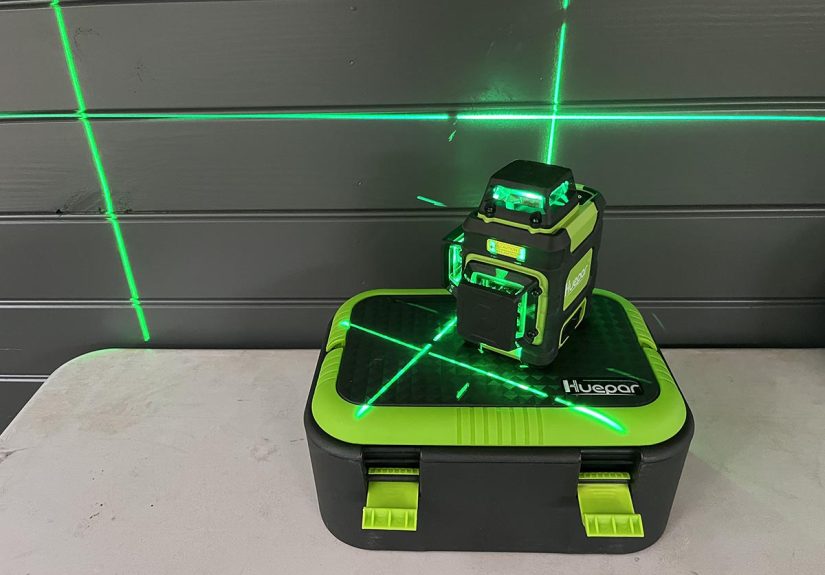
Huepar DIY Models Best Budget-Friendly Green Beam Entry Point
Huepar has become impossible to ignore in this category. Recent hands-on testing from major home publications shows that the brand keeps showing up with affordable, capable green-beam models that offer strong value. The exact best pick depends on the model, but the broad takeaway is clear: Huepar is no longer just the “cheap alternative” corner of the market.
For DIY buyers, that is good news. A Huepar green cross-line or 3D model can be an appealing middle ground between bargain-bin frustration and premium-brand sticker shock. You may not get the same tank-like feel as the top pro brands, but you often get a lot of visibility and features for the money.
How to Choose the Right Laser Level for Your Projects
Here is the simplest buying rule: match the laser to the work, not to your emotions after watching three tool videos at midnight.
If you mostly hang art, mirrors, curtain rods, and shelves, a basic self-leveling cross-line laser is enough. If you do room-wide trim or tile, move up to a 360-degree model. If you work professionally and need plumb, square, and level references all day, go 3-plane. If you work outside on longer distances, think rotary laser plus detector.
Also, keep budget in perspective. The sweet spot for many quality consumer laser levels sits in the low-to-mid price range. Spend more only when the added capability will actually save you time or improve accuracy on the kinds of jobs you really do.
Real-World Experiences: What People Learn After Actually Using Laser Levels
The funny thing about laser levels is that most people do not realize how useful they are until they use one on a real project. Before that, they seem slightly overdramatic. A laser? For hanging shelves? What is next, GPS for a sandwich? But once you use one, it becomes painfully obvious how much time you used to waste with pencil marks, bubble levels, and tiny adjustments that somehow made everything worse before it got better.
A common first experience is pure relief. You turn it on, the line appears across the wall, and suddenly your brain stops doing that exhausting little geometry dance. Instead of measuring one bracket, then the next, then checking with a level, then stepping back, then realizing it still looks crooked, you just follow the line. The job goes faster, and the result usually looks sharper. That simple shift is why so many people end up wondering why they waited so long to buy one.
Another real-world lesson is that visibility matters more than shoppers expect. A red beam can look perfectly fine in a dim hallway and then practically disappear the moment sunlight pours through a window. That is why green lasers feel like magic the first time you use one in a brighter room. You are not imagining it. The beam is easier to see, which makes the tool easier to trust, which makes the whole job less annoying.
Then there is the tripod lesson. Many people think they can skip it. Then they spend twenty minutes balancing the laser on a paint can, a stack of books, or some deeply questionable tower of offcuts. The second they use a proper tripod or magnetic mount, they realize the accessory was not optional after all. Good positioning is half the battle with laser levels. A great beam is not all that helpful if it is aimed from the world’s saddest improvised platform.
Users also learn quickly that bigger jobs reveal the difference between “fine” and “fantastic.” Hanging two picture frames? Almost any decent self-leveling laser can help. Laying out cabinets across multiple walls, aligning tile over a long run, or working in a partly finished basement? That is when 360-degree and 3-plane models start to feel worth every penny. More coverage means fewer resets, fewer chances for error, and far less muttering under your breath.
Outdoor use teaches another humbling truth: lasers are not superheroes in bright sunlight. Even excellent models can become hard to see outside unless you are working in shade, at shorter distances, or with a receiver. Many first-time buyers expect the beam to glow like a movie prop in full sun. Real life is less cinematic. The right accessory setup matters.
And finally, there is the confidence factor. A good laser level does not just save time. It changes how you approach projects. People take on bigger jobs because layout feels less intimidating. They try trim details, wall treatments, or more precise installations because the reference line is always there. That may be the biggest experience-based takeaway of all: laser levels do not just help you work straighter. They make ambitious projects feel a lot more possible.
Final Verdict
If you want the best laser level of 2025 for overall usefulness, the Bosch GLL50-20G is the easiest recommendation. It blends durability, visibility, and practical design better than almost anything else in the category.
If value is your priority, the SKIL LL932201 is excellent. If you want a dependable classic, the DeWalt DW088K still deserves its loyal following. And if you are a pro who lives and dies by layout accuracy, the Milwaukee M12 3-Plane is where the conversation gets serious.
The best laser level is not the most expensive one. It is the one that matches your work, saves you time, and keeps your finished project from looking like it was aligned during a mild earthquake.