Table of Contents >> Show >> Hide
- What Is “It May Look Like a Walnut”?
- Why the Episode Felt So Different
- Jerry Paris: The Key Link Between Rob Petrie and Mork
- How “Happy Days” Opened the Door for Mork
- The Creative Thread: From Dream Episode to Sitcom Phenomenon
- Why Robin Williams Was the Perfect Evolution of the Idea
- The Legacy of “It May Look Like a Walnut”
- Experience Section: Watching the Walnut Episode After Knowing Mork
- Conclusion
- SEO Tags
Before Robin Williams shouted “Nanu nanu” into American pop culture, before Mork arrived on Earth in an egg-shaped spaceship, and before sitcom writers learned that sometimes the best line in a script is simply “Robin will say something here,” there was a living room full of walnuts.
The classic Dick Van Dyke Show episode “It May Look Like a Walnut” is one of those half-hours of television that feels as if someone spilled a science-fiction comic book into a suburban sitcom and then decided not to clean it up. Written by Carl Reiner and directed by Jerry Paris, the episode aired during the show’s second season in 1963. On the surface, it is a surreal dream story about Rob Petrie, alien invaders, missing thumbs, stolen imaginations, and enough walnuts to make a squirrel consider early retirement. Underneath, it became part of a surprising creative chain that eventually helped lead to Robin Williams’ breakout role as Mork on Happy Days and then Mork & Mindy.
That is the fun of television history. A joke in one decade becomes a premise in another. A weird idea that once made network executives sweat later becomes the doorway to one of the most explosive comic talents ever seen on TV. In this case, the bridge between Rob Petrie’s walnut nightmare and Mork from Ork was Jerry Paris, the actor-director who understood that aliens could invade a sitcom without destroying it. In fact, they could make it funnier.
What Is “It May Look Like a Walnut”?
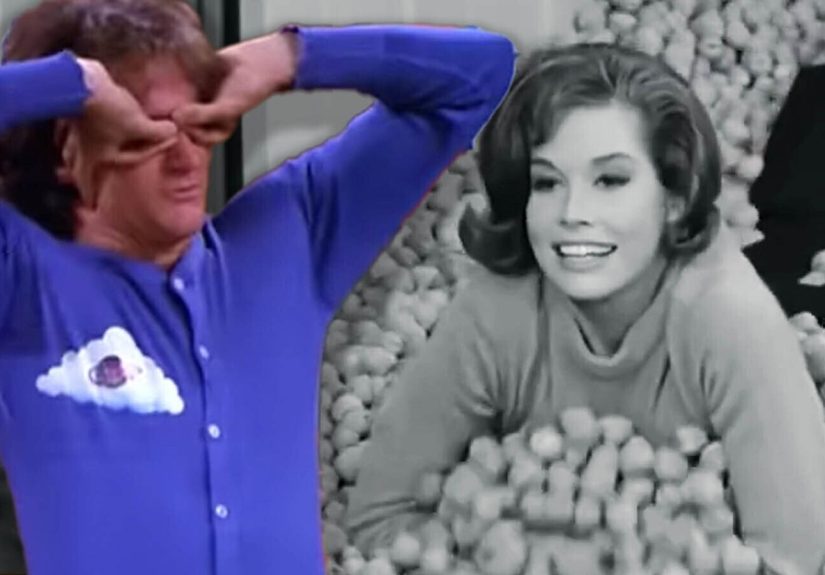
“It May Look Like a Walnut” is Season 2, Episode 20 of The Dick Van Dyke Show. The episode centers on Rob Petrie, played by Dick Van Dyke, after he watches a frightening science-fiction program before bed. Laura Petrie, played by Mary Tyler Moore, wants no part of the spooky broadcast, but Rob cannot resist teasing her with the show’s ridiculous premise. The imagined invader is Kolak from the planet Twilo, a strange alien figure who looks suspiciously like Danny Thomas and uses walnuts in a plan to rob humans of their thumbs and imaginations.
That sentence alone deserves a small award. “Alien steals thumbs with walnuts” sounds like something written on a diner napkin after too much coffee, yet the episode works because it treats its nonsense with perfect sitcom seriousness. The next morning, Rob wakes to find walnuts everywhere. Laura is oddly calm. People begin acting as if the impossible has become ordinary. Rob’s comfortable world bends into a paranoid sci-fi nightmare, and the comedy comes from watching a sensible man try to remain sensible while his house turns into a nut-themed Twilight Zone.
Why the Episode Felt So Different
Most episodes of The Dick Van Dyke Show were built around recognizable domestic or workplace misunderstandings. Rob, Laura, Buddy, Sally, and the rest of the Alan Brady Show crew operated in a world of writers’ rooms, dinner parties, neighbors, jealousies, and show-business embarrassment. “It May Look Like a Walnut” keeps the same characters but drops them into a surreal dream structure. Suddenly, the familiar Petrie home becomes a battlefield between ordinary life and absurd fantasy.
That contrast is exactly why the episode is still remembered. The show did not need elaborate special effects. It had Dick Van Dyke’s elastic body language, Mary Tyler Moore’s sharp timing, Carl Reiner’s comic architecture, and a director willing to make the living room look as if a nut truck had backed through the wall. The comedy is visual, verbal, and psychological all at once. Rob is not just afraid of aliens; he is afraid that the world he understands has quietly changed the rules while he was asleep.
The Walnuts Were More Than a Gag
The walnuts became the episode’s great visual punchline. They are silly, yes, but they also make the nightmare feel weirdly physical. Rob cannot argue with walnuts piled around his home. A dream may be invisible, but a floor covered in shells has excellent comic evidence. The more walnuts appear, the more Rob’s panic becomes reasonable, which is the secret sauce of good farce. The audience knows the premise is absurd, but the character’s reaction is emotionally honest.
That formula would later serve Mork & Mindy beautifully. Mork’s behavior was outrageous, but the show worked because Mindy treated him as a real person, not merely a walking gag machine. A sitcom can survive almost any fantasy element if the emotional reactions stay human.
Jerry Paris: The Key Link Between Rob Petrie and Mork
The most important behind-the-scenes connection is Jerry Paris. Viewers of The Dick Van Dyke Show knew him as Jerry Helper, the Petries’ neighbor and Rob’s dentist friend. But Paris also became a major sitcom director. “It May Look Like a Walnut” was an early and important directing assignment for him, and it showed that he could handle comedy that broke away from the standard living-room rhythm.
Years later, Paris directed episodes of Happy Days. When producer Garry Marshall was considering an outer-space visitor for the Cunningham universe, Paris had already survived the walnut invasion. He understood that a sitcom alien did not have to be a serious science-fiction creature. The alien could be a comic mirror, a visitor who made ordinary people look strange simply by misunderstanding them.
That is the DNA shared by “It May Look Like a Walnut” and Mork’s first appearance. Both stories begin with a normal sitcom setting. Both introduce a science-fiction interruption. Both use the outsider idea to make familiar human habits seem ridiculous. The alien is not there to explain astrophysics. He is there to ask why humans behave like humans, which is often a much harder question.
How “Happy Days” Opened the Door for Mork
Mork first appeared in the Happy Days episode “My Favorite Orkan.” The concept was playful: Richie Cunningham encounters an alien named Mork, who wants to study ordinary human life. In the original sitcom ecosystem, this was a wild swing. Happy Days was built on 1950s nostalgia, diners, leather jackets, jukeboxes, and the gravity-defying confidence of Fonzie. Dropping an alien into that world was like putting a disco ball in a soda shop and pretending nobody would notice.
But the experiment worked because Robin Williams entered the role like a weather event. He was not merely “quirky.” He seemed to be receiving signals from a private comedy satellite. His body moved differently. His voice changed speed without asking permission. He could turn a simple line into a juggling act. The audience reaction made it clear that Mork was not a one-time novelty; he was a spin-off waiting to hatch.
That led to Mork & Mindy, which premiered in 1978 and paired Williams with Pam Dawber as Mindy McConnell. The premise was simple enough for a bumper sticker: an alien from Ork comes to Earth, lives with a human woman in Boulder, Colorado, and reports back on human behavior. The execution, however, depended on Williams’ improvisational fireworks and Dawber’s grounded straight-woman performance. Without Mindy’s calm intelligence, Mork might have floated into pure chaos. With her, chaos had a couch to sit on.
The Creative Thread: From Dream Episode to Sitcom Phenomenon
It would be too simple to say that “It May Look Like a Walnut” directly created Mork & Mindy. Television rarely works like a single falling domino. The rise of Mork also involved the late-1970s craze for science fiction, the cultural aftershock of Star Wars, Garry Marshall’s instinct for spin-offs, and Robin Williams’ once-in-a-generation audition. Still, the Dick Van Dyke Show episode mattered because it gave Jerry Paris a working example of how alien absurdity could live inside a mainstream sitcom.
“Walnut” showed that viewers would accept a sudden fantasy detour if the comedy stayed sharp. It proved that science fiction could be used not as spectacle but as a joke engine. It also demonstrated that the suburban sitcom home could become strange without losing its warmth. Those lessons are all over Mork & Mindy.
Rob Petrie and Mork Share a Comic Problem
Rob and Mork are very different characters, but they share one crucial comic problem: both are trying to understand a world that refuses to behave. Rob wakes into a reality that seems invaded by Twilo. Mork arrives from Ork and finds Earth customs baffling. Rob says, in effect, “Why has my normal world gone crazy?” Mork says, “Why do you call this normal?”
That reversal is the heart of outsider comedy. In “It May Look Like a Walnut,” the outsider force invades Rob’s life. In Mork & Mindy, the outsider becomes the main character. The perspective flips, but the comic machinery is related.
Why Robin Williams Was the Perfect Evolution of the Idea
If “It May Look Like a Walnut” supplied a strange blueprint, Robin Williams supplied the rocket fuel. Many actors could have played Mork as cute, odd, or robotic. Williams played him as a living explosion of curiosity. He made alienness feel childlike, philosophical, and completely unpredictable. One second Mork was a clown; the next he was asking a painfully sincere question about loneliness, friendship, or love.
That balance helped Mork & Mindy become more than a gimmick. The best episodes were not just about Mork misusing household objects or misunderstanding slang. They were about how strange human life looks when you remove habit from the equation. Why do people lie to be polite? Why do adults hide sadness? Why is dating so complicated? Why do families argue and then eat dinner together anyway? Mork’s alien innocence made those questions funny, but also oddly touching.
That emotional dimension separates great sitcom fantasy from random weirdness. “It May Look Like a Walnut” is funny because Rob’s terror is real to him. Mork & Mindy is funny because Mork’s confusion is real to him. In both cases, the joke is absurd, but the feeling is sincere.
The Legacy of “It May Look Like a Walnut”
Classic TV fans often rank “It May Look Like a Walnut” among the most memorable episodes of The Dick Van Dyke Show. That reputation makes sense. The episode is clever, risky, and visually unforgettable. It also captures the creative confidence of a series that knew its characters well enough to bend reality around them.
Its influence on the Mork idea gives it an extra layer of importance. The episode stands as a reminder that television history is full of strange little handoffs. A director learns from one show, carries an idea to another, and suddenly a young comedian gets the role that changes his life. That is not a neat corporate strategy. That is creative compost. Old jokes decay into new flowers. Sometimes the flowers arrive from Ork wearing suspenders.
For viewers, the connection makes both shows more enjoyable. Rewatching “It May Look Like a Walnut” after knowing about Mork is like finding a fossil of a future sitcom. The alien is not Mork yet. The tone is not the same. The world is black-and-white suburbia, not late-1970s Boulder. But the spark is there: the idea that an alien presence can turn ordinary American life into comedy gold.
Experience Section: Watching the Walnut Episode After Knowing Mork
Watching “It May Look Like a Walnut” today is a little like opening a time capsule and discovering that someone packed it with snack food and existential dread. The episode begins in a cozy, familiar place: Rob and Laura’s bedroom, the kind of domestic setting where the biggest problem is usually a misunderstanding, a neighbor, or Rob tripping over furniture with Olympic commitment. Then the story tilts. The scary TV program seeps into Rob’s imagination, and suddenly the Petrie home feels less like a sitcom set and more like a suburban landing zone.
The fun is not only in the walnuts, although the walnuts do a heroic amount of work. The fun is in seeing how confidently the episode trusts the audience to follow a ridiculous idea. Nobody stops to explain why walnuts are funny. They simply are. They pile up, appear in breakfast, and turn a normal house into a visual punchline. It is the kind of comedy that rewards viewers who enjoy both smart writing and absolute foolishness. In other words, it is comedy wearing a tie but keeping a whoopee cushion in the desk drawer.
Knowing that this episode helped inspire the path toward Mork makes the viewing experience even richer. You start noticing how the alien concept is used not for spectacle but for contrast. Rob’s world is ordered. Mork’s later world would be curious. In both cases, alien comedy works because it makes normal behavior look suspicious. Rob cannot understand why everyone around him seems to accept the walnut invasion. Mork cannot understand why humans accept half the things they do every day. Why shake hands? Why date? Why pretend to be fine when you are clearly not fine? Why wear matching socks when life is short and laundry is a tyrant?
That is where the two shows secretly shake hands. “It May Look Like a Walnut” turns the human into the confused observer. Mork & Mindy turns the alien into the confused observer. Both approaches reveal how fragile “normal” really is. Change one rule, add one strange visitor, remove one thumb, and suddenly society looks like it was assembled by committee during a power outage.
There is also a pleasure in watching Jerry Paris’ direction with hindsight. The episode has pace, surprise, and a willingness to go big without becoming sloppy. Paris understood that weird comedy still needs structure. That skill mattered later when Mork entered the more conventional world of Happy Days. An alien can be wild, but the scene still needs timing. The guest star can be unpredictable, but the camera still has to know where the laugh is.
For modern viewers, the episode is a reminder that innovation does not always arrive looking fashionable. Sometimes it looks like a 1963 black-and-white sitcom about a man afraid of walnuts. But inside that oddball half-hour is a lesson that television keeps relearning: audiences enjoy surprise when it is anchored by character. Rob Petrie is funny because we know him before the madness begins. Mork is funny because Mindy gives his madness a human frame. The stranger the premise, the more important the emotional anchor becomes.
That is why the walnut episode still feels fresh. It is not just “old TV.” It is a small, nut-covered laboratory where sitcom fantasy learned to breathe. And years later, when Robin Williams burst through the door as Mork, television was ready for him, even if no one was truly ready for the amount of comic oxygen he brought into the room.
Conclusion
The Dick Van Dyke Show episode “It May Look Like a Walnut” did not simply vanish after its original broadcast. It lingered in the memory of Jerry Paris, proved that surreal science-fiction comedy could work inside a sitcom, and helped shape the creative path that led to Mork’s arrival on Happy Days. From there, Robin Williams transformed a one-off alien idea into Mork & Mindy, one of the most distinctive sitcom success stories of the late 1970s.
The connection is delightfully strange and perfectly fitting. A dream about walnuts, thumbs, and imagination helped lead to a character who seemed to be made entirely of imagination. That is classic television at its best: unpredictable, collaborative, and just weird enough to outlive the decade that made it.
Note: This article is written as original, publication-ready SEO content based on verified classic television history and synthesized entertainment references.