Table of Contents >> Show >> Hide
- How the U.S. Got Here
- How Many Missiles and Munitions Are We Talking About?
- Why These Transfers Hit U.S. Stockpiles So Hard
- Did America Really Deplete Its Own Stockpiles?
- Examples That Show the Strain
- What Washington Got in Return
- The Real Lesson: Stockpiles Are Strategy
- Will the Problem Get Better?
- Final Takeaway
- Extended Perspective: The Experience Behind the Stockpile Story
For years, America’s defense planners worked from a comfortable peacetime assumption: the United States would always have enough missiles, enough shells, enough surge capacity, and enough industrial muscle to make more if things got ugly. Then Russia invaded Ukraine, the Pentagon opened its warehouses, and that assumption got mugged by reality.
The headline sounds dramatic, but it is not fantasy: the United States really did send so many missiles and so much ammunition to Ukraine that it began to strain, and in some cases noticeably deplete, parts of its own stockpiles. That does not mean the Pentagon ran out of everything or that American bases were left with broomsticks and stern language. It does mean Washington discovered that modern warfare burns through expensive precision weapons far faster than peacetime budgeting likes to admit.
Ukraine’s war has become a crash course in industrial math. Missiles that took years to design and months to build were being used in days. Systems the U.S. once bought in modest annual quantities suddenly became urgent not only for Ukraine, but for America, NATO, the Middle East, and the Indo-Pacific all at once. In plain English: everybody wanted the same stuff, at the same time, from factories that were never built for this kind of appetite.
That is why this story matters beyond Ukraine. It is about American military readiness, the limits of the post-Cold War defense model, and the awkward truth that the “arsenal of democracy” had gotten a little too comfortable acting like a boutique supplier.
How the U.S. Got Here
Much of the military aid to Ukraine moved through presidential drawdown authority, which allows the president to transfer weapons directly from existing U.S. stocks during an emergency. That approach is fast, and speed mattered. Ukraine did not need a five-year procurement plan. It needed weapons while Russian missiles were already in the air.
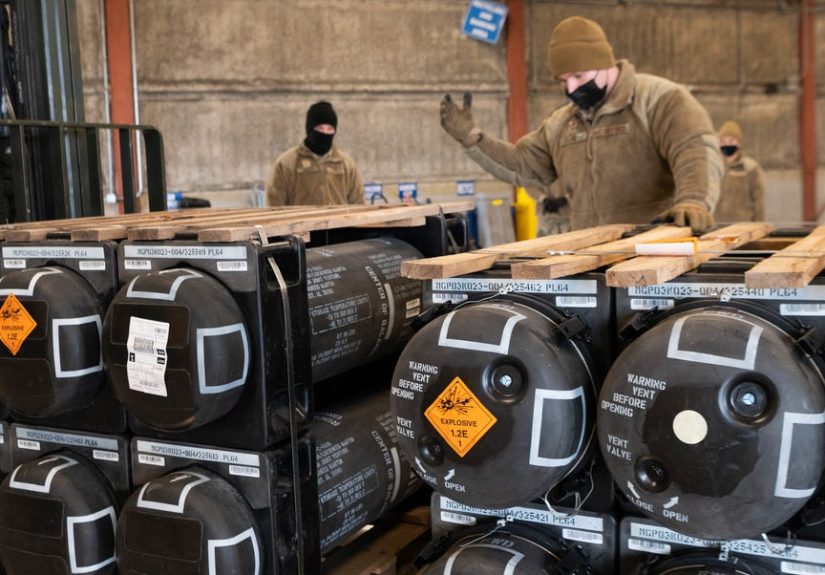
So Washington did what it could do fastest: it shipped what it already had. That meant pulling from inventories of Stinger air-defense missiles, Javelin anti-armor missiles, artillery rounds, HIMARS ammunition, Patriot munitions, and a long list of supporting gear. This helped Ukraine survive some of the most dangerous phases of the war, but it also pushed the Pentagon into a tradeoff that had been easy to ignore before 2022. Every missile sent abroad was one less missile sitting on an American shelf.
By early 2025, the Pentagon’s own public fact sheets showed the sheer scale of what had been committed: more than 3,000 Stinger anti-aircraft missiles, more than 10,000 Javelin anti-armor systems, three Patriot air-defense batteries and munitions, more than 40 HIMARS and ammunition, and more than 3 million 155mm artillery rounds. Those are not rounding-error numbers. Those are industrial-age numbers wearing modern price tags.
How Many Missiles and Munitions Are We Talking About?
Let’s start with the two weapons that became symbols of the war’s early phase: the Javelin and the Stinger. The Javelin helped Ukrainian forces wreck armored columns and make Russian tank crews very interested in retirement planning. The Stinger gave Ukrainian defenders a portable way to punish low-flying aircraft and helicopters. Both were exactly the kind of weapon Ukraine needed immediately. Both also came from inventories the U.S. had not been rapidly replenishing in peacetime.
Early analytical estimates from defense experts suggested the U.S. had sent roughly a third of its inventory of Javelins and Stingers. Even if later inventories and transfers changed the exact percentages, the broader point held: America was not shipping pocket change. It was shipping serious shares of weapons that take time, specialized parts, and a surprisingly fragile supplier web to replace.
Then came the heavier strain. Patriot interceptors are not cheap, not simple, and definitely not the kind of thing a factory can crank out like breakfast cereal. Guided rockets for HIMARS, air-defense components, artillery shells, and other munitions piled on top of the burden. By mid-2025, Reuters reported that a Pentagon review tied to low U.S. stockpiles had led to a temporary pause in some shipments that included Patriot missiles, GMLRS rockets, Hellfires, and artillery shells. When the world’s biggest defense spender starts pumping the brakes because shelves are looking thin, that is a sign worth circling in red ink.
Why These Transfers Hit U.S. Stockpiles So Hard
Peacetime production met wartime demand
The simplest explanation is also the least glamorous: America was not making enough of these weapons before the war. After decades of operating under assumptions shaped by counterinsurgency, limited interventions, and smaller annual buys, the U.S. defense industrial base had been optimized for efficiency, predictability, and margins, not for long, grinding, high-intensity warfare against a large state.
That model looks smart on spreadsheets. It looks less smart when a European land war starts consuming artillery and missiles at shocking rates. A factory sized for peacetime replenishment cannot magically become a wartime machine just because Congress gets nervous and discovers the phrase “industrial base” again.
Missiles are ecosystems, not just products
A modern missile is not one thing. It is a stack of things: rocket motors, seekers, electronics, guidance units, propellants, warheads, castings, specialty metals, energetic materials, and the suppliers that feed all of those layers. If one part stalls, the whole line can wobble. The Government Accountability Office has warned that DOD replacement efforts face multiple supply-chain problems, including long lead times. In other words, Washington had money to replace weapons, but money and instant output are not the same thing.
That distinction matters. It is easy to vote for replenishment funding. It is much harder to summon trained workers, machine tools, energetic materials, and qualified subcontractors on command. Defense production is not a streaming service. You cannot click “upgrade to premium” and get 500 more interceptors by Friday.
Did America Really Deplete Its Own Stockpiles?
Yes, but with an important caveat. “Depleted” does not necessarily mean “empty.” It means inventories were drawn down enough to trigger strategic concern, procurement surges, replenishment contracts, readiness debates, and in some cases pauses or reviews of further transfers. That is a serious development, even if it does not make for as cinematic a headline as “last missile leaves warehouse at midnight.”
The strongest evidence is not rhetorical. It is institutional. GAO reported on the Pentagon’s use of tens of billions of dollars to replace weapons sent to Ukraine and highlighted delays tied to industrial-base and supply-chain challenges. Army officials ramped up 155mm production and openly described the effort as a once-in-a-generation rebuilding of the arsenal. Senior commanders warned that support to Ukraine and other theaters was eating into stocks relevant to future contingencies. And Reuters and AP reported directly on stockpile concerns driving policy decisions.
So yes, the U.S. depleted parts of its own stockpiles. Not to the point of helplessness, but enough to force the Pentagon into a less comfortable posture: supporting Ukraine while also worrying about what would be left for other crises.
Examples That Show the Strain
Patriot: brilliant, scarce, expensive
Patriot is a perfect case study because it sits at the intersection of urgency and scarcity. Ukraine needs it to defend cities and critical infrastructure from advanced missile threats. America needs it for its own forces and alliance commitments. U.S. partners want it too. That is how one system becomes the military equivalent of the hottest concert ticket on earth.
Production has been rising, but demand has been rising with it. Even when manufacturers increase output, the queue is still crowded. Patriot batteries are not just launchers; they involve radars, command systems, trained crews, interceptors, maintenance, and supporting infrastructure. Sending even a relatively small number of interceptors can have outsized consequences because they are used against some of the most dangerous threats on the battlefield.
Stinger: the old missile that got young again
Stinger taught another lesson. A weapon can be old, still useful, and maddeningly hard to replenish quickly. Production lines kept alive at low tempo are not the same as production lines ready for a sustained surge. That is why replenishment contracts and multinational orders became such a big deal. The war did not just reveal that Stinger mattered. It revealed that everybody had quietly assumed somebody else had thought ahead.
Javelin: early-war hero, long-tail headache
Javelin became an icon because it matched the battlefield moment perfectly. But icons are expensive. When thousands move out of inventory faster than factories can replace them, planners have to think about the next contingency, not just the current one. A weapon that looks plentiful in peacetime can suddenly look rare when the consumption rate becomes real instead of theoretical.
155mm shells: not a missile, but the same warning
Artillery shells are not the headline glamor item, but they may be the clearest example of how badly peacetime assumptions failed. The Army has spent billions to push 155mm output higher, moving from roughly 14,000 rounds per month before the war to around 30,000 per month in early 2024, with the long-term goal of reaching 100,000 per month. Even there, timelines shifted as the reality of scaling production collided with the reality of factories, supply chains, and workforce limits.
If a major industrial power has to sprint just to make enough conventional shells, it is not hard to understand why precision missile stocks came under pressure too.
What Washington Got in Return
Here is the part critics and defenders both sometimes flatten. The aid to Ukraine did not simply drain U.S. inventories into a black hole. It helped Ukraine blunt Russian offensives, defend cities, and impose real costs on Moscow. It also forced the United States to confront neglected weaknesses in its own defense industrial base.
In that sense, the pain produced a diagnosis. Analysts at CSIS have argued that a large share of Ukraine-related appropriations is effectively being invested back into the United States, stimulating production lines, contracts, and industrial capacity. That does not mean depletion was imaginary. It means the response to depletion is now reshaping American defense manufacturing in very real ways.
There is also a strategic argument here. Weapons sent to Ukraine have not only supported Kyiv; they have helped the U.S. test whether its own assumptions about stockpiles, surge capacity, and defense planning were honest. Spoiler alert: some were not. That lesson is expensive, but still cheaper than learning the same lesson for the first time in a direct great-power conflict.
The Real Lesson: Stockpiles Are Strategy
The biggest takeaway from this whole saga is not just that America needs more missiles. It is that stockpiles are not a boring logistics footnote. They are strategy in physical form. A country that wants to deter Russia, reassure NATO, arm partners, support Israel, prepare for the Indo-Pacific, and still sleep soundly at night cannot build critical munitions at peacetime trickle rates and assume confidence will do the rest.
The war in Ukraine exposed what many defense officials already suspected but had not fully priced into procurement plans: modern high-intensity warfare is an appetite monster. It eats shells, rockets, interceptors, spare parts, transport capacity, and time. It also punishes nations that mistake accounting efficiency for wartime resilience.
America’s challenge now is not merely to refill what it sent. It is to decide what “enough” looks like in a world where multiple theaters can demand the same munitions at once. That means bigger buys, smarter industrial policies, stronger allied production, more resilient suppliers, and less magical thinking.
Will the Problem Get Better?
It already is, slowly. Production is rising in several key areas. Replenishment contracts are in motion. The Pentagon is putting more emphasis on supply-chain resilience, domestic production, workforce expansion, and long-term industrial planning. NATO allies are also buying more, coordinating more, and in some cases helping keep production lines alive.
But the improvement is measured in months and years, not in a snap of the fingers. That is the uncomfortable truth. You can send missiles quickly. Replacing them takes longer. Much longer. The Pentagon and industry have moved from surprise to urgency, but urgency does not repeal physics, chemistry, or labor shortages.
So the short answer is this: the U.S. can recover, and is recovering, but the war permanently changed how seriously Washington talks about munitions capacity. Missiles are no longer a niche procurement topic for specialists with acronyms and PowerPoint decks. They are now part of a very public debate about whether America can support its allies without discovering, mid-crisis, that its own cupboard is looking a little too honest.
Final Takeaway
The U.S. sent so many missiles and munitions to Ukraine that it depleted important parts of its own stockpiles. That is not a slogan anymore. It is a documented strategic problem with procurement, industrial, and geopolitical consequences. The Pentagon did the fast thing first: send what was on hand. Now it has to do the hard thing: rebuild at scale.
And that may be the lasting legacy of this chapter of the war. Ukraine did not just expose Russian military weaknesses. It exposed American production assumptions too. In the end, the lesson is almost painfully simple: great powers cannot deter with press releases alone. Eventually, deterrence has to come in crates.
Extended Perspective: The Experience Behind the Stockpile Story
One reason this issue has resonated so strongly is that it has touched very different groups in very different ways. For Pentagon planners, the experience has been a brutal exercise in prioritization. On paper, stockpiles look like inventory lines, replacement costs, and readiness models. In real life, they represent choices between current emergencies and future contingencies. Officials had to ask uncomfortable questions: how much can be sent now, how quickly can it be replaced, and what risks does that create elsewhere? That is not just budgeting. It is strategic triage performed in public.
For Ukrainian forces, the experience has been even more immediate. Air-defense crews do not think about supply chains as an abstraction. They think about whether interceptors arrive before the next wave of missiles and drones. Infantry and artillery units do not debate industrial policy in committee language. They care whether the next shipment shows up while the line is still holding. In that sense, America’s stockpile problem has never been only an American problem. It has been connected directly to how long Ukraine can absorb pressure and keep defending its cities and front lines.
For defense manufacturers and their workers, the war has created a strange mix of urgency, opportunity, and strain. Plants that once operated at lower peacetime tempos have had to add shifts, train new workers, modernize old facilities, and chase parts that often come from small suppliers most people have never heard of. The popular image of defense production is a giant company simply deciding to “make more.” The lived reality is more complicated. Expanding output means solving bottlenecks in machining, casting, propellants, electronics, transportation, and skilled labor all at the same time. That experience has changed the conversation inside industry from steady-state efficiency to resilience and surge.
For U.S. lawmakers and voters, the issue has become part foreign-policy debate and part economic debate. Some see the transfers as proof that helping Ukraine also strengthens American industry and deterrence over the long run. Others see the drawdowns as a warning that the U.S. has been too willing to spend down finite inventories without a fast enough plan to refill them. Both sides, in different ways, have been forced to treat munitions as something more than a line in a distant appropriations bill. Missiles, suddenly, have become kitchen-table geopolitics.
For allies, especially in Europe, the experience has been clarifying. The war underscored how dependent many countries remain on U.S. systems, U.S. logistics, and U.S. production depth. It also pushed NATO governments to think more seriously about co-production, joint procurement, and their own industrial readiness. In that sense, the depletion story is not just about American limits. It is also about the broader Western realization that deterrence requires factories, not just summits and speeches.
The most important experience, though, may be psychological. Before Ukraine, many in Washington treated stockpiles as something that mattered eventually. After Ukraine, they matter now. The war changed the mood from complacency to urgency. That shift may end up being just as important as any individual missile shipment.