Table of Contents >> Show >> Hide
- Before You Do Anything: A 60-Second Safety + Sanity Check
- Quick Diagnosis: What “Not Spinning” Actually Looks Like
- Solution #1: Fix the Settings (and Give Your Washer a “Nap” Reset)
- Solution #2: Confirm the Lid Switch or Door Lock Is Actually Locking
- Solution #3: Make Sure It Can Drain (Because Many Washers Won’t Spin if Water Remains)
- Solution #4: Fix an Unbalanced Load (and Level the Washer)
- Solution #5: Inspect the Drive System (Belt, Coupler, Clutch/Splutch, Shift Actuator)
- Solution #6: Handle Deeper Issues (Suspension, Motor, Control Board) and Know When to Call a Pro
- Preventing the Next “Wet Laundry Surprise”
- Conclusion
- Real-World Spin-Cycle Stories (and What They Teach)
Nothing says “adulting is a scam” like opening your Whirlpool washer and finding clothes so wet they could qualify as a small indoor pool.
The good news: a Whirlpool washer not spinning is usually a fixable problemand often a simple one. The better news: you don’t need a PhD in
Appliance Sorcery to troubleshoot it. You just need a little patience, a towel (trust me), and the willingness to temporarily stop blaming
your laundry for being dramatic.
In this guide, you’ll learn the most common reasons a Whirlpool washing machine won’t spin, what each symptom typically means, and the
six best solutionsstarting with the easy “button-clicky” stuff and moving toward the “okay, I need a screwdriver” stuff. Whether you’re dealing
with a Whirlpool top load washer not spinning, a Whirlpool front load washer not spinning, or a washer that won’t drain and spin, you’ll find
a clear path forward.
Before You Do Anything: A 60-Second Safety + Sanity Check
- Unplug the washer before you inspect parts. If you can’t reach the plug, flip the breaker.
- Turn off the water if you’re going to move the machine or open hoses.
- Expect water if you open a drain filter or hose. Have towels and a shallow pan ready.
- Grab the model number (usually under the lid on top-loads, or inside the door frame on front-loads). It helps with correct steps and parts.
Quick Diagnosis: What “Not Spinning” Actually Looks Like
“Not spinning” can mean a few different things. Pinpointing which one you’ve got makes troubleshooting much faster:
| What You See | Most Likely Cause | Start With |
|---|---|---|
| Washer drains, but drum/basket won’t spin | Lid switch / door lock, drive system issue | Solution #2, then #5 |
| Washer won’t drain and won’t spin | Drain hose kink, clogged pump/filter, suds issue | Solution #3 |
| Spins sometimes, but stops or bangs violently | Unbalanced load or washer not level | Solution #4 |
| Motor hums, smells hot, or spins weakly | Belt/coupler/clutch/splutch/actuator wear | Solution #5 |
| Controls act weird, cycles won’t complete | Reset needed or control/communication problem | Solution #1, then #6 |
Solution #1: Fix the Settings (and Give Your Washer a “Nap” Reset)
This is the unglamorous truth: a surprising number of “Whirlpool washer won’t spin” situations are caused by settings.
Not broken parts. Not gremlins. Settings.
What to check on the control panel
- Spin speed: Make sure it’s not set to “No Spin,” “Low,” or an ultra-gentle option.
- Cycle type: Delicates, hand-wash, or bulky cycles may use lower spin to protect fabrics.
- Rinse & Spin / Drain & Spin: If available, run it as a test to isolate spinning vs. washing issues.
- Control lock: Some models will ignore changes if control lock is enabled.
Do a simple reset
- Unplug the washer for 2–5 minutes.
- Plug it back in.
- Run Drain & Spin (or Rinse & Spin) with an empty drum.
If the washer spins empty but not with clothes, the machine is often reacting to balance, load size, drainage, or a safety switch.
Keep goingyour washer is basically giving you clues like a detective who only speaks in damp hoodies.
Solution #2: Confirm the Lid Switch or Door Lock Is Actually Locking
Whirlpool washers are designed not to spin if they think the lid/door is open. That’s not the washer being “overprotective.”
That’s the washer trying to keep you from discovering physics the hard way.
Top-load Whirlpool washer not spinning: lid switch/lid latch signs
- You don’t hear the normal click when the lid closes.
- The washer fills and agitates but refuses to enter high-speed spin.
- Lid lock light flashes or the cycle pauses mid-way.
Front-load Whirlpool washer not spinning: door lock signs
- The door won’t lock, unlocks too early, or errors out during rinse/spin.
- The washer drains but won’t spin up to speed.
What you can do (without turning into a service technician overnight)
- Close firmly: Push the lid/door until it’s fully seated. (Yes, even if you “already did.”)
- Clean the latch area: Wipe lint, detergent gunk, and debris from the latch and strike.
- Check for obstruction: A sock caught near the latch can prevent proper locking.
- Test with an empty spin cycle: If it locks and spins empty but not loaded, shift focus to balance/drain.
If the lock never engages or the machine consistently acts like the lid/door is open when it isn’t, the latch assembly or switch may be failing.
That’s a common repair on both top-load and front-load units.
Solution #3: Make Sure It Can Drain (Because Many Washers Won’t Spin if Water Remains)
Here’s a rule that explains a lot: many Whirlpool washers won’t spin if they can’t drain.
A tub full of water plus high-speed spin equals “indoor wave machine,” and your washer politely declines that adventure.
Fast checks: drain hose and standpipe
- Look for kinks: If the drain hose is bent behind the washer, water flow can choke.
- Check for pinches: Moving the washer back can crush the hose.
- Confirm height: If the drain hose is installed incorrectly (too high/too low depending on setup), draining can be affected.
Front-load models: clean the drain pump filter (if your model has one)
Many front-loaders have a small access panel near the bottom front. Behind it is a drain pump filter that can clog with lint, coins, hair pins,
and other tiny treasures you didn’t know you owned.
- Lay down towels and place a shallow pan in front.
- Open the access panel.
- Slowly loosen the filter cap to let water drain in a controlled way.
- Remove debris, rinse the filter, reinstall snugly.
Also check: oversudsing
Too much detergent (or non-HE detergent in an HE washer) can create excessive suds. Suds can interfere with draining and spinning because the washer
senses abnormal conditions and backs off like, “Nope, not today.”
- Run a rinse cycle with no detergent.
- Use the correct HE detergent and measure carefully.
If your Whirlpool washer not draining or spinning improves after clearing a clog, you’ve likely found the culprit.
If it still won’t drain, the drain pump itself may be jammed or failing.
Solution #4: Fix an Unbalanced Load (and Level the Washer)
If your washer starts to spin, then slows down, pauses, or thumps like it’s trying to break-dance, balance is the prime suspect.
Modern Whirlpool washers use sensors to detect imbalance and will reduce or stop spin to prevent damage.
How to rebalance the load
- Pause the cycle.
- Open the lid/door (after it unlocks).
- Redistribute items evenly around the drum.
- Remove one bulky item (blanket, comforter, bath mat) if needed and wash it separately.
- Restart with a higher spin speed if appropriate for the fabrics.
Level the washer (especially if it “walks”)
- Use a bubble level if you have one (or the “does it rock when I push it?” method).
- Adjust the feet so all four corners sit firmly on the floor.
- On bouncy floors, consider vibration pads (not a miracle, but often helpful).
If your Whirlpool washer spins fine with small loads but struggles with big ones, it’s usually a loading/leveling issuenot a dying machine.
Your washer isn’t weak; it’s just picky about physics.
Solution #5: Inspect the Drive System (Belt, Coupler, Clutch/Splutch, Shift Actuator)
If your washer drains and locks properly, the load is balanced, and it still won’t spinor it spins weaklythen it’s time to look at the parts
that actually make the drum turn. This is where “Whirlpool washer drum not spinning” becomes a mechanical story.
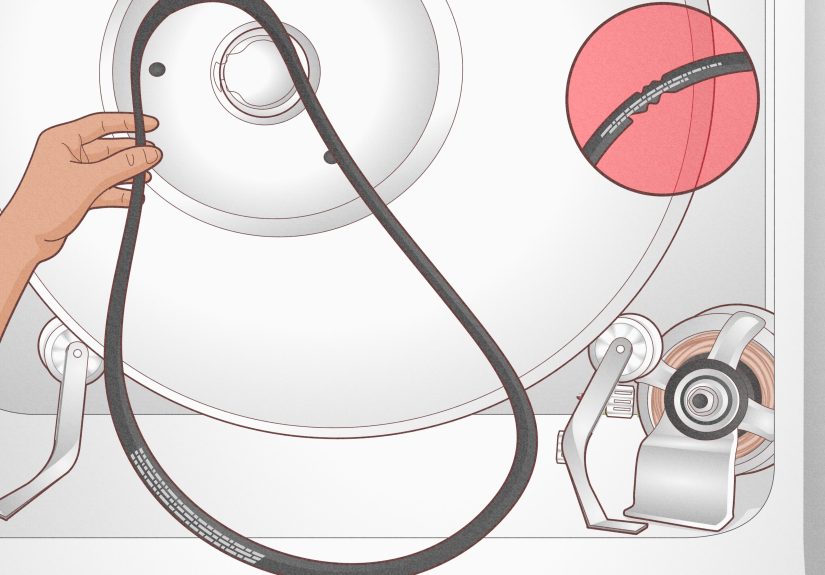
Front-load washers: drive belt and pulley
- Symptoms: motor runs but drum doesn’t, or you hear squealing/slipping.
- What to look for: belt cracks, glazing, looseness, or a belt that’s jumped off the pulley.
Top-load washers: coupler, clutch/splutch, shift actuator, hubs
Many Whirlpool top-load models use components like a clutch/splutch (a shifting clutch mechanism), a shift actuator (switches between agitate and spin),
and hubs that help drive the basket. When these wear out, you might get slow spin, grinding, or “tries to spin but gives up.”
- Symptoms: clicking/grinding, weak spin, intermittent spin, or error behavior during spin transitions.
- Common wear points: splutch/clutch kit, actuator, worn hub teeth.
DIY-friendly approach (realistic version)
- Confirm power is off.
- Remove the back or lower panel as your model allows.
- Visually inspect for a broken belt, loose pulley, shredded rubber, or obvious damage.
- If you see heavy wear or broken parts, use your model number to identify the correct replacement.
If you’re comfortable with basic repairs, replacing a belt or latch can be doable. If you’re not, there’s no shame in calling a probecause
“I fixed it!” is fun, but “I didn’t electrocute myself!” is even better.
Solution #6: Handle Deeper Issues (Suspension, Motor, Control Board) and Know When to Call a Pro
If you’ve done Solutions #1–#5 and your Whirlpool washer still won’t spin, the issue may be beyond simple adjustments and common replaceable parts.
At this point, the washer may be protecting itself from damageor it may have an electrical/mechanical fault that needs proper diagnosis.
Common “deeper” culprits
- Suspension rods/shocks: If the tub bounces excessively, the washer may refuse to spin at full speed.
- Motor or capacitor issues: Weak, intermittent, or non-starting spin can happen when the motor can’t ramp up.
- Main control board or motor control board: If the washer behaves erratically, won’t start cycles, or stops at the same point, controls can be involved.
- Bearings: Loud roaring during spin, plus poor spinning performance, can indicate bearing wear (often a bigger repair).
When it’s time to stop troubleshooting and book service
- You smell burning, see smoke, or hear loud electrical buzzing.
- The breaker trips repeatedly when the washer tries to spin.
- The washer leaks significantly, especially near the pump or bottom pan.
- The drum won’t turn even by hand (with power off) or sounds like rocks in a blender.
- The machine is under warrantydon’t DIY your way out of coverage.
A technician can run diagnostics, read stored error codes, and test components safely with the proper tools. Sometimes the most “budget-friendly”
move is paying for accurate diagnosis instead of playing expensive parts roulette.
Preventing the Next “Wet Laundry Surprise”
- Use HE detergent and measure itmore soap doesn’t mean more clean.
- Don’t overload; heavy items should have space to move.
- Balance bulky loads (wash one comforter with a couple of towels, not a whole wardrobe).
- Check pockets (coins love drain pumps).
- Clean filters if your model has them, and keep the drain hose kink-free.
Conclusion
A Whirlpool washer not spinning can feel like a crisisuntil you remember most spin issues come down to a short list: settings, locks, drainage,
balance, or the drive system. Start simple, test one change at a time, and you’ll usually find the cause without turning your laundry room into
a full-time hobby.
If your washer drains but won’t spin, focus on the lid switch/door lock and drive components. If it won’t drain and spin, chase drainage first.
And if it’s banging like a drumline rehearsal, balance and leveling are your best friends. Your laundry deserves a proper spinpreferably the kind
that ends in clean, damp (not dripping) clothes.
Real-World Spin-Cycle Stories (and What They Teach)
Let’s talk about the part nobody puts in the manual: the human side of a washer that won’t spin. Because the truth is, a spin-cycle failure
rarely happens on a peaceful Tuesday when you’re ahead on chores. It happens when you’re already running late, your favorite hoodie is trapped inside,
and the washer is making a noise that suggests it has strong opinions about your life choices.
One common “story” is the Comforter Catastrophe. Someone washes a king-size comforter in a top-load washer, hears a few thumps,
and assumes it’s fine. Then the machine stops spinning, the load is soaked, and the comforter weighs approximately as much as a small rhinoceros.
The takeaway? Bulky items need room to move, and they often need a matching “buddy” item (like towels) to help balance the drum. If the washer senses
the load is off, it may keep trying to redistribute… and never commit to a full spin. Not because it’s brokenbecause it’s cautious.
Another frequent one is The Mystery of the Vanishing Spin: the washer spins on small loads but fails on larger ones. People often
suspect a failing motor. But more often, it’s simple: the machine is slightly unlevel, and bigger loads amplify the wobble. After a quick adjustment
of the feet, the washer suddenly behaves like it got a personality upgrade. The lesson: a small tilt can create big drama at 800+ RPM.
Then there’s The Coin Heist, where the washer “won’t drain and won’t spin.” The owner checks settings, restarts, mutters a few words
the detergent bottle doesn’t approve ofthen finally opens the drain filter (front-load) or checks the pump area and finds: spare change, hair ties,
and a bobby pin that has apparently been paying rent there for months. The takeaway is brutally practical: pockets are the number-one supplier of
pump clogs. If your washer won’t spin, don’t overlook drainage, because standing water can stop spin cold.
My favorite category is Door Lock Gaslighting. The washer fills, washes, and then acts like the door is open when it clearly isn’t.
Sometimes it’s lint or detergent buildup around the latch. Sometimes the latch is worn and just barely failinglike a doorman who’s decided he’s
“not feeling it tonight.” A quick cleaning can fix it, but if the lock keeps misbehaving, replacing the latch assembly often ends the saga.
Finally, there’s the “It Spins… but Weakly” situation: clothes come out wetter than usual, even though the cycle completes.
That often points to low spin speed settings, an unbalanced load that forced the machine to reduce speed, or a drive component starting to slip.
The practical lesson: if your Whirlpool washer is spinning but leaving clothes too wet, pay attention to whether it’s reaching full speedand
whether it sounds strained doing it.
The big takeaway from all these real-life scenarios is that you don’t need to guess wildly. If you match the symptom to the categorysettings,
locking, drainage, balance, drive systemyou can troubleshoot calmly and methodically. And yes, you’re allowed to celebrate a successful spin cycle
like you just won an Olympic medal. Laundry victory is still victory.