Table of Contents >> Show >> Hide
- The Historical Appeal of 19th Century Swedish Stools
- What Defines a 19th Century Swedish Stool?
- From Gustavian Grace to Folk Practicality
- Common Types of 19th Century Swedish Stools
- Why Paint and Patina Matter So Much
- How These Stools Were Used in Swedish Homes
- How to Identify a Good Antique Swedish Stool Today
- Decorating With 19th Century Swedish Stools in Modern Homes
- Why Collectors and Designers Keep Coming Back to Them
- Conclusion
- Experiences Related to 19th Century Swedish Stools
If ever a piece of furniture deserved a standing ovation while remaining seated, it is the 19th century Swedish stool. Humble? Absolutely. Flashy? Not even a little. But that is exactly the charm. These stools were never trying to be the loudest thing in the room. They were built to work, built to last, and somehow ended up becoming some of the most quietly beautiful antiques you can bring into a modern home.
Part of their appeal lies in contradiction. A Swedish stool from the 1800s can feel rustic and refined at the same time. It may have a thick pine seat, hand-cut legs, old repairs, chipped paint, and enough patina to make a collector grin like they just found treasure at a country sale. Yet it can also carry the elegant restraint associated with Swedish design: soft colors, simple lines, and a sense that decoration should whisper, not shout.
Today, 19th century Swedish stools sit at the crossroads of antique collecting, interior design, and practical living. They work as extra seating, side tables, bedside accents, and sculptural objects that make a room feel more layered and less showroom-perfect. In other words, they are the furniture equivalent of a person who wears old linen beautifully and somehow always knows which bread to order.
The Historical Appeal of 19th Century Swedish Stools
To understand why these stools still matter, it helps to look at the broader story of Swedish furniture. During and after the Gustavian era, Swedish makers adapted European neoclassical ideas into something lighter, more practical, and less grandiose. In country homes and rural workshops, that elegance filtered into everyday objects. Not every stool was a noble piece with carved ribbon details and polished symmetry. Many were straightforward household tools. But even simple examples often reflect the Swedish talent for balancing utility with visual calm.
That balance is what makes 19th century Swedish stools so compelling now. They are not overdesigned. They were built for real rooms, real kitchens, real hearths, and real lives. They belonged in farmhouses, cottages, manor houses, workshops, and bedrooms. Some were plain and sturdy. Some were painted in muted blues, grays, creams, or earthy greens. Some leaned toward folk art, while others carried a softened Gustavian spirit. Together, they tell a story about a culture that valued usefulness but had no objection to beauty tagging along.
What Defines a 19th Century Swedish Stool?
Simple, purposeful form
The first thing you notice about a genuine 19th century Swedish stool is its restraint. These stools were designed to do a job, so their shapes are direct and unfussy. You will often see round, oval, or rectangular seats; straight, splayed, or turned legs; and proportions that feel sturdy rather than delicate. Even the more decorative examples usually avoid unnecessary heaviness.
Natural local woods
Pine shows up again and again in Swedish country furniture from the 19th century, and for good reason. It was widely available, workable, and ideal for practical household furniture. Birch, beech, and other woods also appear, especially in pieces that lean more formal or more urban in character. The result is furniture that often has a warm core under painted finishes, with grain and age showing through just enough to remind you this was once a tree and not a factory strategy.
Visible handcraft
One of the great joys of old Swedish stools is that they often still show the maker’s hand. The joinery may be slightly irregular. The seat may be subtly asymmetrical. Tool marks, old dowels, wear around the edges, and repaired legs are common. These are not flaws to be panicked over. They are evidence of life, use, and survival. In the antique world, perfect can be suspicious. Character is usually the better story.
From Gustavian Grace to Folk Practicality
When people hear “Swedish antique furniture,” they often picture pale Gustavian chairs, elegant benches, and refined neoclassical lines. That tradition matters here, because it shaped the visual language of Swedish interiors well into the 19th century. Yet stools occupied a broader social range than formal seating. They could be deeply rustic, strongly regional, and intensely practical.
That is why 19th century Swedish stools are so interesting as a category. Some examples belong to the world of country folk furniture, where the beauty comes from weathered paint, hand-hewn texture, and blunt utility. Others echo more formal Swedish interiors, especially vanity stools, benches, or upholstered forms that feel closer to neoclassical taste. In between those extremes is a wonderful middle ground: pieces that are modest in construction but unexpectedly graceful in proportion.
Think of Swedish stools as the furniture version of dialects. They all belong to the same language family, but the accent changes depending on region, workshop, household wealth, and intended use.
Common Types of 19th Century Swedish Stools
Three-legged country stools
These are among the most beloved forms. A thick seat set on three legs has a primitive honesty that collectors adore. Three-legged stools also sit well on uneven floors, which was not exactly a minor concern in older rural buildings. Some examples are almost sculptural in their simplicity, while others show traces of paint or carved initials that make them feel intensely personal.
Rectangular plank stools
These stools often have a sturdy farmhouse presence. With a broad seat and solid legs, they feel practical and grounded. They are the kind of pieces that look as though they have held everything from baskets of laundry to tired farmers to a cat that considered itself management.
Painted folk stools
Many surviving Swedish stools retain old paint, and that finish is a large part of their appeal. Blues, dusty greens, muted whites, and soft grays are especially attractive because they fit so naturally into both antique and contemporary interiors. When paint wears away at the edges or reveals earlier layers beneath, the stool gains depth that no modern faux-distressing can quite imitate.
Vanity and hall stools
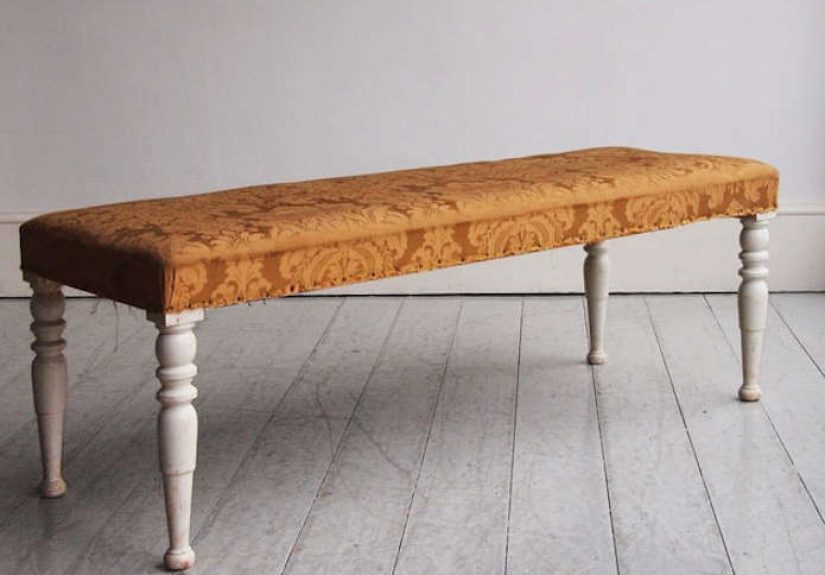
At the more decorative end, some Swedish stools from the 19th century resemble little benches or vanity seats. These may have upholstered tops, shaped aprons, carved details, and a more clearly Gustavian or Empire-influenced profile. They are still practical pieces, but they bring a touch more polish to the room.
Why Paint and Patina Matter So Much
Patina is one of those antique words that gets thrown around a lot, but in the case of 19th century Swedish stools, it truly matters. These pieces were touched constantly. They were moved, stood on, dragged, repainted, repaired, and used in rooms with smoke, sunlight, wool, mud, and daily life. Over time, the surface became layered in a way that cannot be rushed.
Original or early paint is especially prized because it gives the stool emotional temperature. A pale gray stool with rubbed corners feels different from a newly painted reproduction, even if the shapes are similar. The old surface tells you that this piece has already lived a life and is not trying too hard to impress anyone. That is often exactly why it does.
Collectors also appreciate the regional and personal qualities of painted furniture. In Sweden, folk traditions in color and decoration varied widely, and even very simple household objects could carry a local visual identity. Not every stool was ornamented, of course, but even the plain ones often gain richness from age-darkened wood and softened paint layers.
How These Stools Were Used in Swedish Homes
A stool in 19th century Sweden was rarely a one-job object. It could serve at the hearth, the table, the bedside, the work area, or the entry. In smaller homes especially, furniture needed flexibility. A stool might function as a seat one moment and a utility surface the next. It might hold folded textiles, support a wash basin, assist with dressing, or provide a place to pause at the end of a long day.
This versatility is part of why these pieces feel so modern. We still love furniture that earns its keep. In a world where some tables seem designed only to be photographed next to expensive candles, the Swedish stool remains refreshingly honest. It does not ask for applause. It just helps out, looks good, and survives another century.
How to Identify a Good Antique Swedish Stool Today
If you are shopping for one, the best pieces usually share a few traits. First, look at proportion. Swedish stools tend to have a calm sense of balance, even when rustic. Second, study the surface. Old paint, worn edges, and a soft sheen from age are often more desirable than an overly restored finish. Third, inspect the construction. Pegged joints, hand-shaped elements, thick boards, and signs of honest repair can all be positive indicators.
It is also smart to check the underside and the seat. Antique stools often reveal more truth there than on the front-facing side. Is the wood old and dry? Do the joints make sense? Does the wear feel natural? Are there old repairs that show the stool was valued enough to fix instead of discard? Those clues matter.
Some caution is useful too. The popularity of Swedish antiques has encouraged reproductions and heavily refreshed pieces. A stool can still be attractive after restoration, but over-sanded wood, suspiciously uniform distressing, or paint that feels too crisp can reduce authenticity. The goal is not perfection. The goal is integrity.
Decorating With 19th Century Swedish Stools in Modern Homes
One reason these stools remain popular is that they work almost anywhere. In a minimalist room, they add warmth and age. In a traditional room, they add quiet authenticity. In a rustic-modern interior, they are practically overqualified.
Here are a few ways they shine:
- As bedside tables in place of standard nightstands
- Beside a bathtub with folded towels and a candle
- As extra seating in a kitchen or mudroom
- Under a console table for layered texture
- Next to a reading chair with a stack of books
- As a plant stand, provided you promise not to drown it in enthusiasm
They pair beautifully with linen, wool, stone, old brass, pottery, and matte-painted walls. Their muted character makes them easy companions for both antiques and newer pieces. And because they are usually smaller than chairs or benches, they can add age and soul to a room without taking over the whole conversation.
Why Collectors and Designers Keep Coming Back to Them
Designers love 19th century Swedish stools because they solve two problems at once: they are useful, and they soften a room. Collectors love them because no two good examples are exactly alike. Even within similar forms, the differences in paint, wear, carving, and proportion create personality.
There is also a broader design reason for their staying power. Swedish antiques, especially those with Gustavian or folk influence, offer a gentler alternative to heavier European furniture traditions. They bring history without visual noise. They are elegant without looking fragile, country without looking clumsy, and old without looking dusty. That is a very hard balance to achieve, which is probably why the best examples disappear quickly when they hit the market.
Conclusion
19th century Swedish stools prove that small furniture can carry a big story. These pieces reflect a culture shaped by practicality, craftsmanship, regional tradition, and a love of interiors that feel calm rather than crowded. Whether plain and farmhouse-simple or touched by Gustavian refinement, they have an honesty that modern homes still crave.
Their magic is not dramatic. It lives in old paint, balanced proportions, useful size, and the quiet confidence of something made to serve everyday life well. That is why they continue to matter. A good Swedish stool does not merely decorate a room. It steadies it.
Experiences Related to 19th Century Swedish Stools
Living with a 19th century Swedish stool is a different experience from owning most antique furniture because the relationship becomes immediate almost instantly. A large antique cabinet can feel majestic but distant, like it expects a formal introduction before you touch it. A Swedish stool is friendlier. It slips into daily life so naturally that within a week you forget it was ever “styled” and start using it the way people probably did 150 years ago.
One of the first things people notice is scale. These stools are modest, but that modesty is exactly what makes them powerful. You move one beside a chair, and suddenly the room feels more human. You place one by a bed, and it seems less like furniture and more like a quiet companion for a glass of water, a book, or yesterday’s sweater. It does not dominate the space. It simply improves it, which is a rare talent in both furniture and people.
Then there is the tactile experience. Old Swedish stools often have softened edges, dry wood, and worn paint that feels velvety rather than slick. Running your hand across the seat, you can sense where finish has thinned from generations of use. The stool becomes a record of touch. That is part of what makes antiques emotionally satisfying. They remind us that design is not only about appearance. It is also about contact, habit, and use over time.
There is also a surprising emotional comfort in owning something so unpretentious. A 19th century Swedish stool does not make you nervous. You are not terrified to set a folded blanket on it. You do not feel guilty if it gets moved three times in a day. In fact, it seems happiest when it is useful. That practical spirit can subtly change the atmosphere of a room. Spaces begin to feel less staged and more lived in, which is usually when they become most beautiful.
Collectors often talk about the thrill of finding one with the right paint, the right wobble-free stance, the right amount of wear, and that impossible-to-define right feeling. And yes, that feeling is real. Some stools have it and some do not. The best ones seem to hold history without becoming precious. They carry age lightly. They make modern furniture look smarter, and they make imperfect rooms look intentional.
Perhaps the most enjoyable experience of all is that these stools continue to reveal themselves over time. At first you may notice the color. Then the grain under the paint. Then the little repair on one leg. Then the way evening light catches the worn corners. Eventually, the stool stops being a decorative object and becomes part of the home’s rhythm. That may be the finest compliment possible. A 19th century Swedish stool does not just survive into the present. It settles in and gets to work.