Table of Contents >> Show >> Hide
- 1) Use a Rubric (So You’re Scoring Writing, Not Your Mood)
- 2) Review a Portfolio (Because One Sample Can Be a Fluke)
- 3) Give a Realistic Writing Task (Timed, Relevant, and Slightly Uncomfortable)
- 4) Separate “Writing” From “Revising” (Because Editing Is a Different Sport)
- 5) Use Reader-Based Feedback (Peer Review That’s Structured, Not Chaotic)
- 6) Check Consistency With Calibration (So Scores Mean Something)
- Common Mistakes When Evaluating Writing Skills (Avoid These Traps)
- Quick Scorecard: A Simple 10-Minute Evaluation Plan
- Conclusion: Evaluate Writing Like a Coach, Not a Critic
- Real-World Experiences and Scenarios (Extra Insights)
- Scenario 1: The “Great Talker” Who Writes Fog
- Scenario 2: The Strong Drafter Who Refuses to Revise
- Scenario 3: The Clean Writer Who Can’t Organize a Long Piece
- Scenario 4: The Writer Who Sounds Great to One Reader and Confusing to Another
- Scenario 5: The “Tool-Polished” Draft That Still Doesn’t Work
- Scenario 6: Two Evaluators, Two Totally Different Scores
- A practical “best-of-all-worlds” evaluation workflow
Evaluating writing skills sounds simple until you try it. One person says, “This is clear and convincing,” while another says, “This reads like a blender full of commas.”
The truth is: writing quality isn’t a single switch (good/bad). It’s a bundle of skillsthinking, organizing, choosing words, adapting to an audience, and polishing for clarity.
The best evaluations don’t rely on vibes. They use a repeatable process that reveals how someone writes, not just whether you liked the last sentence.
Below are six practical, reliable ways to assess writing abilitywhether you’re hiring, teaching, coaching, or leveling up your own writing.
Each method includes what it measures, how to run it, and specific examples you can copy and use.
1) Use a Rubric (So You’re Scoring Writing, Not Your Mood)
A rubric is a set of criteria that turns “I like it” into “Here’s why it works.” Without one, writing evaluation becomes a talent show judged by three people with three different definitions of “talent.”
With a rubric, you can score consistently across writers, genres, and evaluatorsespecially when multiple people are reviewing the same work.
What a strong writing rubric should include
- Ideas & content: Is there a clear point? Is it accurate, relevant, and meaningful?
- Organization: Does it flow logically with helpful headings, paragraphs, and transitions?
- Audience & purpose: Does the tone match the context (formal report vs. friendly email)?
- Evidence & development: Are claims supported with reasoning, examples, or data when appropriate?
- Style & clarity: Are sentences readable? Is word choice precise (not “nice,” “stuff,” “things,” and other vague houseguests)?
- Conventions: Grammar, spelling, punctuation, and formattingclean enough not to distract.
How to run it
- Pick 5–7 criteria that match the writing you actually need.
- Define performance levels (e.g., 1–4 or 1–5) with short, concrete descriptions.
- Score based on evidence from the text (quote a phrase, point to a paragraph, note a missing transition).
Example (mini rubric you can steal)
Score 1–5 for each category:
- Purpose: Main goal is obvious within the first 2–3 sentences.
- Structure: Clear opening, logical middle, strong close; paragraphs each do one job.
- Clarity: Few “Huh?” moments; sentences are direct and readable.
- Support: Uses examples/details instead of generic claims.
- Polish: Minimal errors; formatting is professional.
Pro tip: If you want to reduce bias, don’t just score the final numberwrite a one-line justification per category (what worked, what didn’t).
That keeps your evaluation anchored to the text instead of your personal relationship with semicolons.
2) Review a Portfolio (Because One Sample Can Be a Fluke)
A single writing sample can be unusually great (they had three coffees and a deadline) or unusually rough (they wrote it on a phone in a parking lot).
Portfolios show consistency, range, and growth. They also reveal whether a writer can adjust tone and structure depending on the situation.
What to look for in multiple samples
- Adaptability: Can they write an email, a short explanation, and a longer piece without sounding like the same robot?
- Consistency: Are strengths and weaknesses repeating across samples?
- Audience awareness: Do they explain terms for beginnersor write for experts when needed?
- Structure: Do they use headings, topic sentences, and logical sequencing?
Portfolio requests that work well
- Short form: One professional email + one 150–300 word explanation for a general audience.
- Longer form: A 600–1,200 word article or report with headings and a conclusion.
- Role-specific: A product description, customer support response, lesson plan, or technical guidewhatever matches the job or goal.
If you’re evaluating students or training writers, portfolio review also helps you score improvement over timeone of the most meaningful measures of writing proficiency.
3) Give a Realistic Writing Task (Timed, Relevant, and Slightly Uncomfortable)
Portfolios show what someone has done. A writing task shows what someone can do now under constraintslike time, word count, a target audience, and a specific objective.
This is especially useful for hiring, promotions, or placement decisions.
Design rules for a fair writing task
- Make it job- or goal-relevant: Test the kind of writing they’ll actually do.
- Set clear constraints: Time limit, audience, tone, and format.
- Provide needed context: Writers shouldn’t fail because you hid the details.
- Score with the same rubric: Keep evaluation consistent across candidates.
Example prompt (works for many roles)
Prompt: “Write a 250–350 word explanation of a new policy for a general audience. Your goal is to reduce confusion and prevent mistakes.
Use a friendly, professional tone. Include a short headline and 3 bullet points.”
What this reveals
- Can they find the main point quickly?
- Can they organize information for scanning readers?
- Can they write clearly without over-explaining?
- Can they maintain tone under time pressure?
Bonus: Add a “plan-first” requirement (2–3 minutes) where they jot a quick outline. Writers who can structure ideas before drafting usually produce cleaner work with fewer “Wait, what was my point?” detours.
4) Separate “Writing” From “Revising” (Because Editing Is a Different Sport)
Some people draft brilliantly but revise poorly. Others draft rough but revise into something sharp.
If you only assess final drafts, you miss an important skill: the ability to improve writing through revision and editing.
Two tasks that work extremely well
- Revision task (big-picture): Give a messy draft and ask the writer to improve clarity, organization, and argument.
They can reorder paragraphs, rewrite a weak introduction, add transitions, and remove fluff. - Proofreading task (polish): Give a clean-ish passage with grammar, punctuation, and formatting issues.
Ask them to correct errors and explain any changes that affect meaning.
How to score revision skill
- Focus: Did they clarify the main idea and keep the writing on track?
- Organization: Did they improve flow and transitions?
- Support: Did they add examples or tighten weak claims?
- Efficiency: Did they remove filler rather than decorate it?
A simple way to make this measurable: ask them to submit “before/after” plus a short note titled “What I changed and why.”
That reveals their judgmentnot just their grammar.
5) Use Reader-Based Feedback (Peer Review That’s Structured, Not Chaotic)
Writing is communication, which means it only “works” if readers understand it.
Reader-based evaluation asks: What did the reader think the writer meant? That’s powerfulbecause confusion is evidence.
A peer review structure that doesn’t devolve into “Looks good!”
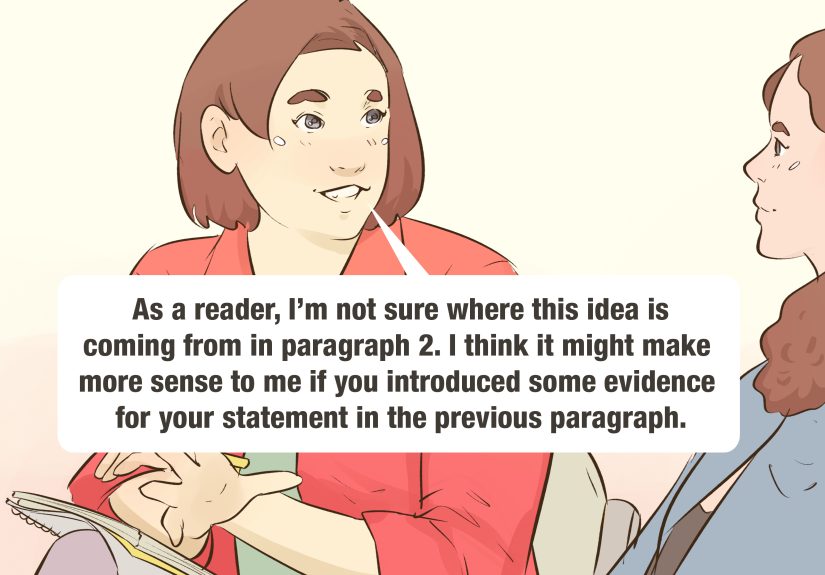
- Summarize: “Here’s what I think your main point is…”
- Identify clarity gaps: “I got lost in paragraph 3 because…”
- Evaluate using the rubric: “Your evidence is strong, but the organization jumps…”
- Suggest next steps: “Consider moving X earlier, adding a heading, or defining Y.”
Make peer review measurable
- Comprehension check: Ask reviewers to answer 3 questions (What’s the goal? Who’s the audience? What should the reader do next?).
- Heat-map confusion: Reviewers mark the exact sentence where they got confused.
- One best fix: Reviewers must propose one change that would create the biggest improvement.
This method is especially useful for evaluating audience awareness, clarity, and logical flowareas that grammar checkers can’t reliably judge.
6) Check Consistency With Calibration (So Scores Mean Something)
If two evaluators read the same piece and give wildly different scores, your process needs calibration.
Consistent scoring is how you turn writing evaluation into a dependable system rather than a literary coin toss.
How to calibrate evaluations
- Use anchor samples: Keep a few “benchmark” writing pieces at each score level so evaluators can compare.
- Score together first: Have evaluators rate 2–3 samples and discuss why they scored them that way.
- Double-score occasionally: Two people score the same piece, then reconcile differences.
- Track patterns: If one evaluator always scores “conventions” harshly, adjust training or clarify rubric language.
Calibration is not just for big standardized tests. Even a small team hiring writersor a department grading student essaysgets better results when everyone agrees on what “good” looks like.
Common Mistakes When Evaluating Writing Skills (Avoid These Traps)
- Overweighting grammar: A clean sentence with no point is still not effective writing.
- Ignoring the audience: Writing can be “correct” and still fail if the reader can’t use it.
- Grading only the final draft: You miss revision skill, which is often the difference between average and excellent.
- Using vague feedback: “Be clearer” isn’t guidance. Point to the sentence and explain what’s missing.
- Letting tools do the thinking: Automated feedback can help polish, but it can’t guarantee strong reasoning or structure.
Quick Scorecard: A Simple 10-Minute Evaluation Plan
If you need a fast, practical method (without building a 12-page rubric), try this:
- One sample: 400–700 words in a realistic genre (email, memo, short article).
- One revision pass: Ask for a tighter version (cut 15–25% without losing meaning).
- Score 5 categories (1–5): Purpose, Organization, Clarity, Support, Polish.
- One reader check: A second person writes a one-sentence summary of the main point.
This approach is lightweight but still reveals the core: can the writer communicate clearly, structure ideas logically, and improve with revision?
Conclusion: Evaluate Writing Like a Coach, Not a Critic
The best way to evaluate writing skills is to combine methods. Use a rubric to stay consistent. Review multiple samples to see range.
Add a realistic writing task to observe performance under constraints. Test revision and proofreading separately.
Include reader-based feedback to measure clarity, and calibrate evaluators so scores stay fair and meaningful.
Writing is a craftpart thinking, part structure, part language, part polish. When your evaluation reflects that reality, you get results you can trust.
And you’ll stop hiring (or grading) people based on whether you personally enjoy their relationship with em dashes.
Real-World Experiences and Scenarios (Extra Insights)
Here are practical “in the wild” experiences and scenarios that show how these six evaluation methods play out in real life. They’re useful because writing doesn’t happen in a vacuum.
It happens in classrooms, workplaces, group projects, and inboxes where someone is always skimming with one eyebrow raised.
Scenario 1: The “Great Talker” Who Writes Fog
A hiring team interviews a candidate who explains ideas clearly out loud. Everyone leaves the room thinking, “Smart person.”
Then the writing sample arrives, and it’s a gentle blizzard of abstract phrases: “leveraging synergistic solutions” with no concrete details.
A rubric helps here because it forces you to score what matters:
purpose (unclear), support (weak), and clarity (low), even if the writer sounds confident in conversation.
A realistic writing tasklike a 300-word customer explanation with a specific goalusually reveals whether the writer can translate ideas into usable language.
Scenario 2: The Strong Drafter Who Refuses to Revise
In many teams, the biggest writing bottleneck isn’t draftingit’s revision. You’ll see someone produce a fast first draft that’s “pretty good,”
then fight every suggested change like the draft is a sacred artifact discovered in a pyramid.
A revision task exposes this quickly. When you ask for a tighter version (cut 20% while improving clarity),
strong revisers will sharpen sentences and reorganize ideas. Weak revisers will mostly swap synonyms and call it a day.
If your organization values collaboration, the “what I changed and why” note is goldit reveals mindset, not just mechanics.
Scenario 3: The Clean Writer Who Can’t Organize a Long Piece
Some writers produce grammatically clean paragraphs but struggle with longer structure: reports that wander, articles with five introductions, or memos that bury the point until the reader is old enough to retire.
Portfolio review across formats helps catch this. A short email sample might look excellent, while a 900-word explainer shows weak organization and thin transitions.
The fix isn’t always “write better”it’s “outline better.” That’s why requiring a brief outline during a timed task can be revealing:
writers who can map structure early typically create clearer long-form work.
Scenario 4: The Writer Who Sounds Great to One Reader and Confusing to Another
Reader-based feedback is your reality check. If one reviewer says “super clear” and another says “I got lost halfway,” don’t average the opinionsinvestigate the confusion points.
Have reviewers highlight the exact sentence where meaning breaks. Often the issue is missing context, undefined terms, or assumptions about what the reader already knows.
Peer review becomes especially powerful when reviewers must write a one-sentence summary of the main point.
If those summaries don’t match, the writing may be elegant but ineffective.
Scenario 5: The “Tool-Polished” Draft That Still Doesn’t Work
Modern writing tools can clean grammar, fix typos, and suggest rewrites. That’s helpfulbut it can also create false confidence.
A draft can be spotless and still fail because the argument is thin, the evidence is missing, or the call-to-action is unclear.
That’s why evaluation should always include higher-level criteria like purpose, organization, and developmentnot just conventions.
A strong rubric keeps tools in their proper role: polish assistants, not thinking substitutes.
Scenario 6: Two Evaluators, Two Totally Different Scores
This is the moment teams realize they don’t have a writing evaluation systemthey have a writing opinion festival.
Calibration solves it. When evaluators score the same anchor samples and discuss why,
they build a shared definition of “strong organization” or “adequate support.”
Double-scoring a small percentage of work (even 10–20%) keeps things honest and helps you spot drift over time.
The result: decisions that writers perceive as fair, and feedback that is actually useful.
A practical “best-of-all-worlds” evaluation workflow
- Start with a rubric: Keep it simple (5–7 criteria) and relevant.
- Collect 2–3 samples: Different genres or audiences.
- Add a short timed task: Realistic scenario, clear constraints.
- Include a revision step: Ask for a tighter, clearer second version.
- Use one reader check: Summary + confusion highlights.
- Calibrate if multiple evaluators: Anchor samples + occasional double scoring.
If you do nothing else, do this: evaluate writing based on evidence in the text and the needs of the audience.
That single shift improves hiring decisions, classroom feedback, and professional developmentbecause it treats writing as communication, not decoration.