Table of Contents >> Show >> Hide
- Who Is Iiu Susiraja?
- Why Are Iiu Susiraja’s Self Portraits Considered Controversial?
- The Power of the Deadpan Face
- Domestic Space as a Stage
- Body Image, Beauty Standards, and the Viewer’s Problem
- Famous Motifs in Iiu Susiraja’s Self Portrait Photography
- Is Iiu Susiraja Making Fun of Herself?
- Why Her Work Matters in the Age of Selfies
- Critical Reception and Museum Recognition
- How to Read Iiu Susiraja’s Images Without Flattening Them
- Experiences and Reflections Related to Iiu Susiraja’s Controversial Self Portraits
- Conclusion: Why Iiu Susiraja’s Self Portraits Still Hit a Nerve
Some artists whisper. Iiu Susiraja walks into the room, places a household object where no household object has emotionally prepared us to see it, stares straight into the camera, and lets the silence do the heavy lifting. The Finnish photographer and video artist, born in 1975 in Turku, Finland, has built an internationally recognized body of work around self-portraits that are funny, uncomfortable, blunt, theatrical, and oddly tender all at once.
Her images are often described as controversial because they refuse the usual rules of self-presentation. There is no soft filter, no flattering angle, no “just woke up like this” lie polished into perfection. Instead, Susiraja photographs herself in domestic interiors with objects such as food, cleaning tools, clothing, toys, exercise equipment, and other everyday items. The results can look absurd, comic, grotesque, vulnerable, or all four before breakfast.
But calling her work merely shocking misses the point. Susiraja’s controversial self portraits are not cheap provocation. They are carefully staged confrontations with beauty standards, femininity, body image, domestic labor, shame, comedy, and the strange theater of being looked at. In a culture where the body is constantly edited, branded, measured, and judged, Susiraja’s art arrives like a deadpan weather report from reality: cloudy, strange, and impossible to ignore.
Who Is Iiu Susiraja?
Iiu Susiraja is a Finnish artist based in Turku, Finland, known primarily for photographic and video-based self-portraiture. Her practice developed around the late 2000s, and she has since become an important voice in contemporary photography. She earned an MFA from the Finnish Academy of Fine Arts in 2018 and has exhibited widely, including at the Museum of Contemporary Art Kiasma in Helsinki and MoMA PS1 in New York.
Her 2023 MoMA PS1 exhibition, A style called a dead fish, marked her first solo museum exhibition in the United States. The show gathered photographs and videos made over roughly fifteen years, presenting Susiraja as an artist whose visual language is instantly recognizable: domestic rooms, ordinary props, frontal poses, bodily awkwardness, and a face so expressionless it could win a staring contest with a refrigerator.
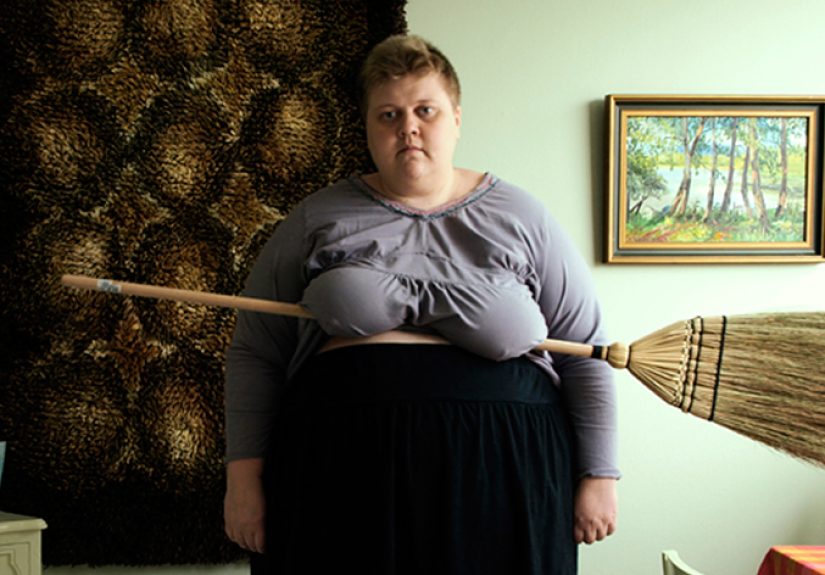
Although she appears in her own photographs, Susiraja’s images are not traditional self-portraits in the “this is who I am” sense. They are closer to performances made for the camera. The artist becomes subject, object, actor, prop manager, comedian, sculptural material, and director. The home becomes a studio. A broom becomes a weaponized joke. A loaf of bread becomes a psychological event.
Why Are Iiu Susiraja’s Self Portraits Considered Controversial?
The controversy around Iiu Susiraja’s self portraits comes from how directly they challenge the viewer’s expectations. Most people are trained to expect photographic self-portraiture to flatter, confess, seduce, empower, or decorate. Susiraja does none of those things neatly. Her work asks a more dangerous question: what happens when a woman refuses to perform beauty correctly?
Her body is central to the work, but not in a way that invites easy slogans. The images are not simple body-positive posters, nor are they self-deprecating jokes. They sit in an uneasy middle ground where the viewer must examine why a pose feels funny, why a body feels “wrong” to some eyes, why a kitchen can feel like a stage, and why a blank expression can feel more confrontational than a scream.
Susiraja often uses food, clothing, and household items in ways that disrupt their normal meaning. Sausages may become ankle weights. A broom may become an absurd extension of the body. A piece of bread may become both nourishment and accusation. These objects are familiar enough to feel harmless, but in her photographs they turn mutinous. The everyday object stops behaving. The viewer, politely sipping coffee, suddenly has to think.
The Power of the Deadpan Face
One of Susiraja’s most powerful tools is her expression. She often looks directly at the camera without smiling, winking, or explaining the joke. This deadpan style creates tension. Is the image funny? Yes. Is it sad? Possibly. Is it angry? Maybe. Is the artist making fun of herself, us, or the entire history of respectable domestic interiors? The answer is: sit with it.
Her blank face gives the viewer no instructions. In advertising, women’s faces are usually asked to sell a mood: desire, softness, confidence, youth, luxury, effortlessness. Susiraja’s face sells nothing. That refusal is radical. She does not rescue the viewer from discomfort by becoming charming. She does not soften the absurdity with a grin. She simply appears, lets the object do its strange work, and keeps control of the frame.
This is why the humor lands with such force. A comedian usually times a punchline; Susiraja often removes the punchline and leaves the audience alone with the setup. The result is dry, awkward, and memorable. It is visual comedy with a poker face.
Domestic Space as a Stage
Many of Susiraja’s photographs are made in ordinary interiors, including her own home or family spaces in Turku. These rooms matter. They are not neutral backgrounds; they are part of the performance. Kitchens, bedrooms, living rooms, patterned wallpaper, furniture, tablecloths, appliances, and exercise equipment all become visual partners in the work.
The domestic setting adds a sharp feminist edge. Homes are often idealized as places of comfort, care, and privacy. Susiraja turns the home into a laboratory of strangeness. She takes the objects associated with chores, eating, grooming, and family life and repositions them into scenes that feel half-slapstick, half-ritual.
In many images, she appears alone. That solitude intensifies the feeling that we are seeing a private act made public. Yet the photographs are not casual snapshots. They are staged, selected, and controlled. The privacy is real, but it is also constructed. Susiraja invites us in, then makes sure we do not get too comfortable on the sofa.
Body Image, Beauty Standards, and the Viewer’s Problem
Any serious analysis of Iiu Susiraja’s photography must address body image. Her plus-size body is visible, central, and unhidden. In an image economy obsessed with thinness, polish, and optimization, that visibility is automatically political, whether the viewer wants to admit it or not.
However, the complexity of her work lies in the fact that it does not reduce her body to a message. The photographs do not simply say, “All bodies are beautiful,” although they certainly resist narrow beauty norms. Instead, they ask why beauty has to be the entry ticket at all. What if a body in art is allowed to be strange, bored, hilarious, uncomfortable, powerful, awkward, and ordinary without asking permission to be considered beautiful?
That question is what makes the work sting. Viewers may initially laugh at a bizarre prop or pose, then realize the laugh has revealed something about their own assumptions. Susiraja’s art is generous enough to be funny, but sharp enough to make the joke look back at us.
Famous Motifs in Iiu Susiraja’s Self Portrait Photography
Food as Prop and Punchline
Food appears frequently in Susiraja’s work: bread, sausages, chocolate, hotdogs, bananas, pizza-like forms, and other edible objects become visual tools. These items bring associations of appetite, domesticity, shame, pleasure, consumption, and social judgment. In her photographs, food is rarely just food. It becomes costume, burden, gag, sculpture, or symbol.
This is one reason the images can feel controversial. Food and the female body are already heavily policed in popular culture. Susiraja places those pressures in the open and makes them ridiculous. She shows how absurd it is that a sausage, a loaf, or a smear of dessert can carry so much cultural baggage. The grocery aisle has apparently been holding graduate-level theory seminars behind our backs.
Cleaning Tools and Household Objects
Cleaning utensils, brooms, plungers, tablecloths, and other domestic objects often appear in her scenes. These objects carry associations with labor, order, hygiene, and traditional femininity. Susiraja disrupts those meanings by wearing, holding, trapping, or staging them against her body.
The effect is comic but unsettling. A broom no longer cleans. A tablecloth no longer decorates. A household object becomes an accomplice in a visual rebellion against the tidy fantasy of domestic womanhood.
Exercise Equipment and the Performance of Health
Susiraja has also used exercise equipment in images that poke at the culture of fitness, discipline, and body correction. In these scenes, the machine does not simply represent health. It becomes part of a larger joke about how society turns the body into a project that must always be improved, reduced, tightened, or displayed.
Her presence on or near these machines is not motivational in the usual glossy sense. There are no inspirational captions, no sunrise, no “new year, new me” energy. Instead, the images question why bodies are expected to justify themselves through effort.
Is Iiu Susiraja Making Fun of Herself?
This is one of the most common questions viewers ask, and it is also one of the least useful if answered too quickly. Susiraja’s work uses humor, but it does not feel like surrender. She may place herself in absurd situations, but she controls the camera, the composition, the props, and the terms of looking.
There is a difference between being mocked and using mockery as a weapon. Susiraja’s images often appear to flirt with embarrassment, then reverse the direction of embarrassment back toward the viewer. If we feel awkward, the photograph does not apologize. It simply waits.
That waiting is part of the art. Susiraja does not over-explain herself. She leaves room for contradiction. The images can be comic and dignified, grotesque and elegant, private and public, vulnerable and commanding. They are not interested in becoming easy inspirational content. Thank goodness. The internet has enough inspirational content wearing beige linen and holding oat milk.
Why Her Work Matters in the Age of Selfies
The title “Controversial Self Portraits By Finnish Photographer Iiu Susiraja” naturally invites comparison with selfie culture. After all, both involve the artist turning the camera on herself. But Susiraja’s photographs are almost the anti-selfie. They resist the logic of digital approval.
Most selfies are built around control: best angle, best face, best lighting, best version of the self. Susiraja also controls her images, but she uses control to create discomfort rather than perfection. Her self-portraits do not ask to be liked. They ask to be seen.
That distinction matters. In social media culture, people often learn to edit themselves into acceptable shapes before they appear in public. Susiraja’s work exposes the weirdness of that process. She does not reject performance; she exaggerates it until the performance becomes visible. Her photographs remind us that every image of the self is staged in some way. The difference is that Susiraja lets us see the stage lights, the props, and the absurdity of the whole production.
Critical Reception and Museum Recognition
Susiraja’s reputation has grown steadily through exhibitions, gallery presentations, critical essays, and museum shows. Her work has been shown in Finland and internationally, and her presence at MoMA PS1 introduced many American viewers to the breadth of her photographic and video practice.
Critics have noted her unusual balance of humor and discomfort. Some emphasize the feminist and body-politics dimensions of the work. Others focus on the formal qualities: composition, repetition, staging, color, and the transformation of everyday objects into visual symbols. The strongest readings understand that Susiraja’s art is not one-note. It is not only about fatness, not only about domesticity, not only about absurdity, and not only about comedy. It is about how all those forces collide in the act of looking.
Her photographs also belong to a broader history of artists who use their own bodies to question identity, gender, power, and representation. Yet Susiraja’s tone is unmistakably her own. Her images do not beg for empathy. They do not perform wounded sincerity. They stand there, weird and exact, like a joke told by someone who refuses to laugh first.
How to Read Iiu Susiraja’s Images Without Flattening Them
The best way to approach Susiraja’s work is to resist quick moral labeling. It is tempting to decide immediately that an image is empowering, disturbing, feminist, grotesque, comic, or controversial. It may be all of these. It may also be something less convenient.
Start with what is visible. Notice the room. Notice the object. Notice where the object touches or interrupts the body. Notice the artist’s expression. Notice whether the scene feels staged, accidental, theatrical, or ritualistic. Then notice your own reaction. Did you laugh? Did you look away? Did you feel protective, judgmental, amused, confused? Susiraja’s work often happens in that second stage, when the viewer begins watching themselves watch.
This is why her images endure beyond their initial shock. A strange photograph may grab attention for a moment. A strong photograph keeps changing the longer you sit with it. Susiraja’s best works do exactly that. They begin as visual oddities and slowly become mirrors with excellent comic timing.
Experiences and Reflections Related to Iiu Susiraja’s Controversial Self Portraits
Encountering Iiu Susiraja’s controversial self portraits can feel like walking into a room where the furniture has developed opinions. At first, the viewer may notice the obvious absurdity: the strange prop, the direct stare, the domestic setting turned slightly sideways. Then, after the initial surprise fades, the deeper experience begins. The image starts asking why it felt surprising in the first place.
For many viewers, Susiraja’s work brings up memories of private awkwardness: the strange things people do at home when nobody is watching, the unglamorous rituals of getting dressed, eating, cleaning, resting, stretching, failing to exercise, or staring into the middle distance while holding a snack with too much emotional significance. Her photographs make private absurdity public, but they do so without turning it into confession. That is part of their brilliance.
There is also a powerful viewing experience around discomfort. In a gallery, people may laugh quietly, then stop themselves. They may wonder whether laughing is allowed. That hesitation is productive. Susiraja’s art does not provide a safe instruction manual for reaction. Instead, it asks the viewer to take responsibility for interpretation. If an image feels comic, why? If it feels embarrassing, for whom? If it feels rebellious, what rule has been broken?
Writers, photographers, and artists can learn a great deal from her method. First, she proves that originality does not always require exotic locations or expensive production. A room, a body, a camera, daylight, and one stubbornly ordinary object can become enough. Second, she shows the value of consistency. Her repeated use of domestic interiors, frontal composition, deadpan expression, and awkward props creates a world with its own grammar. You recognize a Susiraja image not because it repeats the same joke, but because it repeats a way of thinking.
Her work also offers a useful lesson for anyone living under the pressure of constant self-branding. We are often encouraged to present ourselves as polished, productive, attractive, and emotionally well-lit. Susiraja’s photographs suggest another possibility: the self does not need to become a lifestyle product. The self can be confusing. The self can be funny without being cute. The self can occupy space without apologizing, explaining, or shrinking.
That does not mean everyone must imitate her visual language. Please do not tape sausages to your ankles at brunch unless the brunch is conceptually prepared. But her courage as an artist can inspire a broader creative attitude: look at ordinary materials differently, distrust easy beauty, and allow humor to become a serious tool. Susiraja’s images remind us that art can be intelligent without being chilly, funny without being shallow, and uncomfortable without being cruel.
Perhaps the most lasting experience of her work is the feeling that the image has refused to behave. The object refuses its function. The body refuses idealization. The face refuses expression. The home refuses comfort. The photograph refuses easy meaning. In that refusal, Susiraja creates a strange freedom. She does not ask viewers to agree with her, admire her, or even understand her immediately. She asks them to look, and then to notice what looking reveals.
Conclusion: Why Iiu Susiraja’s Self Portraits Still Hit a Nerve
Iiu Susiraja’s controversial self portraits matter because they challenge the polite lies of visual culture. They reject the idea that women’s bodies must be decorative, that homes must be tidy stages of virtue, that humor must be harmless, and that self-portraits must flatter the self. Her work is funny, but the laughter has teeth. It is vulnerable, but never helpless. It is strange, but never random.
By using her own body, domestic spaces, and everyday objects, Susiraja transforms ordinary life into a theater of resistance. She makes viewers confront beauty standards, body politics, femininity, privacy, shame, and the absurd demands of self-presentation. Her photographs do not offer easy comfort. They offer something better: a chance to see how much cultural noise surrounds the simple act of a person standing in a room.
In the end, the controversy is not just in the images. It is in us. Susiraja’s camera points at herself, but the work looks back at the viewer. That is why her self-portraits linger long after the first laugh, the first wince, or the first confused “what exactly am I looking at?” They are not merely controversial photographs. They are small, deadpan revolutions staged in domestic rooms, using the materials of daily life and the fearless logic of an artist who knows that the truth can be very funny when it refuses to dress up.