Table of Contents >> Show >> Hide
- The Big Idea: Clean + Safe Water Comes From Three Things
- Your “Don’t Panic” Quick-Start Checklist
- Tools You’ll Actually Use (and Not Regret Buying)
- The Cleaning Routine That Keeps Water Clear
- Water Testing: The Part That Keeps the Water Safe
- Vacuuming and Brushing: The “Elbow Grease” That Prevents Algae
- Filter Care: Where Cloudy Water Goes to Get Un-Cloudy
- “Shock,” Superchlorinate, or Just… Clean Better?
- Keeping the Water Safe for Swimmers (Not Just Pretty)
- Pool Chemical Safety: Keep the Water Safe Without Gassing Yourself
- Physical Safety Bonus Round: Drains, Covers, and Common-Sense Layers
- When to Call a Pro (Because “DIY” Has Limits)
- Conclusion: A Clean Pool Is a System, Not a Single Product
- Experiences From the Real World: What Pool Owners Commonly Run Into (and How They Solve It)
A clean pool is basically a tiny outdoor science labexcept your reward is cannonballs, not a Nobel Prize.
The good news: once you understand the handful of “levers” that control water quality, pool cleaning stops
feeling like a mystery and starts feeling like a routine you can run on autopilot.
This guide breaks pool care into simple, repeatable steps (with the “why” explained in plain English), so you can
keep your pool sparkling, your water safe, and your weekend plans intact.
The Big Idea: Clean + Safe Water Comes From Three Things
If pool water gets gross, it’s almost always because one of these three pillars slipped:
- Circulation (moving water so sanitizer reaches everywhere)
- Filtration (removing particles so water stays clear)
- Chemistry (keeping disinfectant effective and water comfortable)
Skimming and vacuuming handle the visible mess. Water testing and balancing handle the invisible messthe germs and
chemistry issues you can’t spot until your eyes start stinging or the water turns “mountain-lake green.”
Your “Don’t Panic” Quick-Start Checklist
If you want the shortest path to a cleaner pool, do these in order:
- Skim the surface and empty the skimmer baskets.
- Brush walls, steps, and corners (algae loves corners like cats love boxes).
- Vacuum the floor (manual or robot) and net out big debris.
- Run the pump long enough for good turnover, especially after heavy use or storms.
- Test the water, then adjust pH and sanitizer first.
- Clean/backwash the filter when pressure rises or flow drops.
That’s the core loop. Everything else is a “situational tool,” not a daily requirement.
Tools You’ll Actually Use (and Not Regret Buying)
Must-haves
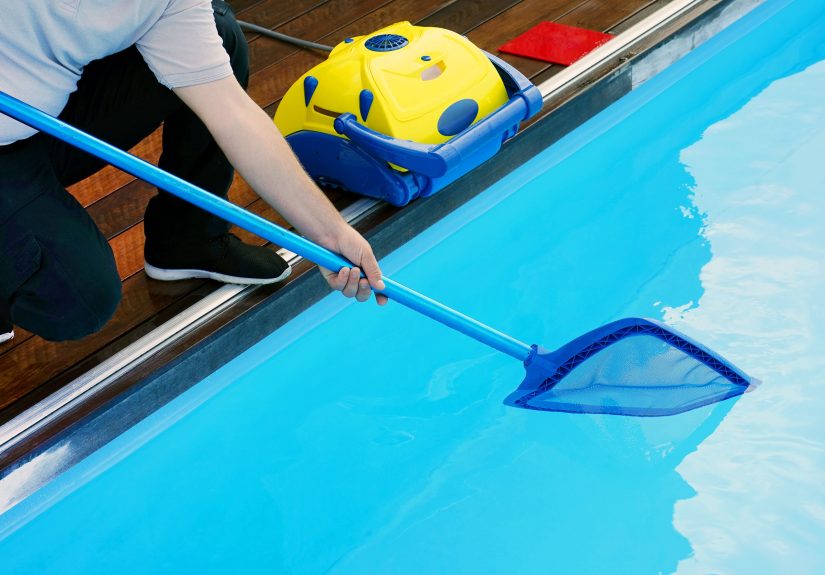
- Telescoping pole + leaf net (surface skimming and “retrieving mysterious objects”)
- Pool brush matched to your surface (plaster, vinyl, fiberglass each have different needs)
- Vacuum setup or an automatic/robot cleaner
- Reliable test kit or test strips (kits often give more precise readings)
- Filter pressure gauge (most systems have onedon’t ignore it)
Nice-to-haves
- Fine-mesh skimmer sock (helps catch smaller debris before it hits the filter)
- Wall brush for tile line (keeps sunscreen/scum from becoming modern art)
- Leaf rake (for fall and post-storm cleanups)
The Cleaning Routine That Keeps Water Clear
Daily (or every swim day)
- Skim the surface: Leaves and bugs steal chlorine and cloud water as they break down.
- Check water clarity: If you can’t clearly see the deepest area, pause swimming and troubleshoot.
- Quick look at equipment: Any strange noises, leaks, or low flow should be handled early.
Weekly
- Brush walls, steps, and around ladders/returns to knock biofilm loose.
- Vacuum to remove settled debris (manual vacuuming is usually slow, steady, overlapping passes).
- Empty baskets (skimmer and pump basket) so circulation doesn’t choke.
- Test and balance water (more on ranges below).
Monthly (or as needed)
- Deep-clean the filter based on type and pressure trends.
- Inspect return jets and confirm strong flow.
- Check “slow movers” like calcium hardness and stabilizer (cyanuric acid) if you use it.
This cadence lines up with common maintenance guidance: remove debris, vacuum, adjust chemicals, and keep filtration
working efficiently. The key is consistencytiny chores beat big emergencies every time.
Water Testing: The Part That Keeps the Water Safe
“Clean” water can still be unsafe if sanitizer is too low or pH is out of range. That’s why testing matters.
CDC guidance for home pools emphasizes maintaining appropriate pH and disinfectant levels so chlorine can do its job.
Target ranges (common U.S. guidance)
Exact targets can vary by pool type, surface, and local guidance. Use your product labels and test kit instructions,
but these ranges are widely referenced in U.S. public health materials and industry standards:
| Parameter | Typical target | Why you care |
|---|---|---|
| Free chlorine (pool) | At least 1 ppm (often ~1–4 ppm) | Kills germs; too low increases illness risk and algae growth |
| Free chlorine (pool with cyanuric acid) | At least 2 ppm in pools (per CDC home guidance) | Stabilizer protects chlorine from sunlight but can slow disinfection if mismanaged |
| pH | ~7.0–7.8 (many aim 7.2–7.6) | Out-of-range pH reduces sanitizer effectiveness and can irritate eyes/skin |
| Total alkalinity | Often ~80–120 ppm | Buffers pH so it doesn’t swing wildly |
| Calcium hardness | Often ~200–400 ppm (varies by surface) | Too low can be corrosive; too high can cause scale/cloudiness |
| Cyanuric acid (stabilizer, if used) | Commonly ~30–50 ppm (outdoor pools) | Prevents UV chlorine loss; too high can reduce chlorine’s speed/effectiveness |
CDC recommends keeping pool pH in range (roughly 7.0–7.8) and maintaining at least 1 ppm free chlorine in pools
(and higher in hot tubs). If you use cyanuric acid or stabilized chlorine products, CDC advises at least 2 ppm
free chlorine in pools and recommends avoiding cyanuric acid in hot tubs.
How to adjust without turning it into a chemistry soap opera
- Fix pH before you chase everything else: Sanitizer works better when pH is in range.
- Then fix sanitizer: Bring free chlorine up to your target and keep it there consistently.
- Then buffer (alkalinity): If pH keeps bouncing, alkalinity may need attention.
- Then calcium and stabilizer: These are important, but they usually change slowly.
Example: “My chlorine is fine, but it smells like chlorine.”
That sharp “pool smell” often comes from chloramines (combined chlorine), which build up when chlorine reacts with sweat,
urine, and other contaminants. The fix is usually better swimmer hygiene (shower before swimming), proper filtration,
and oxidizing/“shocking” according to product directionsnot simply dumping more chlorine and hoping for the best.
Vacuuming and Brushing: The “Elbow Grease” That Prevents Algae
Brush first, vacuum second
Brushing knocks algae and biofilm off surfaces so your filter and sanitizer can actually deal with it.
If you vacuum without brushing, you may leave the clingy stuff behind (algae’s favorite hobby is “gripping”).
Manual vacuuming: slow wins
A good manual vacuum pass looks like mowing a lawn: slow, overlapping lines, and no sudden jerks that kick debris back up.
Many step-by-step guides recommend brushing and skimming first, assembling the vacuum, removing air from the hose, then
vacuuming steadily.
Robots and automatic cleaners
Automatic cleaners can save time, but don’t fully replace brushing. Steps, corners, and waterlines still need occasional
manual attention.
Filter Care: Where Cloudy Water Goes to Get Un-Cloudy
Your filter is basically a bouncer for tiny particles. If the bouncer is asleep, the party gets out of hand.
A simple rule: when filter pressure rises noticeably above clean baseline, it’s time to clean/backwash.
Cartridge filters
- Remove and rinse cartridges thoroughly (top to bottom between pleats).
- For deeper cleans, use a filter cleaner per label directions (and rinse extremely well afterward).
- Let cartridges dry if recommended by the manufacturer (some debris releases better when dry).
Many manufacturer resources stress regular cleaning for performance and water clarity.
Sand filters (backwashing)
Backwashing reverses flow to flush trapped debris out of the sand bed. A common step sequence is:
pump off, set valve to backwash, pump on until water clears, pump off, rinse briefly, then return to “filter.”
Always discharge appropriately and follow your system’s instructions.
D.E. filters
D.E. filters can provide very fine filtration, but they require careful maintenance and proper handling of D.E. media.
Follow manufacturer instructions and local disposal rules.
“Shock,” Superchlorinate, or Just… Clean Better?
“Shocking” generally means raising chlorine high enough to oxidize contaminants and break down chloramines.
It can help after heavy swim days, storms, or early algae signsbut it’s not a substitute for routine maintenance.
When shocking helps
- Water looks dull even though the filter runs
- Strong “chlorine smell” and eye irritation (often chloramines)
- Early algae (slippery walls, green tint)
- After unusually heavy use or a big rainstorm
Important safety note
Follow product label directions carefully, and keep swimmers out until levels return to the normal operating range.
Some public health materials note that elevated chlorine levels can require closure until water returns to standard levels.
Special case: fecal incidents and Cryptosporidium
For public pools, CDC materials define hyperchlorination for high-risk contamination events (like diarrheal incidents) as
raising free chlorine substantially and holding it for a specific time (a “CT” value). This is more of a commercial/public-pool
protocol, but it’s worth knowing that certain germs (like Crypto) are much more chlorine-tolerant and require more aggressive
response strategies in regulated settings.
Keeping the Water Safe for Swimmers (Not Just Pretty)
Swimmer hygiene is pool chemistry’s secret sidekick
- Shower before swimming (less sweat and “personal care product soup” for chlorine to fight).
- Take bathroom breaks and keep kids in properly fitted swim diapers.
- Don’t swim when sick with diarrhea (especially important for preventing spread of Crypto).
- Don’t swallow pool water (it’s not a sports drink, no matter how refreshing it looks).
Clarity is a safety feature
Water should be clear enough to see the bottom of the pool. Clear water helps you spot hazards and is also a practical
signal that filtration and maintenance are working.
Pool Chemical Safety: Keep the Water Safe Without Gassing Yourself
Pool chemicals are helpful when used correctly and hazardous when treated like “just another cleaning supply.”
The biggest safety rules are simpleand worth repeating because they prevent real injuries.
The rules that prevent the “why does my garage smell like a disaster?” moment
- Never mix chemicals (especially chlorine products with acid).
- Handle chemicals in a well-ventilated area and use recommended PPE (gloves/eye protection).
- Open one container at a time and close it before opening another.
- If pre-dissolving is required: add chemical to waternever water to chemical.
- Store chemicals securely in original containers, away from kids/pets and incompatible products.
If your pool uses automated chemical feeders, follow maintenance protocols that prevent accidental mixing in the feed system.
Chemical safety is not just “common sense”it’s a set of habits that keeps small mistakes from turning into emergency-room stories.
Physical Safety Bonus Round: Drains, Covers, and Common-Sense Layers
Cleaning keeps water safe; physical safeguards keep swimmers safe. Drain entrapment is rare but serious, which is why
U.S. safety guidance emphasizes compliant drain covers and anti-entrapment protectionsespecially in public pools and spas.
If you manage a public pool, compliance requirements apply; for homeowners, it’s still smart to keep covers intact and
replace damaged components promptly.
Layers that matter at home
- Fencing and self-latching gates
- Supervision (a designated “water watcher” beats “I thought you were watching!”)
- CPR knowledge and safety equipment nearby
When to Call a Pro (Because “DIY” Has Limits)
Routine cleaning is DIY-friendly. But call a qualified pool professional if you notice:
- Electrical issues, breaker trips, or burning smells
- Persistent cloudy water despite correct chemistry and a clean filter
- Major leaks or rapid water loss
- Pump problems (grinding noises, loss of prime, repeated air in the system)
- Damage to drain covers or suction fittings
Conclusion: A Clean Pool Is a System, Not a Single Product
The safest, cleanest pools aren’t maintained with magic chemicalsthey’re maintained with a simple system:
remove debris, brush and vacuum regularly, keep the pump and filter doing their jobs, and test/balance water so
sanitizer stays effective.
Do that, and your pool stays clear, comfortable, and ready whenever you are. Also: you’ll spend less time “fixing”
your pool and more time actually using it, which is kind of the whole point.
Experiences From the Real World: What Pool Owners Commonly Run Into (and How They Solve It)
Pool care looks easy in short videos: someone tosses in a tablet, the water sparkles, and everybody smiles like they’re in a sunscreen commercial.
In real life, pool ownership has a few classic “plot twists.” Here are common experiences pool owners reportand the practical lessons they take
from them.
1) “A storm turned my pool into a salad.”
After a windy night or heavy rain, debris dumps into the water and chlorine gets consumed fast. The lesson owners learn is that cleaning is not
optional before chemistry. First, net out the big stuff, empty baskets, and brush to loosen grime. Then run the pump longer than usual so the filter
can catch up. Only after circulation is steady do they test and adjust sanitizer and pH. Many people discover that “dumping chemicals into leaf soup”
just creates expensive leaf soup.
2) “My chlorine number looks okay, but the water is still cloudy.”
Cloudiness often comes from suspended particles, not just low sanitizer. Owners learn to treat it like a two-part problem: (1) water balance that
keeps sanitizer working well, and (2) filtration that removes the stuff that makes water hazy. A common fix is to brush, vacuum, and then clean or
backwash the filter when pressure indicates it’s loaded. People who track their filter’s “clean pressure” find troubleshooting becomes much faster,
because they know when the filter is actually due for service.
3) “The pH keeps bouncing like a ping-pong ball.”
This one frustrates new pool owners the most. They add something, test again, add something else… and the water still won’t settle down.
Over time, many learn that total alkalinity often affects pH stability. When alkalinity is too low, pH can swing easily; when it’s too high, pH can
drift upward. The experience-based takeaway is to make smaller adjustments, circulate well between changes, and retestbecause pool water hates being
rushed, and it loves slow, steady corrections.
4) “I used stabilized tablets all season and now nothing works.”
Tablets can be convenient, but many contain cyanuric acid (stabilizer). Owners sometimes discoverusually late in the seasonthat stabilizer can creep
up over time. When that happens, chlorine may not disinfect as quickly, and algae can become harder to control. The lesson: test cyanuric acid
periodically (especially outdoors), balance it within reasonable limits, and avoid relying on one chlorine product forever. Pool care gets easier when
you rotate strategy based on test results rather than habit.
5) “I learned chemical safety the scary way.”
The most memorable experiences are the ones people never want to repeat: opening chemical containers too close together, breathing dust, or accidentally
combining incompatible products. Owners who’ve had a close call tend to become the biggest advocates of the boring rules: open one container at a time,
don’t mix chemicals, use ventilation, wear eye/hand protection, and follow labels precisely. The practical wisdom here is simple: the goal of pool care
is fun, not dramaso treat chemicals like the powerful tools they are.
If there’s one “real-life” theme that shows up again and again, it’s this: pools behave best when you’re consistent. A little skimming, a little
brushing, steady filtration, and regular testing prevent most big problems. And when problems do happen (because weather and life are rude sometimes),
the fastest path back to clear, safe water is methodicalnot frantic.