Table of Contents >> Show >> Hide
- Why Webinar Citations Matter in APA
- The Golden Rule: Recorded vs. Unrecorded Webinars
- How to Format a Webinar Reference in APA
- How to Cite a Webinar in the Text
- Special Cases That Confuse Almost Everyone
- Common Mistakes to Avoid
- Sample Webinar Citations You Can Adapt
- How to Decide Fast: A Simple APA Webinar Checklist
- Final Thoughts on Citing a Webinar in APA
- Real-World Experiences with APA Webinar Citations
- SEO Tags
If you have ever stared at a webinar and thought, “You are clearly a source, but what exactly are you?” welcome to the club. A webinar is a little bit lecture, a little bit video, a little bit online event, and occasionally a little bit chaos. That mix is exactly why students, researchers, bloggers, and business writers often get tripped up when trying to cite one in APA style.
The good news is that citing a webinar in APA is not actually hard once you ask one simple question: Can your reader recover the webinar? In other words, can someone else find it again through a working link, platform archive, or accessible recording? If yes, you usually create a full reference entry. If no, APA generally treats it like a personal communication, which means it gets mentioned in the text but does not appear in the reference list.
This guide breaks down how to properly cite a webinar in APA 7th edition, when to use a reference-list entry, when to skip it, how to format in-text citations, and how to avoid the citation mistakes that make professors sigh into the void. You will also get clear examples, practical tips, and a few real-world scenarios so your citation game looks polished instead of improvised at 11:58 p.m.
Why Webinar Citations Matter in APA
APA style is built around a simple goal: help readers identify and retrieve the source you used. That is why citation rules are less about decoration and more about access. If your webinar is recorded and available online, the citation should give readers enough information to find that exact presentation. If the webinar was live, private, or never archived, there is nothing for readers to retrieve later, so APA handles it differently.
This matters for more than formatting. A proper webinar citation does three useful things at once. First, it gives credit to the presenter or organization. Second, it strengthens your credibility by showing where the information came from. Third, it helps readers track down the source themselves, which is the whole point of academic citation in the first place. Fancy, yes. Practical, also yes.
The Golden Rule: Recorded vs. Unrecorded Webinars
Recorded and retrievable webinars
If the webinar is recorded and your audience can access it, treat it as a recoverable source. That means you should include a full reference-list entry and a standard in-text citation. In most cases, the reference will include:
- Presenter or organization name
- Date of the webinar
- Title of the webinar in italics
- Description in brackets, usually [Webinar]
- Publisher or hosting organization
- URL
Basic format:
Author, A. A. (Year, Month Day). Title of webinar [Webinar]. Publisher. URL
Example:
Morgan, T. L. (2025, January 18). Writing stronger literature reviews without losing your mind [Webinar]. Academic Skills Network. https://www.example.com/webinar
Unrecorded or nonrecoverable webinars
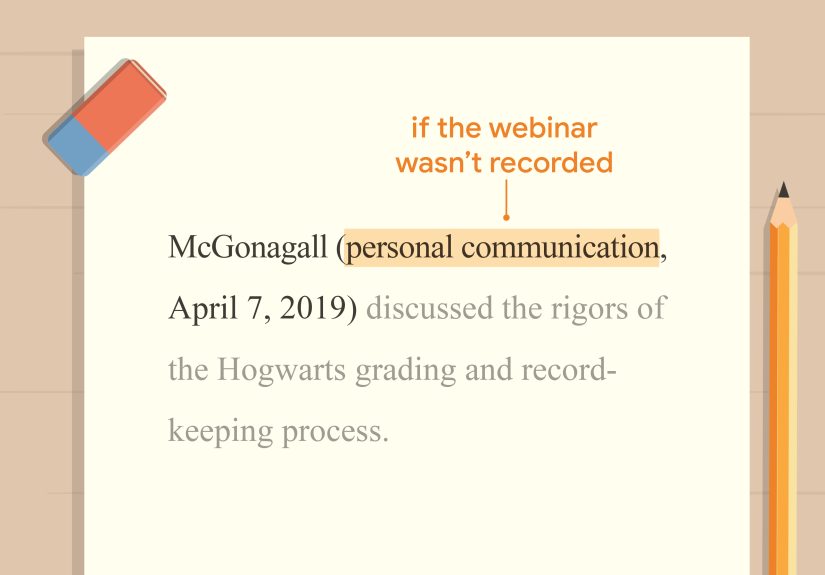
If the webinar was live, private, unrecorded, or otherwise unavailable to readers, APA usually treats it as a personal communication. That means you cite it only in the text and leave it out of the reference list.
Parenthetical example:
(R. Chen, personal communication, March 14, 2026)
Narrative example:
R. Chen (personal communication, March 14, 2026) explained that citation software often struggles with webinar metadata.
That is the first big fork in the road. Figure out whether the webinar is recoverable, and the rest becomes much easier.
How to Format a Webinar Reference in APA
Now let’s build the reference piece by piece. Think of this as assembling a citation sandwich. The bread is the author and date. The filling is the title and format. The final slice is the source information and link. Deliciously academic.
1. Start with the author
The author is usually the webinar presenter. If one person led the session, use that person’s name in standard APA format: last name first, then initials.
Example:
Patel, J. R.
If the webinar was clearly authored by an organization rather than an individual, use the organization name as the author.
Example:
American Marketing Institute.
If a host and a speaker are both listed, focus on the person or group most responsible for the content. In most cases, that is the presenter, not the cheerful moderator who says, “We’ll give everyone two more minutes to join.”
2. Add the date
Use the date the webinar was presented or published, not the date you watched it. In APA, the date belongs in parentheses right after the author.
Example:
Patel, J. R. (2025, October 9).
If no date is available, use (n.d.) for “no date.” That is not ideal, but it is better than inventing a date and launching your reference into fantasy fiction.
3. Write the webinar title in italics
The title should appear in sentence case, which means you capitalize only the first word, the first word after a colon, and proper nouns. Then add the format description in brackets immediately after the title.
Example:
How to cite online lectures without overthinking it [Webinar].
4. Include the publisher or hosting organization
Next, list the organization that hosted, published, or sponsored the webinar, if it is useful for retrieval and not identical to the author. If the organization is the same as the author, APA often omits the repeated publisher name.
Example with different author and publisher:
Nguyen, P. T. (2024, August 21). Digital note-taking strategies for graduate students [Webinar]. Center for Student Success. https://www.example.com/webinar
Example with organization as author:
National Writers Collective. (2025, February 6). APA citation essentials for research papers [Webinar]. https://www.example.com/webinar
5. End with the URL
If the webinar is available online, include the direct URL. Do not add a period after the URL. APA references like clean exits.
How to Cite a Webinar in the Text
Once your reference entry is ready, the in-text citation is usually simple. APA uses the author-date system, so most webinar citations follow the same structure as books, articles, and other online sources.
Parenthetical citation
Use the author’s last name or organization name and the year:
Example:
Webinar fatigue does not always come from screen time alone (Patel, 2025).
Narrative citation
Work the author into your sentence and place the year in parentheses:
Example:
Patel (2025) argued that students cite webinars incorrectly when they treat every online presentation like a YouTube video.
Direct quotes from a webinar
If you quote directly from a recorded webinar, include a timestamp if possible. Since webinars are audiovisual sources, timestamps help readers locate the exact moment you referenced.
Example:
Patel (2025) described citation anxiety as “a formatting problem with dramatic tendencies” (12:44).
If you are paraphrasing rather than quoting, a timestamp is usually unnecessary.
Special Cases That Confuse Almost Everyone
What if the webinar is posted on YouTube?
If the webinar recording is uploaded to YouTube, you may need to cite it as a video rather than as a generic webinar, depending on the source you actually used. This is an important distinction. If you watched the webinar on the host’s website, cite the webinar. If you watched the same session on YouTube, cite the YouTube video version because that is the retrievable source your reader would need to access.
Translation: cite what you actually used, not what the content was born as in a previous life.
What if you used the webinar slides instead of the recording?
If you consulted only the slides, cite the slides. If you used the recording, cite the recording. If you used both, decide which source best supports your discussion, or cite both when appropriate. APA loves specificity, and honestly, it has a point.
What if the webinar is inside a course platform or company intranet?
If the webinar is available only to a limited audience, the best approach depends on who your readers are. If your audience also has access, you may be able to cite it as a course or intranet source with enough information for retrieval. If your readers cannot access it, it may function more like personal communication.
What if there is no named presenter?
Use the organization as the author if that is the clearest source of authorship. If both author and date are missing, use the title in the author position and apply APA rules for missing information carefully. The goal is still retrieval, not perfection theater.
Common Mistakes to Avoid
1. Citing every webinar as a website
A webinar is not automatically just a webpage. If it is a recorded presentation, the bracketed description matters. Using [Webinar] tells readers what kind of source it is.
2. Adding unrecorded webinars to the reference list
If readers cannot recover the webinar, it usually should not appear in the reference list. Personal communication stays in the text only.
3. Using the date you watched the webinar
APA generally wants the publication or presentation date, not your personal viewing date. The source is being cited, not your snack choices while watching it.
4. Forgetting the hosting organization
Leaving out the publisher or host can make a citation harder to retrieve. Include it when it helps readers find the source.
5. Quoting without a timestamp
For direct quotes from a webinar recording, a timestamp is often the most useful locator. Without it, readers may end up wandering through a 58-minute presentation like lost tourists.
Sample Webinar Citations You Can Adapt
Recorded webinar with an individual presenter
Reference:
Alvarez, M. C. (2025, May 2). Using APA with confidence in online research [Webinar]. Research Ready Institute. https://www.example.com/apa-webinar
In-text:
(Alvarez, 2025)
Recorded webinar with an organization as author
Reference:
Scholarly Writing Center. (2024, November 15). Common citation mistakes in graduate papers [Webinar]. https://www.example.com/graduate-webinar
In-text:
(Scholarly Writing Center, 2024)
Unrecorded webinar
In-text only:
(L. Brooks, personal communication, April 9, 2026)
Direct quote from a recorded webinar
In-text:
Alvarez (2025) noted that “the source type should match the version you actually viewed” (18:31).
How to Decide Fast: A Simple APA Webinar Checklist
- Did you watch a webinar live, or a recording?
- Can your reader access that exact source?
- Is there a named presenter, an organization author, or both?
- Do you have a date?
- Did you use the webinar itself, the slides, the transcript, or a YouTube upload?
- Are you paraphrasing, or quoting directly?
If you answer those six questions before writing the citation, you will avoid about 90 percent of the usual APA webinar mess.
Final Thoughts on Citing a Webinar in APA
Learning how to properly cite a webinar in APA is really about learning how APA thinks. The style is less interested in labels and more interested in recovery. If the webinar is available to your readers, build a full reference entry with the presenter, date, title, bracketed format, host, and URL. If the webinar was live and is no longer accessible, treat it like personal communication and cite it only in the text.
The smartest approach is also the simplest one: cite the exact version you used. If you watched a recording on a website, cite the webinar. If you watched it on YouTube, cite the video version. If you used the slides, cite the slides. If you heard a live private session that no one can retrieve later, keep it in-text only. Once you follow that logic, APA stops feeling like a maze and starts looking more like a map.
And that, dear writer, is the difference between a reference list that looks confident and one that looks like it was assembled during a mild academic thunderstorm.
Real-World Experiences with APA Webinar Citations
The funny thing about webinar citations is that most people do not learn them in a calm, organized, ideal environment. They learn them in the middle of deadlines, half-finished outlines, and browser tabs multiplying like rabbits. That makes experience one of the best teachers here.
One common experience happens in graduate school. A student attends a live webinar hosted by a professional association, takes pages of notes, and confidently drops the webinar into the reference list. Later, they realize the session was never recorded and there is no public archive. Suddenly, the reference entry has nowhere to point. The fix is simple once you know APA: remove it from the reference list and cite it in the text as personal communication. But in the moment, it feels like discovering your citation has been wearing the wrong costume all semester.
Another familiar situation happens with recorded training sessions at work. Someone watches a webinar through an internal employee portal, then writes a report for a public audience. The problem is access. Coworkers can retrieve the recording, but outside readers cannot. That is where writers have to think carefully about audience. If the report is internal, the source may be cited as a retrievable internal resource. If the report is public, the webinar may function more like a nonrecoverable source. This is where APA becomes less about memorizing formulas and more about making smart source decisions.
There is also the classic YouTube confusion. A writer attends a webinar hosted by a university, but later finds the recording reposted on YouTube and uses that version to double-check a quote. Now the question becomes: which source should be cited? In practice, experienced writers learn to cite the version they actually consulted for the information they used. That small habit saves a lot of trouble. It also prevents readers from being sent to a webinar landing page that no longer works while the real usable source is sitting on YouTube all along.
Many writers also discover that direct quotes from webinars create their own mini-drama. Quoting from a video without a page number can feel strange at first, especially if you are used to books and journal articles. But after doing it once or twice, timestamps start to feel wonderfully practical. They are less mysterious than page numbers and honestly more helpful. A reader can jump straight to 14:22 and hear the exact statement instead of playing detective across a 47-minute presentation.
Perhaps the biggest experience-based lesson is this: webinar citations get easier when you stop asking, “What category do I force this into?” and start asking, “What exactly did I use, and can my reader find it?” That mindset works whether you are a student writing a term paper, a professor preparing course materials, a content writer building a research-backed article, or a business professional documenting training sources. APA webinar citation is not about pleasing a formatting robot. It is about tracing knowledge clearly and honestly.
Once writers internalize that logic, they become faster, more accurate, and much less likely to panic when faced with a webinar, workshop, lecture recording, or online presentation. The source may still look like a shape-shifter, but the citation decision becomes surprisingly steady. And that is a very satisfying upgrade from citation chaos to citation competence.