Table of Contents >> Show >> Hide
- What Is the Pythagorean Theorem?
- Why Proving the Theorem Matters
- How to Prove the Pythagorean Theorem: 10 Steps
- Step 1: Start With a Right Triangle
- Step 2: Make Four Copies of the Triangle
- Step 3: Arrange the Four Triangles Into a Large Square
- Step 4: Write the Area of the Large Square One Way
- Step 5: Write the Area of the Large Square Another Way
- Step 6: Set the Two Area Expressions Equal
- Step 7: Subtract 2ab From Both Sides
- Step 8: Test the Proof With a 3-4-5 Triangle
- Step 9: Understand the Visual Meaning
- Step 10: State the Final Conclusion Clearly
- Other Popular Ways to Prove the Pythagorean Theorem
- Common Mistakes When Proving the Pythagorean Theorem
- Why the Pythagorean Theorem Is So Useful
- Experience-Based Tips for Learning and Teaching the Proof
- Conclusion
The Pythagorean Theorem is one of those math ideas that somehow escaped the classroom and wandered confidently into real life. It helps builders square corners, designers measure diagonals, engineers plan structures, gamers calculate distances, and students survive geometry homework without having to bribe a calculator with snacks. At its heart, the theorem says something beautifully simple: in a right triangle, the square of one short side plus the square of the other short side equals the square of the longest side.
Written as a formula, it looks like this: a2 + b2 = c2. The sides a and b are the legs of the right triangle, and c is the hypotenuse, the side opposite the 90-degree angle. But knowing the formula is only the beginning. Proving it is where the magic happens. A proof shows why the theorem is always true, not just why it works for famous examples like 3-4-5 triangles.
This guide explains how to prove the Pythagorean Theorem in 10 clear steps using a classic geometric area proof. Along the way, we will also discuss why the theorem matters, how to avoid common mistakes, and how to make the proof easier to understand if you are learning it, teaching it, or trying to impress someone at a party where geometry is somehow the entertainment.
What Is the Pythagorean Theorem?
The Pythagorean Theorem applies only to right triangles. A right triangle has one angle measuring exactly 90 degrees. The two sides that form the right angle are called legs, and the side across from the right angle is called the hypotenuse. The hypotenuse is always the longest side of the triangle.
The theorem states:
In any right triangle, the area of the square built on the hypotenuse equals the combined areas of the squares built on the two legs.
That may sound more dramatic than the formula, but it is the same idea. If one leg has length a, the other leg has length b, and the hypotenuse has length c, then the areas of the three squares are a2, b2, and c2. The proof shows that a2 + b2 must equal c2.
Why Proving the Theorem Matters
Memorizing a2 + b2 = c2 is useful, but proving it helps you understand geometry on a deeper level. A formula is like a recipe card; a proof is like watching the chef explain why the cake does not collapse. Once you see the reasoning, the theorem becomes less of a rule to memorize and more of a logical truth you can trust.
The Pythagorean Theorem has been proved in hundreds of ways, including geometric, algebraic, similarity-based, dissection, trapezoid, and even trigonometric approaches. Ancient mathematicians studied it long before modern classrooms existed, and it still attracts fresh attention today because it connects area, distance, proportion, and logical reasoning so elegantly.
How to Prove the Pythagorean Theorem: 10 Steps
Step 1: Start With a Right Triangle
Draw a right triangle and label its two legs a and b. Label the hypotenuse c. Make sure the hypotenuse is across from the right angle, not next to it. This small labeling detail matters more than it looks. If the sides are mislabeled, the proof can quickly turn into mathematical spaghetti.
The goal is to prove that the square of the hypotenuse, c2, equals the sum of the squares of the legs, a2 + b2.
Step 2: Make Four Copies of the Triangle
Now imagine making four identical copies of your right triangle. Each triangle has the same side lengths: a, b, and c. Because they are identical, they have equal areas. The area of one right triangle is:
Area = 1/2ab
So the combined area of four such triangles is:
4 × 1/2ab = 2ab
This will be important later when we compare the area of a large square in two different ways.
Step 3: Arrange the Four Triangles Into a Large Square
Place the four triangles so they form a larger square. The legs a and b line up along the outside edges. Each side of the large square has length a + b, because it is made from one leg of length a and one leg of length b.
Since the large outer shape is a square, its total area is:
(a + b)2
Inside this large square, the four hypotenuses form a smaller tilted square in the center. Each side of that inner square has length c, so its area is:
c2
Step 4: Write the Area of the Large Square One Way
The first way to calculate the large square’s area is simple: use the side length. Since each side is a + b, the area is:
(a + b)2
Expanding this gives:
a2 + 2ab + b2
This expression represents the entire large square: all four triangles plus the smaller square in the middle.
Step 5: Write the Area of the Large Square Another Way
The second way to calculate the same large square is to add the pieces inside it. The large square contains four right triangles and one smaller square.
The four triangles have total area:
2ab
The center square has area:
c2
So the total area is:
2ab + c2
Step 6: Set the Two Area Expressions Equal
Both expressions describe the same large square, so they must be equal:
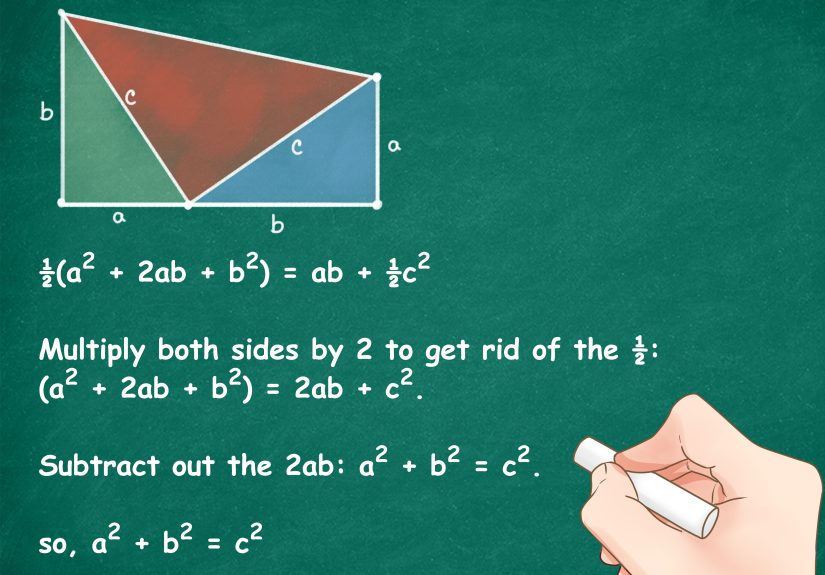
a2 + 2ab + b2 = 2ab + c2
This is the heart of the proof. We are not guessing. We are comparing the same area from two viewpoints: once from the outside, and once by adding the shapes inside. It is the geometry version of checking a restaurant bill by adding each item instead of just trusting the total.
Step 7: Subtract 2ab From Both Sides
Now simplify the equation. Subtract 2ab from both sides:
a2 + b2 = c2
And there it is: the Pythagorean Theorem. No smoke machine, no secret handshake, no ancient math wizard required. The formula follows directly from area relationships.
Step 8: Test the Proof With a 3-4-5 Triangle
To see the theorem in action, use the classic right triangle with legs 3 and 4 and hypotenuse 5.
32 + 42 = 52
9 + 16 = 25
25 = 25
The numbers work perfectly. But remember, the proof is stronger than a single example. The 3-4-5 triangle confirms the theorem in one familiar case, while the geometric proof explains why it works for every right triangle.
Step 9: Understand the Visual Meaning
The visual idea behind the proof is that areas can be rearranged without changing their total amount. The four triangles stay the same size. The outer square stays the same size. What changes is how we interpret the empty or central space. That space reveals the relationship between the square on the hypotenuse and the two squares on the legs.
This is why many Pythagorean proofs use rearrangement. Geometry often becomes clearer when you stop staring at symbols and start moving shapes around in your mind. It is like reorganizing a messy closet and suddenly discovering you did, in fact, own the missing shoe.
Step 10: State the Final Conclusion Clearly
After comparing the two area expressions and simplifying, we conclude:
For every right triangle with legs a and b and hypotenuse c, a2 + b2 = c2.
That is the proof. It works because the area of the same large square can be represented in two equivalent ways. The algebra simply reveals the relationship that the geometry already contains.
Other Popular Ways to Prove the Pythagorean Theorem
Similar Triangle Proof
Another famous proof uses similar triangles. If you draw an altitude from the right angle to the hypotenuse, the original triangle is divided into two smaller right triangles. These smaller triangles are similar to the original triangle and to each other. By using proportions among their corresponding sides, you can derive a2 + b2 = c2.
This proof is elegant because it connects the theorem to similarity, ratios, and proportions. It is especially useful for students who are learning how geometric relationships scale.
Euclid’s Classic Proof
Euclid’s proof appears in Book I of Elements, one of the most influential works in mathematical history. Euclid’s version uses squares built on each side of the right triangle, along with carefully drawn lines and area relationships. It is more formal than the rearrangement proof, but it remains a masterpiece of logical structure.
Garfield’s Trapezoid Proof
James A. Garfield, who later became the 20th president of the United States, created a proof using a trapezoid. His method places right triangles inside a trapezoid and compares the trapezoid’s area with the combined areas of the triangles. The result again simplifies to the Pythagorean Theorem. Presidential geometry: surprisingly productive, and much less stressful than campaign season.
Dissection Proofs
Dissection proofs cut squares and triangles into pieces that can be rearranged. These proofs are highly visual and often feel like mathematical puzzles. They show that the area of the square on the hypotenuse can be assembled from the areas of the squares on the legs.
Common Mistakes When Proving the Pythagorean Theorem
Using the Theorem Inside Its Own Proof
The biggest mistake is circular reasoning. You cannot use a2 + b2 = c2 to prove a2 + b2 = c2. That is like saying, “This is true because it is true,” which is not a proof; it is a math-flavored shrug.
Forgetting That It Only Applies to Right Triangles
The theorem does not apply to every triangle. It applies specifically to right triangles. For non-right triangles, relationships among sides are handled by more general tools such as the Law of Cosines.
Labeling the Hypotenuse Incorrectly
The hypotenuse must be the side opposite the right angle. If you label one of the legs as c, your equation will not match the geometry. Always identify the 90-degree angle first, then find the side across from it.
Confusing Side Lengths With Areas
The theorem compares squares of side lengths, not the side lengths themselves. That means a + b = c is not the theorem. In fact, in a triangle, the sum of two side lengths must be greater than the third side. The Pythagorean relationship is about squared lengths and area.
Why the Pythagorean Theorem Is So Useful
The theorem is useful because it gives a reliable way to find missing side lengths in right triangles. In construction, it helps workers create square corners. In navigation, it helps calculate straight-line distances. In coordinate geometry, it leads to the distance formula. In physics and engineering, it appears whenever perpendicular components combine into a resultant value.
For example, suppose a ladder is leaning against a wall. If the base of the ladder is 6 feet from the wall and the top reaches 8 feet high, the ladder length is the hypotenuse:
62 + 82 = c2
36 + 64 = c2
100 = c2
c = 10
The ladder is 10 feet long. Congratulations: geometry has just prevented you from buying the wrong ladder and inventing a new category of home improvement regret.
Experience-Based Tips for Learning and Teaching the Proof
One of the best ways to understand how to prove the Pythagorean Theorem is to stop treating it like a formula first and start treating it like a shape story. Many students struggle because they meet the theorem as symbols before they have built the visual picture. The formula a2 + b2 = c2 is compact, but compact ideas can feel intimidating. A helpful experience is to draw the triangle, draw the squares on each side, and physically shade the areas. Once students see that the theorem is really about area, the proof becomes less mysterious.
Another practical tip is to use graph paper. Draw a right triangle with legs of 3 units and 4 units. Then build a 3-by-3 square on one leg, a 4-by-4 square on the other, and a 5-by-5 square on the hypotenuse. Counting the boxes gives 9, 16, and 25. This does not prove the theorem for all right triangles, but it creates a strong visual foundation. It gives the brain something concrete to hold onto before moving into algebra.
For learners who dislike geometry, the rearrangement proof is often the friendliest starting point. It feels more like a puzzle than a lecture. Cut out four identical right triangles from paper, arrange them into a large square, and then rearrange them to expose the relationship between the smaller areas. When students can move the pieces with their hands, the theorem becomes memorable. Suddenly, c2 is not just a symbol; it is the empty square in the middle of a real arrangement.
When teaching the proof, avoid rushing the algebra. The step where a2 + 2ab + b2 becomes equal to 2ab + c2 is where many students mentally check out and begin thinking about lunch. Slow down there. Explain that both expressions describe the same total area. Once that idea clicks, subtracting 2ab from both sides feels natural instead of random.
It also helps to connect the proof to real-world examples. Ask students how to measure the diagonal of a TV screen, a rectangular garden, a laptop display, or a soccer field. The theorem becomes more interesting when it solves visible problems. Even better, let students estimate first, then calculate. Estimation builds number sense, while calculation confirms the answer.
A final experience-based suggestion is to compare multiple proofs. The area proof, similar triangle proof, Euclidean proof, and trapezoid proof all reach the same conclusion from different directions. That variety is powerful. It shows that mathematics is not one narrow hallway but a building with many doors. Some learners prefer visuals, some prefer algebra, and some enjoy formal logic. The Pythagorean Theorem welcomes all of them, which is one reason it has remained one of the most loved and widely taught theorems in mathematics.
Conclusion
Learning how to prove the Pythagorean Theorem is more than a geometry exercise. It is a lesson in how mathematics builds truth. The classic area proof works because it compares the same square in two different ways, then simplifies the result until the famous relationship appears: a2 + b2 = c2. Once you understand the proof, the theorem feels less like a rule dropped from the sky and more like a logical result you can see, test, and explain.
Whether you are a student preparing for a test, a teacher planning a lesson, or a curious reader wondering why this ancient theorem still gets so much attention, the proof offers a satisfying answer. Right triangles may look simple, but hidden inside them is one of the most useful ideas in all of mathematics.
Note: This article is original, web-ready HTML content based on established mathematical explanations of the Pythagorean Theorem and its common proof methods, with unnecessary reference markers removed for clean publishing.