Table of Contents >> Show >> Hide
- Why Dogs Chase People in the First Place
- What to Do Immediately if a Mean Dog Chases You
- What Not to Do When an Aggressive Dog Approaches
- If the Dog Lunges or Tries to Bite
- If You Fall or Are Knocked Down
- Special Advice for Runners
- Special Advice for Cyclists
- How to Protect a Child from a Chasing Dog
- What to Do After a Dog Bite
- How to Avoid Dog Chases Before They Happen
- What Dog Owners Should Do to Prevent Chases
- Real-Life Experience: What a Dog Chase Feels Like and What Actually Helps
- Conclusion
Few things make your brain hit the emergency button faster than hearing paws pounding behind you and realizing, “Oh no, that dog is not coming over to discuss friendship.” Whether you are walking, jogging, cycling, delivering a package, or simply taking out the trash, knowing how to react if a mean dog chases you can make a frightening moment much safer.
The first rule is also the hardest: do not panic. Your instincts may scream, “Run like an action-movie hero!” Unfortunately, dogs are built for chasing, and most humans are built for checking email and pretending stairs count as cardio. Running can trigger a dog’s prey drive, increase excitement, and make you look more like something to pursue.
This guide explains what to do when an aggressive dog approaches, chases, corners, or knocks you down. It also covers dog bite prevention, what to do after a bite, how to protect children, and how runners and cyclists can reduce risk. The goal is not to “win” against a dog. The goal is to stay calm, reduce the dog’s motivation to attack, protect vulnerable body parts, and get to safety.
Why Dogs Chase People in the First Place
Not every dog that chases is “mean.” Some dogs are scared, territorial, poorly socialized, overstimulated, protective, or simply chasing because movement is exciting. A dog may also chase because a person is running, waving arms, shouting, entering the dog’s perceived territory, or approaching puppies, food, toys, or an owner.
That said, intention matters less than safety. A playful chase can become dangerous if the dog is large, uncontrolled, or highly aroused. A fearful dog can bite if it feels trapped. A territorial dog may charge to drive you away. Your job is to look boring, nonthreatening, and not worth chasing.
Common signs a dog may bite
Before a chase or bite, dogs often give warning signals. Watch for a stiff body, hard stare, raised hackles, growling, snarling, barking with forward movement, pinned ears, a tucked tail, lunging, showing teeth, or repeated attempts to block your path. Some dogs freeze before biting, which can be more serious than noisy barking.
Do not assume a wagging tail means the dog is friendly. Tail movement can signal excitement, tension, or agitation. A loose, relaxed body is very different from a stiff dog with a fast, high tail wag. Dog body language is a whole language, and unfortunately, many of us only learned “sit” and “who’s a good boy?”
What to Do Immediately if a Mean Dog Chases You
If a dog starts chasing you, your reaction in the first few seconds matters. You want to interrupt the chase pattern without escalating the dog’s excitement.
1. Stop running as soon as you safely can
If you are jogging or walking quickly, slow down and stop. Running away can encourage the dog to keep chasing. Stand still like a tree: feet planted, arms close to your body, hands tucked or folded if possible. This makes you less interesting and reduces the movement that fuels the chase.
2. Avoid direct eye contact
Do not stare into the dog’s eyes. Many dogs read direct eye contact as a challenge. Instead, keep the dog in your side vision. Turn your body slightly sideways rather than facing the dog head-on. This posture looks less confrontational and gives you a better chance to step away slowly.
3. Stay quiet or speak calmly
Do not scream, squeal, or shout in panic. A high-energy reaction can increase the dog’s excitement. If you speak, use a calm, firm voice. Simple words such as “No,” “Stay,” “Go home,” or “Back” may help with some dogs, especially dogs that have heard basic commands before. Avoid angry yelling, because you are not trying to win a barking contest.
4. Keep your hands and arms close
Do not wave your arms, swat, or reach toward the dog’s head. Sudden hand movements can trigger a bite. Keep your fingers curled in and your hands near your chest, pockets, or sides. If the dog jumps, turn slightly away and protect your face and neck.
5. Create a barrier
Place something between you and the dog if you can do so without making sudden movements. A backpack, jacket, purse, umbrella, bicycle, trash can lid, delivery bag, or even a clipboard can act as a shield. Hold the object low and steady. Do not use it to hit the dog unless you are actively being attacked and have no safer choice. The barrier is meant to block, not provoke.
6. Back away slowly
Once the dog pauses, sniffs, loses interest, or stops advancing, slowly back away. Do not turn your back and do not run. Move toward a safe place such as a car, building, gate, porch, or populated area. Keep your body angled, your movements slow, and your voice calm.
What Not to Do When an Aggressive Dog Approaches
In a scary dog encounter, many natural reactions are exactly the wrong ones. Here are the biggest mistakes to avoid.
Do not run
Running can turn a tense dog into a chasing dog. Even small dogs can bite ankles, calves, or feet if you sprint away. Large dogs can catch most people quickly. Unless you are already one step from a secure door or car, running usually increases the risk.
Do not scream
Screaming may attract human help, but it can also intensify the dog’s arousal. If you need help, call out in a controlled way: “Help. Loose dog.” Short, clear words are better than panic noises.
Do not kick unless you are being attacked
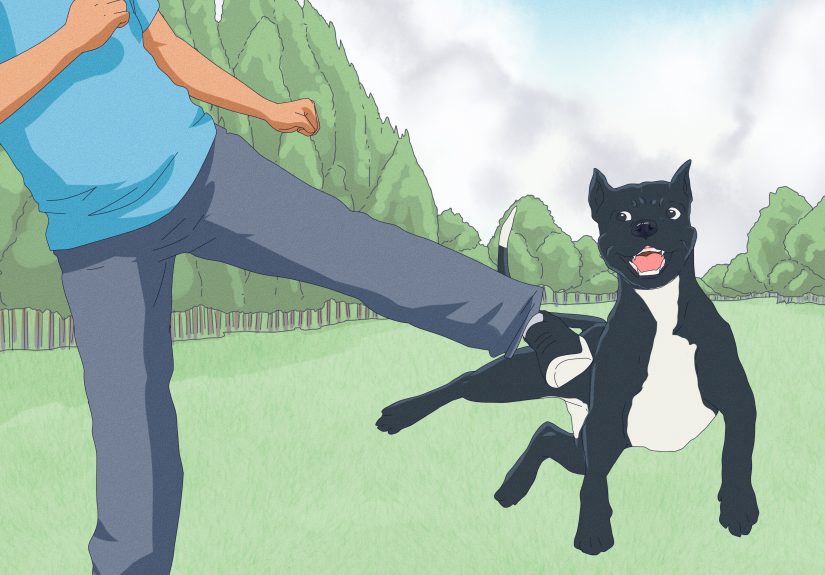
Kicking at a dog that has not bitten you can escalate the situation. It also brings your leg closer to the dog’s mouth. If a dog is actively attacking, self-protection becomes necessary, but your first strategy should be distance, barriers, and de-escalation.
Do not bend over the dog
Leaning over a dog can feel threatening to the animal. Do not crouch down and put your face near the dog. Your face is not a peace offering. It is a very important part of your head.
Do not reach out to “let the dog smell you”
This old advice is often misunderstood. If an unfamiliar dog is tense, chasing, barking, or growling, do not offer your hand. A hand near the dog’s face can become the first bite target. Let the dog decide whether to sniff from a distance while you remain still.
If the Dog Lunges or Tries to Bite
If a dog moves from chasing to lunging, focus on protecting your body and staying upright.
Use your object as a shield
Put a bag, jacket, bike, or other object between you and the dog. If the dog bites the object, let it have the object if that helps you create distance. A torn backpack is annoying. A torn hand is worse.
Protect your face, neck, chest, and hands
Turn your side toward the dog. Keep your arms close and your hands closed. If the dog jumps, use your forearm, backpack, or jacket to block. Avoid pulling away violently if the dog has your clothing, because that can worsen tearing or increase the dog’s grip.
Move toward safety, not toward victory
Your goal is to escape, not to punish the dog. Move slowly toward a door, car, fence, or higher surface if it is immediately available. Avoid cornering the dog. A cornered dog may bite harder because it feels trapped.
If You Fall or Are Knocked Down
If you fall, do not flail. Curl into a ball with your knees tucked in. Cover your head and neck with your arms and hands. Keep your face toward the ground if possible. Stay still and quiet until the dog moves away or help arrives.
This “be a rock” position helps protect your most vulnerable areas. It is especially important for children to learn because kids are more likely to scream, run, or wave their arms when frightened. Teach children a simple phrase: “Stand like a tree, curl like a rock.” It sounds silly enough to remember, and in an emergency, memorable beats complicated.
Special Advice for Runners
Runners are common chase targets because fast movement can trigger a dog’s instinct to pursue. If a loose dog notices you, slow to a walk before it reaches full chase mode. If it runs toward you, stop, turn slightly sideways, avoid eye contact, and keep your hands close.
If you often run in areas with loose dogs, consider changing your route, running with a partner, carrying a loud whistle, or bringing a personal safety alarm. Some runners carry an umbrella because it can open into a visual barrier without harming the dog. Local laws vary on deterrent sprays, so check regulations before carrying any animal deterrent.
What if the dog follows you?
If the dog follows but does not attack, keep walking slowly away once it loses intensity. Do not restart running until you are far away and safely out of sight. Many dogs stop following once the “fun chase game” ends.
Special Advice for Cyclists
Dogs may chase bicycles because wheels, speed, and motion are extremely exciting. If a dog chases you on a bike, do not automatically try to outpedal it, especially near traffic. Speeding up can lead the dog into the road and may cause you to crash.
If safe, slow down, stop, and place the bicycle between you and the dog. The bike becomes a useful barrier. Keep it steady and back away slowly while holding the handlebars. If the dog loses interest, walk the bike away until you are at a safe distance.
How to Protect a Child from a Chasing Dog
Children are at higher risk during dog encounters because they move quickly, make high-pitched sounds, and are closer to a dog’s face level. If a dog runs toward your child, calmly and firmly tell the child, “Stop. Be a tree.” Avoid screaming instructions from across the yard, because your panic can increase the child’s panic.
If you can safely reach the child, stand between the child and the dog without lunging at the dog. Keep the child behind you. Do not lift a small child suddenly if the dog is already jumping or biting, because that can make the dog leap higher. If you can calmly pick up the child before the dog reaches you, do so while turning your body away.
Teach children dog safety before they need it
Children should learn never to approach unfamiliar dogs, reach through fences, hug dogs around the neck, bother dogs while eating, or run from dogs. They should ask the owner before petting a dog and wait for the dog to approach calmly. Even family dogs need space, especially when sleeping, eating, chewing, injured, or caring for puppies.
What to Do After a Dog Bite
Once you are safe, take every dog bite seriously. Even small puncture wounds can introduce bacteria under the skin.
First aid for a dog bite
Wash the wound thoroughly with soap and running water for several minutes. If there is bleeding, apply gentle pressure with a clean cloth. Use an antibiotic ointment if available, cover the wound with a clean bandage, and keep it protected until you receive medical advice.
Seek prompt medical care for deep punctures, bites on the face or hands, heavy bleeding, wounds that gape open, bites from an unknown dog, signs of infection, or any bite involving a child, older adult, pregnant person, or someone with a weakened immune system.
Watch for infection
Contact a healthcare professional if you notice increasing redness, swelling, warmth, pain, pus, red streaks, fever, numbness, or trouble moving the affected area. Dog bites can become infected, and early treatment is much easier than waiting until your hand looks like it has joined a horror franchise.
Ask about rabies and tetanus
If the dog is unknown, unvaccinated, acting strangely, or cannot be observed, contact medical professionals or local health authorities right away. A clinician may also ask about your tetanus vaccination status. Do not guess your way through rabies risk. That is a job for healthcare and public health professionals.
Report the bite
Report the incident to local animal control or the appropriate local authority. Provide the location, dog description, owner information if known, and details of what happened. If possible, take photos of injuries, damaged clothing, and the location. Reporting helps protect other people and may help officials verify vaccination or quarantine requirements.
How to Avoid Dog Chases Before They Happen
The safest dog chase is the one that never begins. Prevention depends on awareness, respectful behavior, and smart route choices.
Give unfamiliar dogs space
Do not approach dogs behind fences, in cars, tied outside stores, or roaming loose. A dog that seems friendly from ten feet away may feel very different when you step into its personal bubble. If a loose dog is roaming in your neighborhood, contact animal control rather than trying to catch it yourself.
Read the environment
Be extra alert near open gates, unfenced yards, rural roads, delivery routes, alleys, and homes with “Beware of Dog” signs. Also be cautious around dogs that are eating, sleeping, guarding property, nursing puppies, or playing intensely with toys.
Do not surprise dogs
If you must pass near a dog, avoid sudden movement. Give the dog a wide path. Speak calmly if needed so the dog knows you are there, but do not call the dog toward you. You are passing by, not hosting a meet-and-greet.
What Dog Owners Should Do to Prevent Chases
Dog bite prevention is not only the responsibility of the person being chased. Owners must keep dogs safely contained, leashed where required, trained, and supervised. A dog that repeatedly chases people needs management and professional help from a veterinarian, certified trainer, or qualified behavior professional.
Owners should secure dogs before opening the front door, especially when mail carriers, delivery drivers, neighbors, or guests arrive. Dogs can bolt through screen doors, gates, and garage openings faster than people expect. If a dog has a history of aggression, management tools such as secure fencing, leashes, gates, and properly conditioned basket muzzles may be necessary.
Punishing aggressive behavior through yelling, hitting, or shock-based corrections can make fear and reactivity worse. Safer behavior plans usually focus on management, positive reinforcement, desensitization, counterconditioning, and professional guidance.
Real-Life Experience: What a Dog Chase Feels Like and What Actually Helps
Imagine this: you are walking through a quiet neighborhood, enjoying the bold confidence of someone who remembered to bring water, when a gate rattles. A medium-sized dog bursts into the driveway and begins barking like you personally insulted its ancestors. Your first instinct is to speed up. Your second instinct is to check whether you can suddenly become an Olympic sprinter. This is the moment when preparation matters.
The most useful thing you can do is pause your body before your fear takes over. Stop moving fast. Turn slightly sideways. Keep your arms in. Look away from the dog’s eyes while still tracking where it is. Take a slow breath. If you have a backpack, purse, jacket, or umbrella, bring it calmly between you and the dog. This does not make you weak; it makes you strategic. Even a simple tote bag can become a temporary shield.
In many real-world encounters, the dog’s energy changes when the person stops acting like prey. The chase loses momentum. The dog may bark, circle, sniff, or posture. That does not feel pleasant, but it is better than feeding the chase with running and yelling. A calm, firm “No” or “Go home” may work if the dog has heard those words before. Some dogs pause when they hear a confident human voice. Others do not care. Either way, your body language still matters most.
One common mistake people make is trying to befriend the dog too quickly. They crouch, smile, reach out a hand, and say, “It’s okay, buddy.” That may work with a nervous but social dog in a controlled setting. It is risky with a charging dog. Your hand is not a business card. Do not place it near the dog’s mouth. Let the dog calm down while you remain still and nonthreatening.
Another experience many walkers report is being followed after the initial charge. This is awkward because the danger feels unresolved. The best response is patience. Back away slowly. Do not turn around and march off. Do not restart your jog. Keep your barrier ready and move toward a safer area. If the owner appears, ask them calmly to secure the dog. Avoid arguing while the dog is still loose; your priority is safety, not winning the neighborhood debate championship.
For cyclists, the experience can be even more chaotic. A dog may target the spinning wheels or ankles. The safest move is often to slow down, stop if traffic allows, and put the bike between your body and the dog. The bicycle frame gives you space and structure. Trying to outride the dog may work sometimes, but it can also pull the dog into traffic or cause a crash. A controlled stop can turn a chase into a standoff, and a standoff is usually easier to manage than a moving pursuit.
People who have been bitten often say they underestimated small wounds. A puncture can look unimpressive at first and become painful or infected later. After any bite, washing the wound, covering it, and contacting a medical professional is not being dramatic. It is being sensible. You should also report the bite, especially if the dog is unknown or loose. Reporting is not about revenge; it helps prevent the next person from being chased or bitten.
The biggest lesson from real encounters is this: calm behavior is not the same as feeling calm. You may be terrified. Your heart may be tap dancing. That is normal. The goal is to make your outside behavior boring and steady while your inside voice screams into a pillow. Stop, stand sideways, avoid eye contact, use a barrier, back away slowly, and protect yourself if you fall. Those simple steps can turn a dangerous moment into a survivable one.
Conclusion
Knowing how to react if a mean dog chases you can help you stay safer in a frightening situation. The most important steps are simple but powerful: stop running, stay calm, avoid direct eye contact, keep your arms close, create a barrier, and back away slowly. If you are knocked down, curl into a ball and protect your head, neck, and face. If you are bitten, wash the wound, seek medical guidance, and report the incident.
Dogs chase for many reasons, including fear, territory, excitement, and poor control. You do not need to diagnose the dog in the moment. You need to reduce movement, avoid escalating the threat, and get to safety. A little knowledge now can make a big difference laterespecially when the neighborhood “mean dog” decides your morning walk needs a surprise boss level.
Note: This article is for general safety education and is based on widely accepted guidance from U.S. public health, veterinary, humane society, animal behavior, and first-aid resources. It is not a substitute for emergency care, medical diagnosis, legal advice, or professional dog behavior consultation.