Table of Contents >> Show >> Hide
- Why Miley Cyrus Thinks She Was “Canceled” First
- The 2013 VMAs and the Peak of Public Outrage
- Where Miley’s Claim Is Right and Where It Isn’t
- The Complication: Some Criticism of Miley Cyrus Was Legitimate
- From Scandal Magnet to Industry Survivor
- Miley Cyrus and the Blueprint for Modern Pop Controversy
- Experiences Around the Miley Cyrus “Canceled” Era
- Conclusion
Before “cancel culture” became a phrase that could headline a panel discussion, ignite a podcast war, or inspire 4,000 opinion threads before breakfast, Miley Cyrus was already living inside the storm. Long before every celebrity controversy came with a think piece, an apology cycle, a reaction video, and three people on TikTok saying, “Actually, here’s the context,” Cyrus was getting scorched in public while trying to shed the sparkly Disney skin of Hannah Montana.
That is why her recent reflection lands with such pop-culture force. Miley Cyrus said she feels like she was “maybe” the first person to be canceled, and while that is not literally true in the historical sense, it is emotionally revealing. What she seems to mean is this: she was among the earliest major stars to experience the full modern punishment package moral outrage, body policing, parent panic, tabloid obsession, internet ridicule, and a public demand that she either explain herself or disappear.
And honestly? That interpretation is hard to dismiss. Cyrus did not just get criticized. She became a national group project in pearl-clutching. One minute she was America’s televised daughter, the next minute she was being treated like proof that civilization had misplaced its car keys.
Why Miley Cyrus Thinks She Was “Canceled” First
Cyrus’s argument is less about chronology than intensity. She is not claiming that no entertainer had ever faced backlash before her. Obviously, celebrities were being scolded, mocked, and publicly punished long before social media became the planet’s loudest cafeteria. What Cyrus is pointing to is the strange, transitional moment she occupied: a period when online outrage was accelerating, celebrity coverage was becoming more aggressive, and audiences felt newly entitled to weigh in on a young woman’s body, behavior, and every badly timed dance move in real time.
In other words, she was not the first famous person people turned on. She was one of the first to be devoured by the internet-age version of fame correction.
That distinction matters. Older stars were certainly hounded by tabloids and TV pundits, but Cyrus arrived at a point when reactions were no longer delayed. They were instant, viral, memed, replayed, and industrialized. A celebrity misstep was no longer just tomorrow’s gossip. It became a permanent public referendum.
The Disney Problem: America Loves a Child Star Until She Grows Up
Part of what made Miley Cyrus such a lightning rod was the role she had played in the culture. She was not introduced as an unpredictable rock star or a provocateur. She was introduced as a teen idol packaged for family viewing. America had seen her as safe, charming, and marketable basically the entertainment equivalent of glitter glue that somehow pays taxes.
That image was always going to be hard to outgrow. Child stars are often told to mature, but not too fast. Be sexy, but not alarming. Be adult, but not disruptive. Be authentic, but please run authenticity through legal first. Cyrus walked straight into that impossible trap.
The early warning sign came in 2009, when her Teen Choice Awards performance triggered fierce debate over whether it was too provocative for a 16-year-old entertainer with a young fan base. At the time, the uproar felt huge because it was huge. The performance became one of those cultural moments where adults suddenly acted as if they had discovered scandal in the same room where they had previously placed the cameras.
Years later, Cyrus looked back on that moment with a mix of humor and disbelief, insisting the infamous pole people obsessed over was not some grand declaration of corruption, but a prop she has since described far less scandalously. Still, the point is not whether critics exaggerated. They did. The point is that America had already started treating her coming-of-age like a public emergency.
The 2013 VMAs and the Peak of Public Outrage
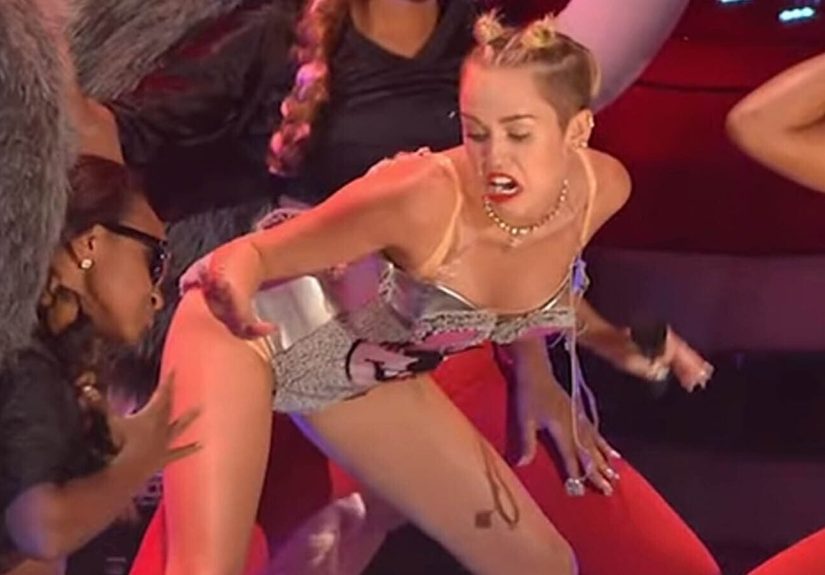
If the Teen Choice Awards controversy was the appetizer, the 2013 MTV Video Music Awards were the full buffet of backlash. Cyrus’s performance with Robin Thicke became one of the defining pop-culture scandals of the decade. It was provocative, chaotic, and impossible to ignore. It also became shorthand for everything people thought had “gone wrong” with Miley Cyrus.
Critics blasted the performance as raunchy, tasteless, attention-seeking, and symptomatic of broader cultural decay because whenever America sees a woman in foam-finger proximity to controversy, somebody immediately starts talking like Rome is falling. Commentators recoiled. Parents groups complained. Morning shows analyzed. Newspapers summarized the reaction as shock bordering on horror.
Cyrus, for her part, later framed the performance as history-making, not career-ending. That difference in interpretation is the whole story. The public thought it was a scandal. She thought it was a strategy. They saw collapse; she saw reinvention.
That mismatch is one reason her “I was first” comment resonates. What today might be understood as a deliberately polarizing brand pivot was then treated as evidence of personal derailment. The conversation around her was not just about art or image. It became moral. And once moral panic enters the room, nuance tends to leave through the back door.
It Was Not Just About Sexuality
It would be too simple to say Miley Cyrus was criticized merely for being provocative. The backlash also included body-shaming, generational panic, and a broader discomfort with how aggressively she rejected her Disney-era identity. She was not simply becoming an adult star. She was doing it loudly, weirdly, and with all the subtlety of a neon wrecking ball.
That mattered because female reinvention is often accepted only when it appears tasteful, controlled, and reassuring to outsiders. Cyrus’s version was messy by design. She did not ask audiences to feel comfortable. She practically dared them not to.
And that is where the cancel-culture comparison starts to make more sense. The backlash was not just “I don’t like this performance.” It was “this person has violated the role we assigned her, and now she must be corrected.” That is not ordinary criticism. That is social punishment.
Where Miley’s Claim Is Right and Where It Isn’t
To be fair, Miley Cyrus was not the first entertainer to be publicly disgraced, mocked, blacklisted, or intensely scrutinized. Pop history is full of stars who were humiliated by tabloids, punished by networks, rejected by audiences, or turned into national punchlines. She was not inventing celebrity backlash. She was stepping into a long, ugly tradition.
But she was early to something more familiar to today’s audiences: the internet-assisted, identity-centered, outrage-fueled cycle that feels recognizably modern. That cycle includes pile-ons, moral branding, memes, think pieces, and the expectation that a star’s public image must be continuously audited.
So no, Miley Cyrus was not the first canceled entertainer in a literal sense. But she may have been one of the first major stars to undergo a cancellation-style experience before the language around it had fully formed. She was punished in a system that had not yet named itself.
That is partly why her comment feels sticky. It is inaccurate if read like a textbook fact. It feels insightful if read like a description of atmosphere.
The Complication: Some Criticism of Miley Cyrus Was Legitimate
Here is where the conversation gets more interesting. Not all criticism of Miley Cyrus was prudish nonsense. Some of it came from serious debates about appropriation, privilege, and the way pop stars borrow from Black culture when it is profitable and distance themselves when it becomes inconvenient.
That critique sharpened during and after the Bangerz era, especially when Cyrus made comments about hip-hop in 2017 that many readers saw as dismissive and hypocritical. The backlash was not simply “the internet hates a woman being sexual again.” It was also “you do not get to profit from a culture and then talk about it like disposable scenery.”
That matters because it keeps the story honest. Cyrus was not just a victim of reactionary outrage. She was also a participant in a messier celebrity machine, one where image-making can collide with race, power, and selective self-awareness. Her later apologies acknowledged that point. In 2019, she apologized again for those comments, describing them as insensitive and taking responsibility for the disconnect they caused.
So the fairest reading is not that Miley Cyrus was unfairly “canceled” for everything. It is that she experienced a mixture of overreaction, misogyny, moral panic, and legitimate criticism all at once, in public, with the volume permanently set to stadium mode.
From Scandal Magnet to Industry Survivor
If there is one thing that weakens the idea of cancellation in Miley Cyrus’s case, it is the simple fact that she survived it. More than that, she outlasted it. She evolved from tabloid obsession into a durable pop figure whose career now looks less like a cautionary tale and more like a bizarrely effective stress test.
Her 2023 smash “Flowers” reminded everyone that public fascination and public respect are not the same thing and that sometimes a star only earns the second after enduring far too much of the first. The song became a global phenomenon, won major Grammys, and helped reframe Cyrus not as a former controversy machine but as a seasoned artist with range, resilience, and an almost supernatural ability to turn personal narrative into pop architecture.
That success also changed how people revisit the past. When a celebrity flames out, old scandals become evidence. When a celebrity endures, those same scandals get rewritten as chapters. Cyrus now benefits from the retrospective generosity usually given only to survivors. What once looked like chaos now gets discussed as reinvention. What once drew disgust now gets folded into the mythology.
That does not mean the backlash was good for her. It means she lived through it long enough for culture to reinterpret it. Survival is not proof that the damage was imaginary. It is proof that damage did not win.
Miley Cyrus and the Blueprint for Modern Pop Controversy
What Miley Cyrus figured out maybe before anyone else at her scale is that modern fame no longer runs on admiration alone. It runs on conflict, rebranding, misreading, argument, and endless audience ownership. Fans do not just consume celebrity now. They supervise it.
That is why her “first entertainer to be canceled” remark keeps bouncing around online. It taps into a real shift in how celebrity works. The public no longer merely watches stars evolve. It demands veto power over the process. Cyrus became one of the earliest examples of what happens when a star refuses to ask permission.
She turned adulthood into spectacle, rebellion into branding, and criticism into fuel. Sometimes that produced bold art. Sometimes it produced awkward overcorrection. Sometimes it produced both in the same week. But it undeniably helped define the modern pop playbook: break the image, absorb the outrage, keep moving, and let time do the expensive PR work.
Experiences Around the Miley Cyrus “Canceled” Era
To really understand why Miley Cyrus’s comment hits such a nerve, you have to remember what it felt like to watch her career unfold in real time. For a lot of people, Miley was not just another singer making headlines. She was a kind of public growing-up experiment. Kids watched her on Disney. Parents tolerated her because she seemed safe. Teenagers copied the haircut, the songs, the attitude, then watched the adults around them act personally betrayed when she stopped behaving like a permanent babysitter-approved mascot.
That experience was weirdly formative for audiences. If you were young, Miley’s backlash taught you that fame could flip in an instant. One performance could transform a person from beloved to mocked. One image change could trigger think pieces about morality. One phase of self-invention could become a referendum on your character. She became an example of how narrow the lane really was for young women in entertainment: be exciting, but not too sexual; be bold, but not too unruly; be marketable, but never make the audience confront the fact that child stars eventually become adults with their own instincts.
For older viewers, the experience was different but just as revealing. Miley became a vessel for generational anxiety. People projected onto her everything they feared about media, celebrity, youth culture, and declining standards. She was not merely being judged as a performer. She was being used as a warning label. That is a heavy role for any artist, but especially for one who was still figuring herself out while cameras rolled and headlines sharpened their knives.
The internet made those experiences more intense. You did not just hear that Miley Cyrus had caused controversy; you watched the controversy multiply in real time. Reaction clips, screenshots, angry tweets, morning-show monologues, late-night jokes, editorial outrage it all created the feeling that the public was not just discussing her, but surrounding her. That is part of why her description of being “canceled” feels so emotionally believable. The process looked less like criticism and more like enclosure.
And yet, there was another side to the experience too. Many fans saw Miley as one of the first stars willing to be sloppy in public instead of polished on demand. They saw nerve where others saw nuisance. They saw a young woman refusing to perform palatability. Even when she miscalculated, they understood the impulse behind it: she was trying to own her image before the culture fossilized it for her. That gave her a strange kind of loyalty. People did not always agree with her choices, but they recognized that she was making them herself.
That is why the Miley Cyrus story still feels relevant. It was never just about one singer, one performance, or one scandal cycle. It was about what modern celebrity asks from women and how brutally it reacts when they stop cooperating. Her experience was messy, contradictory, sometimes self-inflicted, sometimes wildly unfair, and almost always oversized. Which, come to think of it, is a very Miley Cyrus way to become a symbol.
Conclusion
Miley Cyrus probably was not the first entertainer to be canceled. History is way too crowded for that. But she may have been one of the first to experience the full modern version of celebrity backlash before the culture had even settled on the phrase for it.
That is what makes her reflection so compelling. It is not a precise historical claim. It is a revealing emotional truth from someone who went through an early prototype of the outrage machine and kept walking anyway.
In the end, Cyrus’s legacy is not that she got canceled. It is that she became one of the clearest examples of what happens when a star survives public punishment, learns from part of it, disputes other parts of it, and still finds a way to come back with a hit big enough to make the whole conversation feel slightly ridiculous. Which, in pop music, is basically the platinum edition of revenge.