Table of Contents >> Show >> Hide
- What Is a Self-Playing Violin?
- The Hupfeld Phonoliszt-Violina: The Star of the Show
- How the Self-Playing Violin Actually Worked
- The American Cousin: Mills Violano-Virtuoso
- Why Audiences Found It So Astonishing
- Self-Playing Violins and the Birth of Music Automation
- Why These Machines Still Matter Today
- Modern Echoes: From Mechanical Cabinets to Violin Robots
- Design, Craftsmanship, and the Beauty of Overengineering
- The Collector and Museum Experience
- Lessons From the Eighth Wonder
- Personal Experiences and Reflections on Self-Playing Violins
- Conclusion: Why the Self-Playing Violin Still Feels Like a Wonder
Imagine walking into a museum, hearing a violin sing with surprising sweetness, and then realizing there is no violinist. No tuxedo. No dramatic hair flip. No nervous soloist pretending not to sweat under the lights. Just a cabinet, a piano, a set of violins, a rotating bow, hidden bellows, paper rolls, levers, motors, and enough mechanical confidence to make a modern robot feel underdressed.
That is the magic of the self-playing violin, one of the strangest and most delightful achievements in the history of automatic musical instruments. Long before artificial intelligence could compose a jingle for your sandwich shop, engineers were already trying to make machines perform music with real wood, real strings, real bows, and real drama. The most famous example, the Hupfeld Phonoliszt-Violina, was so astonishing in its day that it earned the nickname “Eighth Wonder of the World.” That may sound like marketing with a monocle, but once you see how the machine works, the title feels surprisingly fair.
This article explores the self-playing violin, why it amazed audiences, how the technology worked, and why machines like the Phonoliszt-Violina and the American Mills Violano-Virtuoso still fascinate musicians, engineers, collectors, museum visitors, and anyone who has ever looked at a violin and thought, “Beautiful instrument, but could it maybe operate itself while I drink coffee?”
What Is a Self-Playing Violin?
A self-playing violin is an automatic musical instrument designed to perform violin music without a human player holding the bow or pressing the strings by hand. Unlike a recording, which simply reproduces sound through a speaker, a self-playing violin creates sound physically. Strings vibrate. Bows or bowing wheels make contact. Mechanical fingers stop the strings at specific pitches. A piano or other accompaniment may play at the same time.
That distinction matters. A gramophone can replay a violin performance, but a self-playing violin performs in real time. It is not pretending to be an instrument; it is an instrument. The machine is the musician, stage manager, accompanist, and fussy maintenance technician all rolled into one cabinet.
The best-known self-playing violin machines appeared during the golden age of mechanical music in the late 19th and early 20th centuries. Player pianos, orchestrions, coin-operated music cabinets, and fairground organs were popular forms of entertainment before radio and recorded music became dominant. In hotels, restaurants, arcades, parlors, and exhibition halls, these machines brought music to people without hiring a band. Convenient? Absolutely. Slightly uncanny? Also yes, and that was part of the charm.
The Hupfeld Phonoliszt-Violina: The Star of the Show
The phrase “Self-Playing Violin: Eighth Wonder Of The World” is most closely associated with the Hupfeld Phonoliszt-Violina, a German automatic music machine developed by Ludwig Hupfeld’s company in the early 1900s. Hupfeld was already a major name in mechanical music, producing player pianos and other automated instruments. But the violin presented a problem that was far more complicated than striking piano keys.
A piano is mechanically friendly. Push a key, a hammer hits a string, and the note appears. A violin is moodier. It requires bow pressure, bow speed, finger placement, timing, tone control, and a shocking amount of tiny human adjustment. Making a machine play a convincing violin line was not simply a matter of adding gears and hoping for applause. Engineers had to translate the movements of a trained performer into a reliable mechanical system.
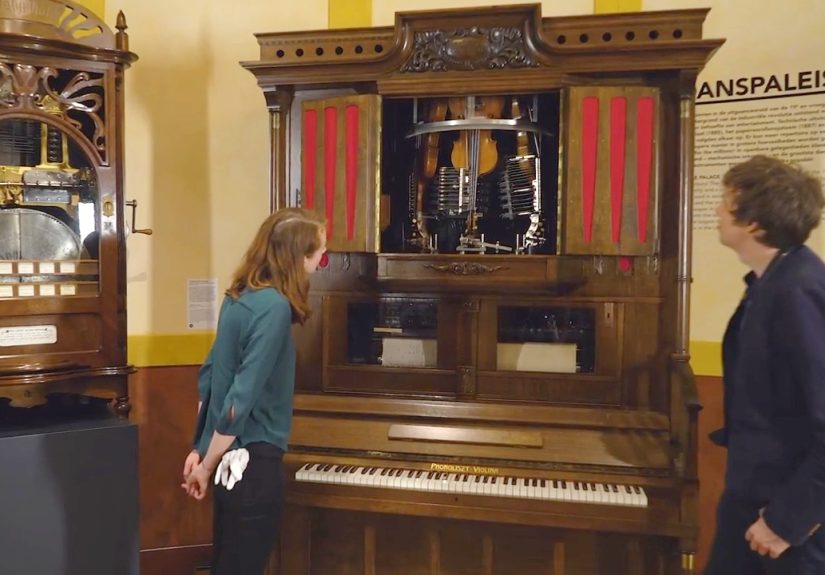
The Phonoliszt-Violina solved the problem in spectacular fashion. Instead of one violin doing everything, it used multiple violins mounted vertically inside a cabinet. Each violin was assigned a specific active string, and mechanical fingers stopped the strings at the right places. A large rotating circular bow, fitted with horsehair, moved continuously and created the bowed sound as the violins were pressed against it. Below the violins, a self-playing piano provided accompaniment.
To early 20th-century audiences, this was not just a clever gadget. It looked like a cabinet had swallowed a conservatory student and become more punctual. At the 1910 Brussels International Exposition, the instrument’s reputation soared, and the “Eighth Wonder of the World” label helped turn it into a legend of mechanical music.
How the Self-Playing Violin Actually Worked
The most fascinating part of the self-playing violin is not merely that it played music, but how physical and delicate the process was. The Phonoliszt-Violina relied on a paper music roll, much like a player piano. Holes in the roll controlled the timing of notes and mechanical actions. As the roll moved through the system, air pressure, bellows, valves, and linkages translated those holes into performance instructions.
Think of the paper roll as antique software. It stored the music in a readable format, and the machine executed the program. Instead of code running through silicon, the information traveled through paper, air, wood, metal, leather, and horsehair. It was analog automation with a top hat.
The Rotating Bow
The rotating bow was the visual centerpiece. Human violinists move a bow back and forth across the strings. Hupfeld’s design used a circular bow that rotated continuously. The violins were positioned so they could be brought into contact with the bow when a note was needed. This avoided the need to imitate every back-and-forth bow stroke of a human arm, which would have turned the cabinet into a mechanical octopus with confidence issues.
The Mechanical Fingers
On a normal violin, the player’s left-hand fingers press the strings against the fingerboard to change pitch. In the Phonoliszt-Violina, mechanical “fingers” performed this task. These small actuators stopped the strings at predetermined positions, allowing the machine to produce different notes. The action had to be precise because a violin has no frets. Being slightly off on a violin is not charming; it is how you summon neighborhood complaints.
The Piano Accompaniment
The piano portion made the instrument more complete. The violin carried melody, while the piano added harmony, rhythm, and structure. This combination made the machine feel less like a laboratory demonstration and more like a miniature salon concert. It could perform popular pieces, classical arrangements, and music designed specifically for automatic instruments.
The American Cousin: Mills Violano-Virtuoso
Across the Atlantic, the Mills Novelty Company of Chicago created another major self-playing violin machine: the Mills Violano-Virtuoso. While the Hupfeld Phonoliszt-Violina became famous for its multiple vertical violins and rotating horsehair bow, the Violano-Virtuoso took a different engineering path. It combined a real violin with a keyboardless piano and used electric motors, electromagnets, perforated paper rolls, and small bowing wheels.
The Violano-Virtuoso grew out of earlier work by inventor Henry Konrad Sandell, whose electric self-playing violin patent was assigned to Mills. Early models focused on the violin alone, but adding piano accompaniment made the machine far more entertaining and commercially appealing. By the 1910s, the Violano-Virtuoso had become a coin-operated marvel suitable for public venues and, in some versions, private homes.
The American machine was proudly electromechanical. Instead of relying primarily on pneumatics like many player pianos, the Violano used electric power to activate its moving parts. Metal fingers stopped the strings, while rotating bowing discs set the strings vibrating. The piano mechanism supplied accompaniment, and the music roll told the whole contraption what to do. It was part instrument, part robot, part jukebox ancestor, and part “please do not let children climb inside this cabinet.”
Why Audiences Found It So Astonishing
To understand why the self-playing violin caused such excitement, it helps to remember the entertainment world of the early 1900s. Today, we carry millions of songs in our pockets. If we want violin music, we can stream a concerto while buying toothpaste. In 1910, hearing music on demand was still a special experience. Mechanical instruments gave people access to performances without needing a live musician present.
But the violin was different from a piano or a music box. The violin was associated with human expression, breath-like phrasing, and emotional nuance. It could sigh, shimmer, cry, flirt, and occasionally sound like a cat objecting to rent prices. Making a machine play it seemed almost impossible. That impossibility became the attraction.
The Phonoliszt-Violina did not need to equal the greatest human violinists to be impressive. Its wonder came from watching a complex system transform mechanical instructions into living acoustic sound. The machine made visible the hidden relationship between music and motion. It showed that performance could be analyzed, encoded, and reproduced through engineering, even if the soul of music remained stubbornly hard to bottle.
Self-Playing Violins and the Birth of Music Automation
The self-playing violin belongs to a larger story: the long human dream of automating art. From ancient water organs to clockwork figures, player pianos, orchestrions, synthesizers, MIDI instruments, and modern music software, people have always tried to build machines that perform. The self-playing violin is one of the most dramatic chapters because it tackled one of the least machine-friendly instruments in the orchestra.
In a way, these machines anticipated modern debates about automation and creativity. When a self-playing violin performs a piece, who is the artist? The composer? The arranger who prepared the roll? The engineer who designed the mechanism? The craftsperson who restored the machine? The machine itself? The answer is probably “yes,” followed by a long argument among music historians over excellent coffee.
What makes the self-playing violin special is that it does not replace music with machinery. It reveals the machinery already hidden inside performance. A violinist’s hand is biological engineering. Bowing is controlled physics. Fingering is precision positioning. Tone is friction, pressure, resonance, and judgment. The self-playing violin turns those invisible skills into visible parts.
Why These Machines Still Matter Today
Self-playing violins are not just antique curiosities. They continue to matter because they connect music, robotics, mechanical design, acoustics, preservation, and cultural history. A restored Phonoliszt-Violina or Violano-Virtuoso can teach modern audiences how advanced early automation really was. These machines were not crude toys. They were sophisticated systems built with patience, craftsmanship, and mechanical imagination.
They also challenge the idea that technological wonder belongs only to the digital age. Long before touchscreens, microchips, or cloud computing, inventors were building cabinets capable of reading stored information and turning it into coordinated musical action. That is a form of programming. It simply smelled more like polished wood and machine oil.
For musicians, the self-playing violin is a reminder of what human players do so beautifully. The machine can reproduce notes, rhythm, and some expression, but it also highlights how much subtle decision-making a human performer brings to every phrase. The best violinists do not merely play the notes. They breathe through them. They bend time. They make silence part of the music. A machine can amaze us, but a human can still break our hearts with one note. That is not a weakness of the machine; it is the reason both are worth hearing.
Modern Echoes: From Mechanical Cabinets to Violin Robots
The dream did not end with Hupfeld and Mills. Modern engineers and artists have continued exploring robotic violin performance. Contemporary projects use sensors, motors, MIDI files, software, and robotic control systems to bow and finger real violins. Some are experimental sculptures. Others are research projects. Many are delightfully overcomplicated in the best possible way.
These newer inventions show how difficult violin automation remains. Even with computers, motors, and digital control, the violin still resists easy mechanical imitation. Bow angle, pressure, speed, string changes, pitch accuracy, vibrato, and articulation all matter. A robot can play a violin, but making it sound expressive is another mountain entirely. The violin remains the tiny wooden diva of the instrument world.
That is why the early self-playing violin machines remain so impressive. They accomplished so much with the tools of their time. No laptops. No machine learning. No tiny cameras analyzing bow position. Just clever mechanics, careful design, and an almost unreasonable belief that a violin could be persuaded to perform inside a cabinet.
Design, Craftsmanship, and the Beauty of Overengineering
Part of the appeal of the self-playing violin is visual. These machines look magnificent. Many were housed in fine wooden cabinets with glass panels, decorative trim, and carefully arranged mechanisms. They were meant to be seen as well as heard. When the cabinet doors opened, the audience could watch the parts move: bows spinning, fingers lifting, paper rolls turning, piano hammers striking.
This theatricality matters. The self-playing violin was not only a music machine; it was a performance object. The machine performed music, but it also performed technology. It said, “Look what human ingenuity can do.” In an age of industrial optimism, that message had power.
Today, when many devices hide their workings behind sealed screens and smooth plastic, these old machines feel refreshingly honest. You can see the cause and effect. A hole in paper triggers a valve. A valve moves a mechanism. A mechanism touches a string. The string vibrates, the cabinet resonates, and suddenly the room has music. It is complicated, but it is not invisible. That visible complexity is part of its beauty.
The Collector and Museum Experience
Seeing a self-playing violin in person is very different from watching a video. The sound is acoustic, so it occupies the room like a live instrument. You hear the strings, the piano, the mechanical movement, and the cabinet’s resonance. You may also hear little clicks, breaths, and motions from the mechanism. Far from ruining the experience, those sounds remind you that the machine is alive in its own peculiar way.
Collectors and museums face a serious challenge when preserving these instruments. A self-playing violin is not a static object like a painting. Its meaning depends on movement. If it cannot play, a major part of its identity disappears. Restoration requires knowledge of music, mechanics, woodworking, electrical systems, paper rolls, tuning, and historical materials. In other words, you need a musician, engineer, archivist, and patient wizard on the same team.
When restored properly, these machines can still surprise modern listeners. The music may not sound like a modern concert hall performance, but it carries a special atmosphere. It is a voice from the age when automation was not silent, invisible, and hidden in apps. It was loud, polished, physical, and proud of itself.
Lessons From the Eighth Wonder
The self-playing violin teaches several useful lessons. First, automation is older than we think. Second, difficult problems often inspire the most creative engineering. Third, music and technology have never been enemies; they have been awkward dance partners for centuries. Sometimes one steps on the other’s foot, but occasionally they produce something unforgettable.
The Phonoliszt-Violina and the Violano-Virtuoso also remind us that wonder is not only about perfection. These machines are magical partly because they are so complex, so visible, and so improbable. A flawless digital playback file is convenient, but it rarely makes people gasp. A cabinet full of violins playing themselves? That still feels like a magic trick performed by a watchmaker.
Personal Experiences and Reflections on Self-Playing Violins
The first time someone encounters a self-playing violin, the reaction is usually a mix of disbelief and laughter. Not mocking laughter, but the kind that escapes when your brain briefly refuses to process what your eyes are reporting. A violin is supposed to need a person. We expect shoulders, fingers, a chin rest, and the serious expression of someone who has practiced scales for many years. When the music comes from a cabinet instead, the experience feels like catching furniture with a secret hobby.
That reaction is valuable because it restores a sense of wonder that modern technology often dulls. We are used to miracles arriving in boring packaging. A phone can translate languages, navigate cities, and record studio-quality video, but because it is a flat rectangle, we stop being amazed. A self-playing violin does the opposite. It makes the technology visible and theatrical. Every moving part seems to announce, “Yes, this is difficult, and yes, we are doing it anyway.”
For anyone who loves music, the machine creates a strange emotional split. On one hand, it is impressive to hear a violin produce notes without a player. On the other hand, it makes you appreciate human musicians even more. The machine can coordinate actions, but the human performer brings intention. A violinist listens while playing and adjusts constantly. The bow may lean a little more into a phrase. A note may arrive a breath late for emotional effect. Vibrato may widen or disappear. These tiny choices are where much of the music lives.
For engineers and makers, the self-playing violin is a masterclass in problem-solving. It takes a complicated human activity and breaks it into smaller mechanical tasks: select the note, stop the string, bow the string, control volume, coordinate timing, and blend with accompaniment. Each task is solvable, but none is trivial. The genius lies in making all of them happen together reliably enough that an audience hears music rather than a cabinet having a nervous breakdown.
For writers and storytellers, the self-playing violin is a perfect metaphor. It sits between past and future, art and machinery, elegance and absurdity. It is beautiful because it tries something almost unreasonable. That is why the “Eighth Wonder of the World” label still works. The wonder is not just that the machine plays. The wonder is that someone looked at one of the most expressive instruments ever made and said, “Let’s build a mechanism for that.” Then, somehow, they did.
In a world increasingly shaped by artificial intelligence and automation, the self-playing violin feels newly relevant. It reminds us that every generation has its own version of the same question: What can machines do, and what should remain human? The answer is not simple, but the self-playing violin offers a graceful hint. Machines can extend imagination. They can preserve performances, entertain crowds, and reveal the structure beneath art. But they do not cancel human creativity. They depend on it.
That may be the best reason to keep celebrating these instruments. A self-playing violin is not a replacement for a musician. It is a love letter to music written in gears, bellows, paper, wires, and wood. It proves that technology can be playful, elegant, and deeply human, especially when it is trying very hard to make a violin sing.
Conclusion: Why the Self-Playing Violin Still Feels Like a Wonder
The self-playing violin remains one of the most charming achievements in mechanical music history. The Hupfeld Phonoliszt-Violina earned its “Eighth Wonder of the World” reputation by doing what many thought impossible: making violins perform automatically with convincing musical presence. The Mills Violano-Virtuoso brought a similar marvel into American entertainment culture, combining violin, piano, paper rolls, electric motors, and coin-operated convenience.
More than a century later, these machines still inspire because they are both brilliant and slightly ridiculous. They show us that engineering can be poetic, that music can be mechanical without losing all its magic, and that human curiosity is capable of building astonishing things for the simple joy of hearing a tune. In the end, the self-playing violin is not just a machine that plays music. It is a reminder that wonder often begins when someone asks an unreasonable question and refuses to let common sense ruin the fun.