Table of Contents >> Show >> Hide
- Introduction: A Fighter Jet Question With Nuclear-Sized Consequences
- China’s Nuclear Air Leg Is No Longer Theoretical
- Why Fighters Enter the Conversation
- J-20: The Stealth Candidate
- J-16: The Practical Heavy Fighter Option
- Why China Has Historically Avoided Tactical Nuclear Fighters
- What Would Motivate Beijing?
- Reasons to Be Skeptical
- What Signs Should Analysts Watch?
- Regional Impact: Why U.S. Allies Care
- So, Will Chinese Fighters Soon Take On a New Nuclear Role?
- Experience-Based Perspective: How to Read This Topic Without Falling for Hype
- Conclusion
Note: This article analyzes public, open-source information only. It does not provide operational instructions, classified details, or technical guidance for weapon use.
Introduction: A Fighter Jet Question With Nuclear-Sized Consequences
When people talk about nuclear weapons, they usually picture submarines hiding under the ocean, missiles sitting in hardened silos, or big bombers cruising across the sky like extremely expensive thunderclouds. Fighter jets are not usually the first image that comes to mindunless you follow NATO’s dual-capable aircraft mission, in which case you probably have stronger opinions about aircraft certification than most people have about coffee.
So the question “Will Chinese fighters soon take on a new nuclear role?” is not just aviation gossip. It touches on China’s nuclear modernization, the future of the People’s Liberation Army Air Force, regional deterrence in the Indo-Pacific, and the possibility that Beijing may be exploring more flexible air-delivered nuclear options. The short answer is: possibly, but not publicly confirmed. The better answer is more interesting: China already has a growing air-based nuclear capability centered on bombers, while the idea of nuclear-capable fighters remains a plausible but speculative next step.
That distinction matters. A confirmed nuclear bomber force is one thing. A stealth fighter or heavy multirole fighter adapted for nuclear delivery would be a different signal altogether. It would suggest that China wants not only a survivable strategic deterrent, but also more varied ways to complicate U.S. and allied planning in the Western Pacific.
China’s Nuclear Air Leg Is No Longer Theoretical
For decades, China’s nuclear deterrent was mostly associated with land-based missiles. Beijing’s traditional posture emphasized a relatively small nuclear force, a declared no-first-use policy, and the ability to retaliate after a nuclear attack. That posture has not disappeared, but the hardware around it has changed dramatically.
Public arms-control research now estimates that China has a rapidly expanding nuclear arsenal, with hundreds of warheads and more delivery systems under development. The most visible change is the move toward a fuller nuclear triad: land-based missiles, submarine-launched missiles, and aircraft-delivered nuclear weapons. That last categorythe air legused to be the weakest and least developed piece of China’s deterrent puzzle. Today, it is becoming much harder to ignore.
The H-6N bomber is the star of this air-leg story. It is not a stealthy flying-wing bomber like the U.S. B-2 or B-21. It is a modernized Chinese derivative of an older Soviet-era bomber design. But the H-6N has been adapted for longer-range missions, aerial refueling, and carriage of an air-launched ballistic missile. In public analysis, that missile is commonly associated with the JL-1, also known as JingLei-1, which appeared in China’s 2025 military parade as an air-delivered nuclear system.
That matters because it gives China an airborne nuclear delivery path that does not require a bomber to fly directly over a heavily defended target. Instead, the bomber can remain farther away and rely on a standoff missile. In plain English: the plane does not have to knock on the front door if it can send a very scary package from the driveway.
Why Fighters Enter the Conversation
The fighter question gained attention after public discussion about cooperation between Chinese aircraft designers and China’s nuclear weapons research establishment. Some observers interpreted those comments as a hint that Chengdu-built aircraftpossibly including the J-20 stealth fightercould be studied for future nuclear roles. That is not the same as proof. A hint is not a deployment. A conference remark is not a squadron. Still, in defense analysis, hints can be worth watching when they fit a broader trend.
China is modernizing nearly every part of its military aerospace sector. The J-20 has moved from symbol to operational reality. The twin-seat J-20S variant has attracted attention because of its possible command-and-control, electronic warfare, precision strike, and manned-unmanned teaming roles. Meanwhile, the J-16 heavy fighter gives China a powerful non-stealth multirole platform with longer reach and heavier payload capacity than smaller fighters.
If China wanted a fighter-based nuclear option, analysts often point to three broad candidates: a stealth aircraft such as the J-20, a heavy multirole aircraft such as the J-16, or a future combat aircraft not yet fully revealed. Each option would send a different message.
J-20: The Stealth Candidate
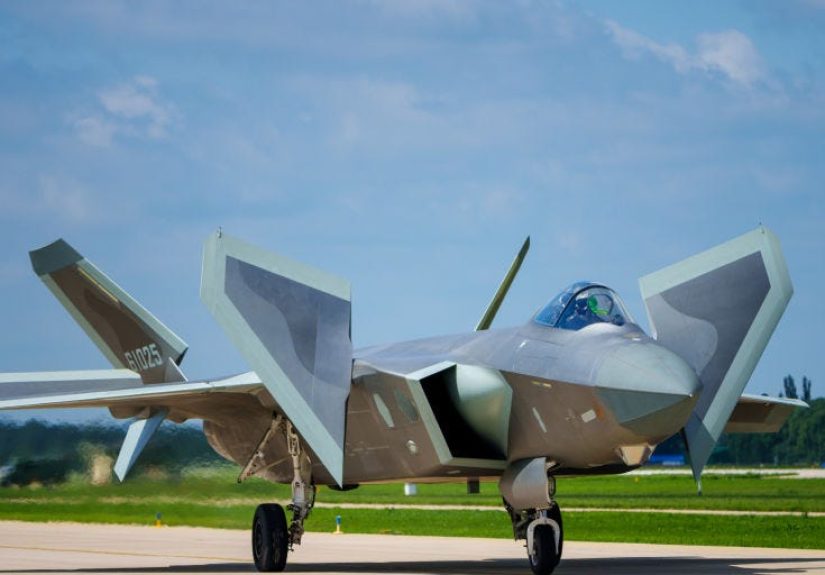
The J-20 is China’s premier fifth-generation fighter. It was originally seen mainly as an air-superiority platform designed to threaten enemy aircraft, tankers, surveillance planes, and support assets at long range. Over time, public discussion has increasingly treated the J-20 as a more flexible aircraft, especially as new variants appear.
A nuclear-capable J-20 would make sense from one angle: stealth. A fighter that can reduce its radar signature may have a better chance of penetrating defended airspace than a large, non-stealth bomber. That is the basic logic behind the U.S. F-35A becoming a dual-capable aircraft for the B61-12 nuclear gravity bomb. Stealth does not make an aircraft magicradars do not simply throw up their hands and go homebut it can complicate detection, tracking, and interception.
For China, a nuclear J-20 would be especially relevant before the long-rumored H-20 stealth bomber becomes operational. The H-20, if and when it appears in meaningful numbers, would likely be a more natural platform for a penetrating nuclear strike mission. Until then, a fighter option could theoretically provide a bridge capability.
But there are problems. The J-20’s internal weapons bay was not publicly designed around nuclear delivery. Any nuclear weapon carried internally would need to fit within the aircraft’s stealth-preserving configuration. External carriage would likely reduce stealth, which defeats much of the purpose. That means a nuclear J-20 would require careful integration, certification, training, command procedures, and safety controlsnot just a dramatic poster at an air show.
J-16: The Practical Heavy Fighter Option
The J-16 may be less glamorous than the J-20, but it is arguably a more practical aircraft for some strike missions. It is a large twin-engine multirole fighter derived from the Flanker family, with strong payload capacity and useful range. In a purely technical sense, a heavy fighter like the J-16 is easier to imagine carrying larger weapons than a smaller fighter such as the J-10.
However, the J-16 is not stealthy. In a nuclear role, that limits how it could be used. It would be more suitable for standoff delivery or regional signaling than for deep penetration into advanced air defenses. If China wanted a visible, flexible, theater-range nuclear signal, a J-16-type platform could make sense. If China wanted a stealthy first-rank penetration platform, the J-20 or a future bomber would make more sense.
This is why the fighter question is not simply “Can a jet carry a weapon?” In nuclear strategy, the better question is: what mission would the aircraft serve? Deterrence? Signaling? Regional strike? Backup delivery? Political theater with wings? The answer changes the platform.
Why China Has Historically Avoided Tactical Nuclear Fighters
China’s nuclear doctrine has traditionally differed from U.S. and Russian approaches. Beijing has long emphasized no first use and assured retaliation. That posture made a large force of tactical nuclear fighters less central to Chinese planning. During the Cold War, the United States and NATO developed dual-capable aircraft partly to deter a massive conventional or nuclear conflict in Europe. Russia inherited and expanded a large nonstrategic nuclear arsenal. China took a different path.
There were historical exceptions. China reportedly experimented with modified Q-5 attack aircraft decades ago, but that did not become a major visible pillar of Chinese nuclear posture. For most of the modern era, Chinese nuclear forces were associated more with missiles than tactical aircraft.
That is why a nuclear role for current Chinese fighters would be significant. It would not be just another aircraft upgrade. It would suggest a shift toward a more diversified nuclear toolkit, possibly including more flexible regional options. In strategic terms, that is like moving from a simple toolbox to a garage full of specialized equipment. Useful? Maybe. Stabilizing? Not necessarily.
What Would Motivate Beijing?
1. Strengthening Regional Deterrence
The Western Pacific is full of potential flashpoints: Taiwan, the East China Sea, the South China Sea, Guam, Japan, and U.S. alliance networks. A fighter-based nuclear capability could give China another way to signal resolve during a crisis. Even if never used, such a capability could force adversaries to think harder about escalation.
2. Complicating U.S. and Allied Defense Planning
Military planners dislike uncertainty. If China’s nuclear delivery options include land missiles, submarines, bombers, and possibly fighters, defenders must monitor more platforms and more scenarios. That does not mean China would use nuclear weapons first. It does mean crisis management becomes more complicated.
3. Matching Global Nuclear Trends
The United States has modernized air-delivered nuclear weapons through the B61-12 program and certified the F-35A as a nuclear-capable stealth fighter. Russia maintains a broad set of nuclear-capable systems. China may see fighter-based nuclear options as part of becoming a more complete great-power nuclear force.
4. Filling the Gap Before the H-20
If China’s future stealth bomber is delayed or produced slowly, a nuclear-capable fighter could provide an interim option. It would not fully replace a strategic bomber, but it could add flexibility while China continues developing long-range aviation.
Reasons to Be Skeptical
The strongest argument against a near-term Chinese nuclear fighter role is simple: there is no public confirmation. Defense watchers are good at connecting dots, but sometimes the dots spell “maybe” instead of “definitely.”
There are also institutional barriers. Nuclear weapons require strict command and control, specialized storage, security procedures, aircraft certification, crew training, and political authorization structures. Assigning a fighter unit to a nuclear mission is not like adding a new paint scheme or installing a software patch. It changes the identity of the unit and the risks surrounding it.
China may also prefer to keep its air nuclear mission centered on bombers because that is more consistent with strategic deterrence than tactical nuclear warfighting. The H-6N and future H-20 fit more naturally into a triad structure. Fighters, by contrast, can blur the line between conventional and nuclear missions. In a crisis, that ambiguity can be dangerous. If an opponent sees aircraft taking off and cannot tell whether the mission is conventional or nuclear, everyone’s blood pressure gets promoted to general officer.
What Signs Should Analysts Watch?
Because official confirmation may not arrive quickly, public analysts will watch indirect indicators. These could include unusual statements from Chinese defense institutions, changes in training patterns, new aircraft variants with expanded strike roles, evidence of specialized infrastructure at air bases, or public appearances of new air-launched weapons sized for fighter carriage.
Still, caution is essential. Not every new missile is nuclear. Not every stealth aircraft is a nuclear platform. Not every speech at a technical institute is a secret doctrine reveal. The best analysis separates what is known, what is likely, and what is just aviation-flavored fortune-telling.
Regional Impact: Why U.S. Allies Care
A Chinese fighter-based nuclear role would be watched closely in Japan, South Korea, Australia, the Philippines, and Taiwan. It would also matter to U.S. forces stationed across the region. Even if the capability were limited, its psychological and strategic effects could be large.
For allies, the concern would not only be nuclear attack. It would be escalation control. A crisis around Taiwan, for example, could involve conventional missile strikes, air and naval operations, cyberattacks, space disruptions, and intense political signaling. Add ambiguous dual-capable aircraft to that mix, and the risk of miscalculation rises.
That is why arms-control experts often emphasize transparency, crisis communication, and clear signaling. The more nuclear and conventional systems overlap, the more important communication becomes. Unfortunately, communication is often the first thing that gets worse during a crisisright when it is needed most. International security sometimes has the user interface of a 1998 printer driver.
So, Will Chinese Fighters Soon Take On a New Nuclear Role?
The most balanced answer is: not proven, but increasingly plausible. China’s confirmed air nuclear modernization is centered on bombers, especially the H-6N and its air-launched missile role. The future H-20 bomber remains the more obvious long-term platform for a penetrating strategic air mission. But the J-20, J-20S, J-16, or a future combat aircraft could become part of a broader nuclear study or eventual capability.
If China does move in that direction, it would likely be driven by deterrence flexibility, regional signaling, and the desire to complicate U.S. and allied planning. It would not necessarily mean China has abandoned no first use. But it would show that Beijing wants more options under the nuclear umbrella, and options can change how crises feel even before they change how wars are fought.
For now, the safest conclusion is that Chinese fighters are not publicly confirmed as nuclear-delivery aircraft. But the strategic environment that would make such a role attractive is very real. China’s nuclear force is expanding. Its air force is becoming more capable. Its stealth and strike aircraft are evolving. In that context, the fighter-nuclear question is not wild speculation. It is a warning light on the dashboardmaybe not a fire, but definitely not something to cover with duct tape.
Experience-Based Perspective: How to Read This Topic Without Falling for Hype
One of the biggest lessons from following modern military aviation is that new aircraft rumors age like bananas. One week, a blurry photo appears online. The next week, someone declares that the balance of power has changed forever. A month later, better information arrives and everyone quietly edits their confidence level. The topic of Chinese fighters and nuclear roles deserves a calmer approach.
A useful experience-based rule is to separate capability from mission. A fighter may be physically capable of carrying many types of weapons, but that does not mean it has been assigned a nuclear role. Nuclear certification is a political, technical, and organizational process. It involves safety rules, command authority, special training, secure storage, and long-term doctrine. Without those pieces, a theoretical capability remains theoretical.
Another lesson is to watch the boring details. Military parades are dramatic, but base infrastructure, repeated training patterns, official wording, and procurement behavior often matter more. When China displayed the JL-1 air-launched missile with the broader nuclear triad, that was a meaningful public signal. When Chinese state media describes expanded J-20S mission sets, that is also worth noting. But neither automatically proves that a J-20 is carrying nuclear weapons. In defense analysis, “interesting” and “confirmed” are cousins, not twins.
It also helps to compare China with other nuclear powers without assuming China will copy them exactly. The United States uses dual-capable fighters as part of extended deterrence, especially in the NATO context. Russia has its own large mix of nonstrategic nuclear systems. China has historically emphasized a different doctrine, centered on retaliation and no first use. If Beijing adds fighter-based nuclear options, it may do so in a Chinese way: controlled by centralized authority, tied to strategic signaling, and integrated gradually rather than announced with fireworks and a theme song.
For writers, students, and readers, the best approach is disciplined curiosity. Avoid two traps. The first trap is complacency: assuming China will never change because its past doctrine was restrained. The second trap is alarmism: assuming every new aircraft variant is secretly nuclear. The truth is usually more complicated and more useful. China is clearly expanding and modernizing its nuclear forces. Its air force is clearly gaining range, stealth, sensors, and strike options. Whether fighters become nuclear platforms is still uncertain, but the trend line makes the question reasonable.
In practical publishing terms, this topic works best when framed as analysis, not prophecy. A strong article should say what is known, what is suspected, and what remains unproven. That makes the piece more credible for readers and more durable for search engines. After all, nothing ruins an evergreen defense article faster than declaring “confirmed!” when the evidence only says “hmm, interesting.”
The experience here is simple: treat nuclear aviation claims like a runway at night. Move carefully, use multiple lights, and never assume the shape in the distance is exactly what it first appears to be.
Conclusion
Chinese fighters may one day take on a nuclear role, but public evidence has not yet confirmed that they have. The more solid story is China’s rapid nuclear modernization and the emergence of a real air-delivered nuclear capability through the H-6N bomber and JL-1 missile. Fighter aircraft such as the J-20, J-20S, or J-16 could become relevant if Beijing wants more flexible regional deterrence options, but that would represent a major doctrinal and operational step.
For now, the smart answer is cautious: watch the aircraft, watch the weapons, watch the doctrine, and watch what China chooses to reveal. In nuclear strategy, the quiet details often speak louder than the loudest parade.