Table of Contents >> Show >> Hide
- Before You Hide Anything: A Quick Reality Check
- 10 Clever Ways to Hide a TV in Plain Sight
- 1) Turn It Into “Art” With a Frame (or a Frame-Style TV)
- 2) Build a Gallery Wall That Camouflages the Screen
- 3) Slide a Statement Artwork Panel Over It
- 4) Hide It Behind Cabinet Doors (Built-In or Freestanding)
- 5) Add Sliding Barn Doors or Shutters for Architectural Style
- 6) Use a Mirror Solution (Because Nothing Says “Fancy” Like Secret Tech)
- 7) Go Full James Bond With a TV Lift Cabinet
- 8) Recess It Into the Wall and Disguise the Surrounding Finish
- 9) Use a Pull-Down Projector Screen (and Keep the TV Elsewhere)
- 10) Add a Soft Cover: Curtains, Panels, or a Fabric “Screen”
- Make It Look Intentional: Design + Function Tips That Matter
- Common Mistakes to Avoid
- Conclusion: A Screen-Free Look Without Giving Up Movie Night
- Experiences That Make These Ideas “Real” (The Stuff You Learn After Living With a Hidden TV)
TVs are great. The way they look when they’re off? Less “cozy living room” and more “giant black
rectangle judging your throw pillows.” If you love movie nights but don’t want your décor to scream
electronics aisle, you’re in luck: designers and DIYers have come up with plenty of ways to
conceal a flat screen without sacrificing comfort, viewing angles, or your sanity.
This guide breaks down 10 smart, realistic approachesfrom renter-friendly camouflage to
full-on “it rises from the cabinet like a magician’s assistant” drama. You’ll also get planning tips
(cords! ventilation! sound!) so your hidden TV setup looks intentional, not improvised.
Before You Hide Anything: A Quick Reality Check
Hiding a TV isn’t about pretending you don’t watch TV. It’s about controlling what your room
looks like when you’re not watching. A good concealment plan does three things:
- Reduces visual clutter by minimizing the “black void” effect.
- Protects your layout so seating isn’t forced into a “worship the screen” formation.
- Keeps things practical (easy access, good airflow, and no remote-control tantrums).
If your TV is wall-mounted, you’ll lean toward panels, art covers, doors, or a gallery wall approach.
If it’s on a stand, you’ve got even more options: cabinets, lift consoles, and furniture tricks.
10 Clever Ways to Hide a TV in Plain Sight
1) Turn It Into “Art” With a Frame (or a Frame-Style TV)
The simplest way to make a TV blend in is to treat it like artwork. Add a custom bezel/frame around
the screen and style it with a picture light aboveyour eye reads “gallery moment,” not “sports bar.”
If you want the most seamless version, consider a frame-style TV that displays artwork when idle.
Design tip: Match the frame finish to other frames in the room (black, walnut, brass, etc.).
The goal is consistency. A random white “TV frame” in a room full of warm wood frames will stick out
like a marshmallow in a charcuterie board.
Best for: Minimalist rooms, traditional spaces, and anyone who wants “hidden” without moving parts.
2) Build a Gallery Wall That Camouflages the Screen
A gallery wall works because it changes the visual hierarchy. Instead of one big rectangle dominating the wall,
the TV becomes one element among many. The trick is to “frame” the TV with surrounding pieces so it feels
deliberately placed.
- Use frames that are similar in color/finish to reduce contrast.
- Keep art sizes varied (some medium, a couple large, a few small) so the TV doesn’t become the largest “piece.”
- Repeat a color from the room (rug, pillows, paint) to make it all feel connected.
Best for: Eclectic, transitional, and modern roomsespecially if you like layered décor.
3) Slide a Statement Artwork Panel Over It
Want a dramatic “now you see it, now you don’t” moment? Install a sliding art panel that covers the TV when
it’s off. This can be done with a barn-door style track, a top rail system, or concealed sliders depending on the look
you want. When you’re ready to watch, the artwork glides aside.
What makes it work: Choose a piece that’s large enough to fully cover the screen, and position the track
so it clears any soundbar or wall sconces. Also: keep the art lightweight enough that the hardware isn’t doing
an Olympic deadlift every time you open it.
Best for: Anyone who wants a clean wall when the TV is off, without committing to built-ins.
4) Hide It Behind Cabinet Doors (Built-In or Freestanding)
Cabinets are classic for a reason: close the doors and your living room instantly looks calmer. You can do this with
a custom built-in, a media console with doors, or a recessed wall cabinet designed to hold a TV.
Options that look intentional: bifold doors, pocket doors, cane or slatted fronts, or flat-panel doors that
match nearby millwork. If you’re customizing, plan for ventilation and cord routing from day one.
Best for: Traditional spaces, formal living rooms, and people who want to hide more than just the TV
(cable boxes, game consoles, and the “mystery cord collection”).
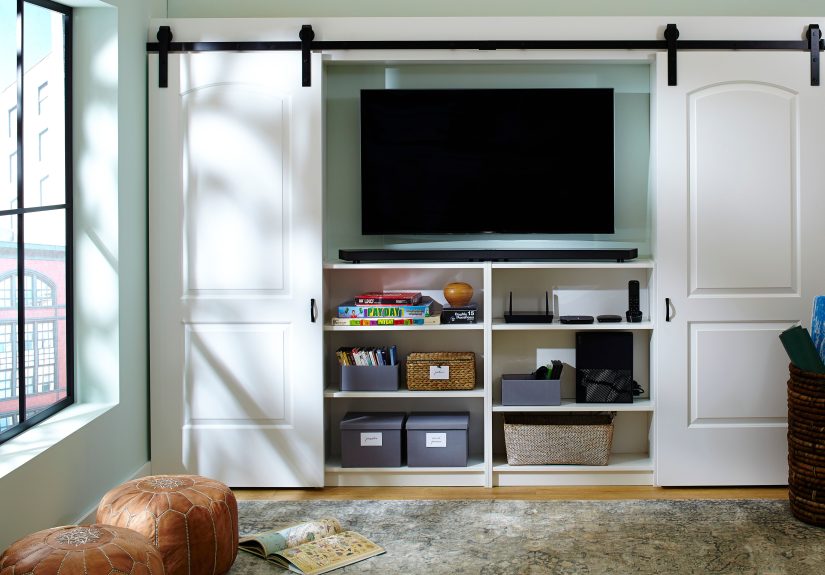
5) Add Sliding Barn Doors or Shutters for Architectural Style
Sliding barn doors can feel rustic, modern farmhouse, or even sleekdepending on the door style and hardware.
Shutters can lean coastal, cottage, or classic. Either way, you’re adding a feature that looks decorative even when
it’s doing its “cover the TV” job.
Make it look elevated: choose doors with clean lines, paint or stain them to relate to other finishes in the room,
and keep hardware proportional. Overly chunky black hardware can read “DIY aisle” if the rest of your room is refined.
Best for: Feature walls, TV-over-fireplace setups (when properly planned), and anyone craving architectural character.
6) Use a Mirror Solution (Because Nothing Says “Fancy” Like Secret Tech)
Mirror TVs are the ultimate “hidden in plain sight” trick: when the TV is off, you see a mirror; when it’s on,
the picture shines through (with the right mirror technology). Another approach is placing a decorative mirror on
a retractable system that moves to reveal the TV behind it.
Important note: This is one of the more technical optionsbest handled with the right products or pro help
but the payoff is huge in bathrooms, bedrooms, and elegant living rooms where you don’t want a screen visually “parked.”
Best for: High-style rooms, primary suites, and spaces where a mirror already makes sense.
7) Go Full James Bond With a TV Lift Cabinet
TV lift cabinets let the screen rise from inside a console or cabinet at the push of a button. When it’s down,
you get a clean surface (or a normal-looking piece of furniture). When it’s up, it’s movie time.
- Bedroom favorite: a lift cabinet at the foot of the bed.
- Living room favorite: a lift credenza that doubles as storage.
- Unexpected win: hidden TVs in bathrooms or multipurpose rooms.
Best for: People who want a dramatic transformation and a totally screen-free vibe the rest of the day.
8) Recess It Into the Wall and Disguise the Surrounding Finish
If you can recess the TV (or build a flush cabinet), you reduce shadows and visual depth, which makes everything
feel calmer. The stealth move is finishing the surrounding area in the same materialpaint, plaster, slats, or paneling
so the TV “disappears” when it’s dark.
Designer trick: A textured wall treatment (like plaster or limewash-style finishes) helps break up the harsh outline
of a screen. Pair that with a darker wall color to reduce contrast and you’ve got camouflage that looks intentional.
Best for: Renovations, built-ins, and homeowners who want the cleanest possible look.
9) Use a Pull-Down Projector Screen (and Keep the TV Elsewhere)
If your goal is a living room that never looks like a “TV room,” a projector screen can be the answer. A ceiling-mounted,
roll-down screen appears only when you need it. You can pair it with a projector on a shelf, in a cabinet, or even a
ceiling lift system if you’re going all-in.
Why it’s clever: Your wall stays art-first, architecture-first, or fireplace-first. Entertainment becomes a temporary setup,
not the room’s permanent focal point.
Best for: Movie lovers, minimalist spaces, and rooms where a big screen would otherwise dominate.
10) Add a Soft Cover: Curtains, Panels, or a Fabric “Screen”
Not every solution needs carpentry. Curtains or fabric panels can hide a TV with zero commitmentespecially if the TV is
placed within a niche, between built-ins, or on a wall where drapery already makes sense.
- Use a ceiling-mounted track for a modern “hotel” feel.
- Try a Roman shade if you want a tailored look.
- Choose heavier fabric if you want the cover to feel purposeful, not flimsy.
Best for: Renters, frequent redecorators, and anyone who wants a quick, reversible fix.
Make It Look Intentional: Design + Function Tips That Matter
Plan the Cords Like a Grown-Up
Even the prettiest hidden TV idea can be undone by visible wires. Use in-wall cable routing (where appropriate),
paintable cord covers, or route everything inside cabinets with a grommeted hole. Keep power strips and adapters
secured and accessiblefuture you will thank present you.
Don’t Cook Your Electronics
Cabinets and hidden compartments need airflow. Leave space around the TV and devices, consider vented doors or
hidden vents, and avoid sealing components in an airtight box. If your setup includes a receiver, game console, or streaming
box, plan for extra ventilation and easy access.
Think About Sound Before You Close the Doors
If your TV hides behind doors or panels, sound can get muffled. Options:
- Use a soundbar mounted outside the cabinet area.
- Choose vented or slatted fronts that let sound pass through.
- Consider separate speakers (or at least don’t trap your audio like it’s grounded).
Keep the Remote Happy
Some concealed setups block IR signals. If your devices don’t respond when the doors are closed, you may need
an IR repeater, a hub-based remote, or to position devices where signals can still reach them. Translation:
your hidden TV should not become a “stand here, wave remote, whisper threats” situation.
Common Mistakes to Avoid
- Hiding the TV but spotlighting it with décor. If everything points to the screen, it’s still the star.
- Using tiny art next to a giant TV. Scale matters. Match the visual weight of the screen.
- Skipping measurements. Tracks, doors, and panels need clearancesmeasure twice, install once.
- Forgetting viewing height. A hidden TV still needs to be comfortable to watch.
- Ignoring access. You’ll need to reach ports, reset devices, and occasionally wrestle an HDMI cable.
Conclusion: A Screen-Free Look Without Giving Up Movie Night
You don’t have to choose between good design and binge-watching. Whether you frame it like art, slide a statement panel
over it, tuck it behind doors, or let it rise up from a cabinet like it has a flair for drama, the best hidden TV solutions
share one thing: they make the room feel like a room again.
Pick the approach that fits your space, budget, and patience level. Then handle the detailscords, ventilation, and sound
so your clever disguise stays clever long after the novelty wears off.
Experiences That Make These Ideas “Real” (The Stuff You Learn After Living With a Hidden TV)
People often assume that hiding a TV is a one-and-done project: you install the thing, close the doors, and suddenly your living room
looks like a magazine spread 24/7. In reality, the best hidden TV setups tend to evolve over a few weeks of normal lifebecause daily habits
reveal the little friction points that design photos don’t show.
One common experience is the “I didn’t realize how much I’d love a calmer wall” moment. When the screen isn’t visually dominating the room,
you may find yourself noticing the rest of your space more: the texture of the wall treatment, the shape of a lamp, the way sunlight hits a piece
of art. It’s not that a TV is inherently ugly; it’s that the off-screen rectangle can feel like a visual stop sign. Once it’s disguised, the room
tends to feel more welcomingespecially in open-concept spaces where the living room is also the dining room, the homework zone, and the place
where someone is always asking, “Where did the dog hide that sock?”
The next lesson people report is that access matters more than you think. A cabinet with doors looks perfectuntil you need to swap
a streaming device, reset a router, or plug in a game console. This is why the most livable hidden TV cabinets include practical details: adjustable
shelves, a back opening for cords, and enough slack in cables so you’re not performing HDMI surgery. If you’re considering built-ins, planning a dedicated
“tech zone” inside a lower cabinet can keep everything tidy and reachable without turning setup day into a long-term commitment.
Another real-world takeaway: sound changes when you cover a TV. Sliding art panels and solid cabinet doors can soften audio in a way that’s
noticeable during dialogue-heavy shows. Many households end up pairing a concealed TV with a soundbar mounted outside the covered area, or they choose slatted
or cane doors that let sound pass through. It’s a small design choice that makes a big differencebecause nobody wants to crank the volume during quiet scenes and
then panic-mute when the action sequence hits.
For gallery-wall camouflage, the lived experience tends to be about maintenance and flexibility. People love how a gallery wall helps the TV blend in,
but they also discover that symmetry and spacing matter. A layout that looks “fine” can start to look off once you add seasonal décor, change frames, or switch to a larger TV.
A practical approach is leaving a little visual “breathing room” around the screen and choosing frames that can be rearranged without leaving the wall looking like a patchwork of
nail holes. Picture ledges can help too, since you can swap art without re-hanging everything.
Finally, many homeowners find that the best hidden TV solutions support how they actually relax. Some love the ritual of sliding a panel asidelike opening curtains before a show.
Others prefer the low-effort magic of Art Mode, where the screen simply reads as décor when idle. And people who choose lift cabinets often describe a surprising benefit: when the TV
is down, they’re less likely to default to “background TV,” which changes how the room feels day-to-day. Not everyone wants that (sports fans, we see you), but it’s a reminder that
design can influence habits in subtle ways.
The most consistent “wish we’d done this sooner” advice? Start with cords and placement. Even if you’re not ready for doors, panels, or a lift cabinet, cleaning up
cables and thoughtfully styling the area around the screen makes a huge impact. Then, when you’re ready to level up, your hidden TV project won’t be a rescue missionit’ll be an upgrade.