Table of Contents >> Show >> Hide
- What Makes a Stargazing Destination Cultural?
- Ancient Places Where the Stars Add Another Layer of Meaning
- 1. Chaco Culture National Historical Park, New Mexico
- 2. Mesa Verde National Park, Colorado
- 3. Hovenweep National Monument, Utah and Colorado
- 4. Salinas Pueblo Missions National Monument, New Mexico
- 5. Bandelier National Monument, New Mexico
- 6. Gila Cliff Dwellings National Monument, New Mexico
- 7. Tonto National Monument, Arizona
- 8. Wupatki National Monument, Arizona
- 9. Walnut Canyon National Monument, Arizona
- 10. Pipe Spring National Monument, Arizona
- Historic Landscapes That Shine After Sunset
- Historic Observatories Where Stargazing Becomes a Shared Tradition
- How to Plan a Respectful Cultural Stargazing Trip
- Experiences That Make Cultural Stargazing Unforgettable
- Conclusion
- SEO Tags
Stargazing is often sold as a simple activity: find darkness, tilt head upward, immediately develop a dramatic opinion about the Milky Way. But the best night-sky trips are rarely just about seeing more stars. They are about standing in places where people have watched, mapped, honored, feared, celebrated, and depended on the sky for centuries.
That is where cultural stargazing comes in. These destinations combine dark skies with archaeology, Indigenous heritage, historic landscapes, missions, trading routes, and observatories that helped shape public understanding of the universe. You are not merely looking at Saturn; you are looking at the same sky that helped communities mark seasons, navigate landscapes, tell stories, and organize daily life long before phones started notifying us that it is “partly cloudy.”
This guide highlights 20 cultural places to go stargazing in the United States. Some are ancient heritage sites, some are historic landscapes, and others are landmark observatories where public astronomy has become part of local culture. In many cases, historic ruins and trails close at sunset, so the best place to observe may be a campground, visitor center parking lot, designated overlook, or ranger-led event rather than the ruins themselves.
What Makes a Stargazing Destination Cultural?
A cultural stargazing destination is more than a dark patch on a light-pollution map. It is a place where the night sky connects with human history, memory, science, art, spirituality, architecture, or community identity. Ancient pueblos, mission ruins, traditional homelands, volcanic landscapes, historic observatories, and public telescope programs can all provide that deeper connection.
The respectful approach matters. Many Indigenous sky traditions are living knowledge systems, not decorative folklore for tourists. Listen to tribal guidance, attend official programs when available, avoid treating sacred sites as photo props, and remember that silence is often the most appropriate contribution a visitor can make. The stars have been there for a very long time; they do not need us to improve their branding.
Ancient Places Where the Stars Add Another Layer of Meaning
1. Chaco Culture National Historical Park, New Mexico
Chaco Culture National Historical Park is the heavyweight champion of cultural stargazing. Its monumental great houses, ceremonial architecture, and remote canyon setting create a powerful sense of scale before the first star appears. Chaco has long been associated with astronomical knowledge, and its night-sky programming helps visitors connect modern astronomy with the deep cultural history of the ancestral Puebloan landscape. Campers and program attendees can experience an exceptionally dark sky far from major city lights.
2. Mesa Verde National Park, Colorado
Mesa Verde is famous for cliff dwellings, but its night sky deserves equal applause. The park protects ancestral Puebloan communities built into mesas and sandstone alcoves, while its certified dark sky supports superb views after sunset. Stargazing is best from approved locations such as campground areas, lodge surroundings, or organized programs. During the day, explore the architectural brilliance of the cliff dwellings; at night, let the Milky Way remind you that human ambition has always had excellent scenery.
3. Hovenweep National Monument, Utah and Colorado
Hovenweep’s stone towers and small village sites sit in a broad high-desert landscape near the Utah-Colorado border. The monument is an International Dark Sky Park, but visitors should pay close attention to access rules: trails and ruins close at sunset. Stargazing is permitted from designated areas such as the campground and visitor center parking lot. That separation is part of responsible travel. The stars are spectacular, and the archaeology is protected from being turned into an accidental nighttime obstacle course.
4. Salinas Pueblo Missions National Monument, New Mexico
Salinas Pueblo Missions brings together Pueblo communities, Spanish colonial history, mission ruins, trade routes, and some of central New Mexico’s clearest skies. Its Abó, Quarai, and Gran Quivira units have hosted dark-sky programs that combine sunset interpretation with telescope viewing and night photography. It is a rare place where an evening can move naturally from stone walls and complex history to a sky full of planets, stars, and the occasional person whispering, “Whoa,” with complete sincerity.
5. Bandelier National Monument, New Mexico
Bandelier’s canyon country contains ancestral Pueblo homes, petroglyphs, masonry structures, and cliffside dwellings. The monument has invested in reducing light pollution and building awareness around its night skies. Stargazing opportunities are often tied to special programs, so timing matters. Visit for the archaeology, stay for the sense of quiet, and remember that even a modest moonlit canyon can make a person feel as though they have accidentally wandered into an epic fantasy novel.
6. Gila Cliff Dwellings National Monument, New Mexico
Deep in the Gila Wilderness, this monument preserves cliff dwellings associated with the Mogollon people. The surrounding region is remote, rugged, and generously supplied with clear nights. Stargazing events at the visitor center area sometimes pair astronomy with the monument’s cultural landscape, while nearby camping expands the opportunity for a longer night-sky stay. Bring warm layers, because the desert has a sneaky habit of acting friendly at sunset and then becoming surprisingly chilly by 10 p.m.
7. Tonto National Monument, Arizona
Tonto National Monument protects cliff dwellings connected to the Salado people, whose communities developed in the Tonto Basin centuries ago. It is also recognized for preserving night skies that resemble those visible to earlier residents of the region. The monument offers a compelling example of why dark-sky conservation is not only about astronomy. It protects a cultural landscape, nocturnal wildlife, and the ability to experience a more natural relationship with darkness.
8. Wupatki National Monument, Arizona
Wupatki sits between the Painted Desert and the ponderosa highlands near Flagstaff. The area was once a major center of trade and community life for ancestral Pueblo peoples, and the monument now benefits from the region’s strong dark-sky protections. Wupatki is especially appealing for travelers who want to combine cultural history with Flagstaff’s astronomy identity. Explore the pueblo structures by day, then plan an evening under the stars from an approved location nearby.
9. Walnut Canyon National Monument, Arizona
Walnut Canyon preserves cliff dwellings tucked into a limestone canyon near Flagstaff. It may not have the vast scale of Mesa Verde, but that is part of its appeal. The site feels intimate, layered, and quietly dramatic. As one of the Flagstaff-area monuments with dark-sky recognition, it benefits from a community that has treated responsible lighting seriously for decades. Visit in daylight for the canyon dwellings, then continue your stargazing adventure in approved nearby viewing areas.
10. Pipe Spring National Monument, Arizona
Pipe Spring tells a complicated story involving water, settlement, ranching, Mormon history, and the Kaibab Paiute people. It is also an International Dark Sky Park within the boundaries of the Kaibab Paiute Reservation. This makes it an especially meaningful destination for visitors interested in cultural astronomy and respectful travel. The night sky here is not a bonus feature; it is part of a broader landscape where land, water, community, and celestial knowledge have long been connected.
Historic Landscapes That Shine After Sunset
11. El Morro National Monument, New Mexico
El Morro is famous for Inscription Rock, where travelers, explorers, soldiers, and settlers left marks and messages over centuries. Long before those inscriptions, the area was important to ancestral Puebloan communities because of its reliable water source. Today, the monument’s remote setting supports exceptional dark-sky viewing. It is the kind of place where history feels unusually close: names carved in stone below, ancient constellations overhead, and absolutely no need to refresh your inbox.
12. Petrified Forest National Park, Arizona
Petrified Forest is more than colorful badlands and fossilized logs. It also includes archaeological sites, petroglyphs, historic Route 66 remnants, and the Painted Desert Inn National Historic Landmark. The park offers dark-sky viewing opportunities through wilderness permits, limited viewing permits, and occasional ranger programs. This is one of the best places for travelers who enjoy a full cultural landscape: geology, human history, roadside Americana, and a Milky Way that looks as though someone increased the contrast setting on the universe.
13. Grand Canyon National Park, Arizona
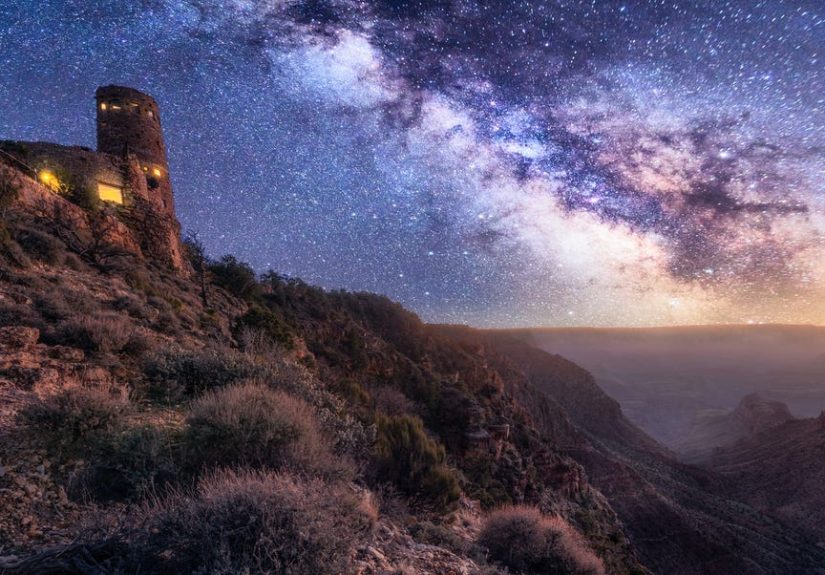
The Grand Canyon is one of the world’s most famous landscapes, but it is also a place of deep cultural significance for many Indigenous peoples. Its dark skies are remarkably accessible, with approved viewing spots around the South Rim and formal astronomy programs at certain times of year. The canyon is open around the clock, making it one of the easier major parks for nighttime observation. Watch the stars from an overlook, but stay well back from the edge. Gravity remains aggressively traditional.
14. Sunset Crater Volcano National Monument, Arizona
A volcanic eruption roughly a thousand years ago transformed this region and changed the lives of the people living nearby. Sunset Crater now offers a dramatic cultural and geological landscape near Flagstaff, with occasional summer night-sky events. The black lava fields, cinder cones, and wide-open sky create a wonderfully strange setting for stargazing. It feels less like visiting a national monument and more like being dropped onto a science-fiction film set with very good interpretive signage.
15. Valles Caldera National Preserve, New Mexico
Valles Caldera is a vast volcanic basin in the Jemez Mountains with long-standing cultural importance to nearby Indigenous communities. It is also an International Dark Sky Park with wide views from designated roadside pullouts and scheduled ranger programs. The preserve is ideal for travelers who want open horizons rather than enclosed canyon walls. In the daytime, the valley looks almost impossibly green and wide; after dark, the sky takes over with the confidence of a headliner who knows every song.
16. Fort Union National Monument, New Mexico
Fort Union preserves the remains of a major nineteenth-century military post and an important stop along the Santa Fe Trail. The ruins, open grasslands, and wide New Mexico horizon make it a quietly evocative place for dark-sky travelers. It is not a destination for wandering through structures at midnight, but it belongs on a cultural stargazing itinerary because the landscape still communicates the isolation and long-distance travel that shaped the American Southwest.
Historic Observatories Where Stargazing Becomes a Shared Tradition
17. Lowell Observatory, Flagstaff, Arizona
Lowell Observatory is one of the most important public astronomy destinations in the United States. Founded in 1894, it is associated with major discoveries, including Pluto, while also offering modern telescope viewing, guided stargazing, science talks, and cultural astronomy programs. Flagstaff’s leadership in dark-sky protection gives Lowell an advantage that many observatories would happily trade several spare lenses for. It is perfect for beginners who want expert guidance without pretending they already know where Orion keeps his belt.
18. Kitt Peak National Observatory, Arizona
Kitt Peak National Observatory sits on the Tohono O’odham Nation and is one of the country’s premier astronomy sites. Its visitor programs can include daytime tours, exhibitions, and evening stargazing experiences under Arizona’s dark skies. The location requires visitors to approach with respect: this is not simply a mountaintop laboratory but part of a living cultural landscape. Kitt Peak is ideal for people who want to see serious science in action while also understanding that place matters as much as equipment.
19. McDonald Observatory, Texas
High in the Davis Mountains of West Texas, McDonald Observatory combines big-sky scenery with a long tradition of public astronomy. Its Star Parties introduce visitors to constellations in an outdoor amphitheater before moving on to telescope viewing. The experience is friendly, educational, and wonderfully unpretentious. You may arrive knowing only that “the bright one is probably Venus,” and leave discussing globular clusters like someone who owns a fleece vest specifically for astronomy.
20. Griffith Observatory, Los Angeles, California
Griffith Observatory is not the darkest place on this list, and Los Angeles does not exactly hide its enthusiasm for electricity. Still, it belongs here because it is a cultural landmark of public astronomy. Since the 1930s, visitors have used its telescopes, attended programs, and watched the city glow below the hills. It proves that stargazing culture does not belong only to remote deserts. Sometimes the most meaningful astronomical experience is sharing a telescope with strangers in a city of millions.
How to Plan a Respectful Cultural Stargazing Trip
Choose the Moon Carefully
A new moon or the days around it usually provide the darkest skies for viewing faint stars, the Milky Way, and meteor showers. A bright moon is not bad; it simply changes the show. Moonlit ruins, cliffs, and volcanic landscapes can be beautiful, but faint deep-sky objects tend to disappear behind the lunar spotlight.
Use Red Light and Give Your Eyes Time
Bring a flashlight or headlamp with a red-light mode. White light wrecks night vision faster than a surprise work email wrecks a peaceful evening. Once you arrive, give your eyes at least 20 minutes to adapt. You will notice more stars, more texture in the Milky Way, and probably one friend claiming they definitely saw a UFO.
Respect Closures, Communities, and Sacred Landscapes
Never enter closed ruins, climb walls, cross barriers, or use drones where they are prohibited. Cultural heritage sites are not background props for social media. Listen to guides, follow tribal and park rules, keep voices low, pack out everything, and avoid playing music. The night sky is already providing the soundtrack.
Experiences That Make Cultural Stargazing Unforgettable
There is a particular kind of silence that arrives when you are standing near an ancient landscape after sunset. It is not complete silence, of course. Wind moves through grass. An owl occasionally offers a professional opinion. Gravel crunches under your shoes with far more volume than it has any right to possess. But compared with a city night, the quiet feels enormous.
That quiet changes how you look at the sky. In a neighborhood filled with porch lights, traffic, screens, and the eternal glow of a convenience store sign, stargazing can feel like a quick visual snack. You look up, identify the Big Dipper, take a photo that looks approximately like a black rectangle, and go home. At a cultural stargazing destination, the experience slows down. The sky becomes part of the setting instead of a ceiling above it.
Imagine sitting at a campground near Chaco Culture National Historical Park while the Milky Way rises over the canyon. You are not recreating the exact experience of people who lived there centuries ago, and you should not pretend that you are. But you can recognize that the sky was not empty space to earlier communities. It was connected to seasons, ceremonies, navigation, agriculture, memory, and identity. That realization makes the view feel more meaningful than simply collecting another impressive astrophotography image.
At a place such as Mesa Verde or Hovenweep, the daytime visit gives you visual context. You see stone rooms, defensive locations, water sources, pathways, and the practical intelligence of communities adapting to difficult landscapes. Then night arrives and the stars make the human story feel larger rather than smaller. Suddenly, the cliff dwelling is not only an archaeological site. It is part of a world shaped by sunlight, weather, moonlight, migrations, and the changing position of the heavens.
Historic observatories create a different but equally powerful feeling. At Lowell, Kitt Peak, McDonald, or Griffith, you are sharing the sky with educators, researchers, families, tourists, and enthusiastic people who own telescopes large enough to require negotiations with their spouses. A guide points out Jupiter, someone gasps when they see Saturn’s rings, and for a few minutes everyone becomes pleasantly humble. It is difficult to maintain an inflated sense of importance when a telescope reminds you that you are standing on a moving planet in one small corner of a galaxy.
The most memorable cultural stargazing trips often involve small details: the smell of desert sage after a warm day, a ranger explaining why a trail closes at night, a child asking whether stars can hear us, or a stranger lending you binoculars because they want you to see a cluster of stars properly. These moments make the trip personal without making it possessive.
That is the beauty of cultural stargazing. You do not leave believing that you have conquered the night sky. You leave understanding that you briefly joined a much longer human habit: looking upward, asking questions, telling stories, and feeling delightfully tiny beneath an impossible number of stars.
Conclusion
The best cultural places to go stargazing offer more than darkness. They connect astronomy with heritage, landscape, public science, and the long human habit of looking up for meaning. Whether you choose ancient Pueblo sites, mission ruins, volcanic country, historic trails, or a legendary observatory, the goal is the same: slow down, look carefully, and respect the place beneath your feet as much as the stars above your head.