Table of Contents >> Show >> Hide
- What Is a Liminal Space, Exactly?
- Why Empty Places Feel So Unsettling
- Why Liminal Spaces Feel Nostalgic Too
- The Importance of Human Presence
- Why the Internet Fell in Love With Liminal Spaces
- Architecture, Emotion, and the Body
- Are Liminal Spaces Always Negative?
- What Liminal Spaces Reveal About Us
- Experiences That Capture the Feeling of Liminal Spaces
- Conclusion
Walk into an empty school hallway on a summer afternoon, and your brain immediately starts acting like it just heard a suspicious noise in the attic. Nothing is technically wrong. The lights work. The floor is clean. The lockers are minding their own business. And yet the whole place feels off. Not haunted, exactly. Just weird in a way that’s hard to name.
That strange sensation is what makes liminal spaces so fascinating. These are places caught between one state and another: hallways, waiting rooms, stairwells, hotel corridors, parking garages, dead malls, abandoned theaters, vacant office floors. They’re spaces designed for movement, transition, or crowds, but when they’re empty or half-forgotten, they seem to slip out of normal reality. They feel familiar and alien at the same time, like a memory wearing the wrong shoes.
The internet has turned liminal spaces into a full-blown aesthetic, but the reaction itself is older than social media. We’re unsettled by these places because they mess with several deep systems at once: our expectations, our sense of safety, our memories, our social instincts, and our understanding of how a place is supposed to behave. In other words, your brain doesn’t love it when a food court suddenly feels like the set of a low-budget apocalypse movie.
What Is a Liminal Space, Exactly?
The word liminal comes from a Latin root meaning “threshold.” In anthropology, the idea originally described the middle stage of a transition, the in-between period when someone is no longer in one state but not fully in the next. Over time, that idea spread far beyond rituals and sociology. Today, we use it to describe both emotional transitions and physical spaces that feel suspended between identities.
Some liminal spaces are ordinary by design. Think airports, staircases, lobbies, bridges, waiting rooms, and hallways. These places are built for passing through, not settling in. They aren’t destinations. They’re spatial commas. You’re not meant to build a life there. You’re meant to move along.
Other liminal spaces are liminal because time has done something odd to them. An abandoned mall, a closed movie theater, a defunct arcade, or a school gym after hours can feel like they’re stuck between use and disuse, past and present, memory and decay. The place still looks legible, but its old script has been erased. It used to tell you what to do. Now it just stares back.
Why Empty Places Feel So Unsettling
1. They break the “spatial narrative” your brain expects
We don’t just see places. We read them. A stadium means crowds. A classroom means chatter. A mall means motion, noise, smells, signs, and a mild chance of overpriced pretzels. Over time, we build what you might call a spatial narrative: a mental story about what belongs in a given setting.
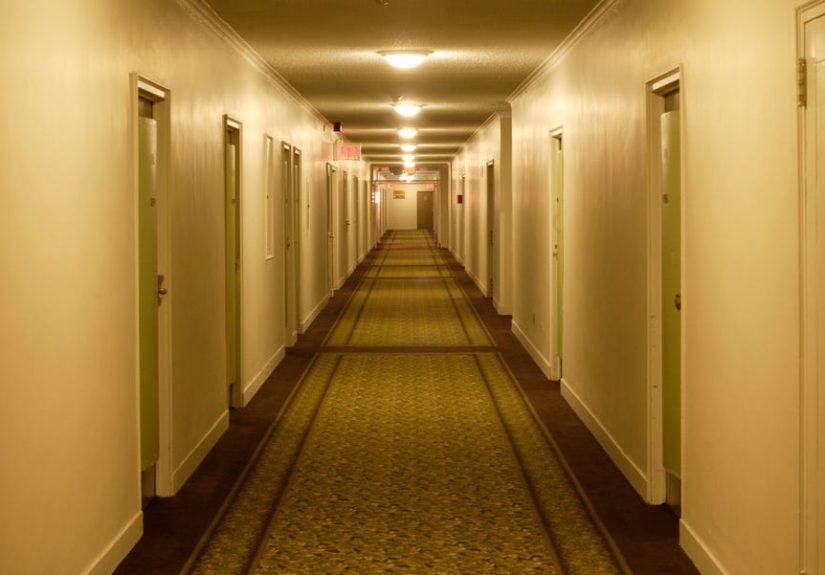
When that story disappears, we feel disoriented. A giant parking lot with no cars. A school corridor with no students. A hotel hallway with perfect lighting and zero people. The physical structure is the same, but the social cues are gone. Your brain notices the mismatch immediately. It starts asking questions: Why is this empty? Is this temporary? Am I early, late, lost, or in a horror movie?
That’s one reason liminal spaces feel so strange. The space still carries the shape of human activity, but not the activity itself. It’s like seeing a stage after the actors have vanished. The scenery remains. The script does not.
2. Uncertainty makes the brain nervous
Human beings are not huge fans of ambiguity. We like patterns, cues, and environments that tell us what’s happening. Empty transitional spaces often don’t do that. Instead, they create low-level uncertainty. Is the place closed? Unsafe? Forgotten? Temporarily paused? Your brain can’t immediately decide whether the scene is harmless, meaningful, or threatening.
That matters because uncertainty is closely tied to anxiety. When a situation feels ambiguous, the brain tends to become more alert. It scans for danger, fills in missing context, and leans on prediction. Liminal spaces are full of missing context. They are especially weird because they rarely contain obvious threats. They simply remove the cues that usually reassure us. No crowd noise. No casual movement. No evidence that normal life is functioning as expected.
In that silence, even tiny details suddenly feel loud. A fluorescent hum. A flickering sign. A distant echo. A scuffed tile. A closed storefront gate. Your nervous system starts treating the absence of explanation as information. That doesn’t always produce fear, but it does produce vigilance. And vigilance, frankly, is not a relaxing interior design style.
3. Familiarity plus wrongness creates the uncanny
Liminal spaces often trigger what psychologists and designers describe as an uncanny effect. Something is recognizable, but subtly wrong. The proportions might feel odd. The emptiness feels unnatural. The lighting is too even or too dim. The room looks like real life, but not quite enough like real life.
This is why abandoned malls are so powerful. They aren’t random ruins. They’re deeply familiar public environments tied to routines, memory, and social life. When those spaces become silent shells, the contrast is jarring. They still look like places built for people, commerce, noise, and energy, yet they now exist in a suspended state. They’re not fully dead, but they’re no longer fully alive either. They occupy the eerie middle.
Research on the “uncanny valley” of physical places suggests that built environments can feel eerie when they deviate from familiar structural patterns just enough to seem abnormal. In plain English: your brain hates when a room looks almost right. Not terrible. Not impossible. Just wrong enough to feel creepy. It’s the architectural equivalent of someone smiling one second too long.
Why Liminal Spaces Feel Nostalgic Too
If liminal spaces were only scary, they wouldn’t have become such a beloved online obsession. Part of their pull is that they’re often nostalgic. A dead mall may feel eerie, but it can also evoke childhood weekends, food court memories, movie dates, arcade sounds, and the old thrill of wandering around with no plan and exactly six dollars.
Nostalgia is not a simple happy emotion. It’s mixed. Bittersweet. It combines warmth and loss, comfort and ache. That emotional cocktail fits liminal spaces perfectly. Many of these places awaken autobiographical memory, the deeply personal sense of “I know this world” or “I used to belong here.” But the place in front of you is no longer the place you remember. So the brain holds both truths at once.
That’s why a vacant roller rink, empty classroom, or fading hotel pool can hit so hard. You’re not just looking at architecture. You’re looking at memory that no longer matches the present tense. The space becomes a conversation between what was, what is, and what probably isn’t coming back.
Neuroscience research on nostalgia also helps explain the pull. Nostalgic experiences involve autobiographical memory, self-reflection, emotional regulation, and reward systems. In other words, nostalgia doesn’t just remind us of the past. It activates meaning. It helps us reflect, soothe ourselves, and reconnect with identity. So yes, the abandoned mall is unsettling. But it can also feel weirdly comforting, like emotional bubble wrap wrapped around existential dread.
The Importance of Human Presence
One of the biggest reasons liminal spaces feel wrong is simple: people are missing. Humans are social creatures, and we constantly use other people as environmental cues. We look to them, often unconsciously, to understand whether a place is safe, normal, busy, boring, or worth avoiding.
When those people disappear from a place that was clearly built for them, the environment feels unmoored. A full train platform makes sense. An empty train platform at noon feels suspicious. A school stairwell during class changes from ordinary to eerie the moment it becomes too quiet. The architecture hasn’t changed, but the social meaning has.
This absence matters even more in public places designed around collective behavior. Stadiums, malls, airports, theaters, convention centers, and office towers aren’t just buildings. They’re containers for shared routines. When you remove the bodies, the choreography disappears. The place becomes legible in one sense and deeply unreadable in another.
Why the Internet Fell in Love With Liminal Spaces
The online fascination with liminal spaces exploded because the internet is excellent at turning complex emotions into image genres. But the trend also arrived at the right cultural moment. During and after the pandemic, many people saw public spaces emptied out in real life. Deserted streets, abandoned retail corridors, closed schools, silent transit hubs, and ghostly office districts stopped being purely imaginary. They became part of collective memory.
That helped liminal space imagery resonate on a deeper level. These photos weren’t just creepy. They reflected a broader cultural feeling of living between versions of the world. Not fully before. Not fully after. Just stuck in the doorway, emotionally holding a tote bag and wondering what happened.
Online communities also sharpened the aesthetic. The most popular liminal images are usually ordinary places drained of activity: indoor pools, school cafeterias, suburban streets at dusk, fluorescent hallways, worn carpets, hotel conference rooms, chain restaurants after closing. They work because they’re common enough to trigger recognition but empty enough to feel detached from normal time.
And perhaps that’s the secret. A good liminal image doesn’t merely show emptiness. It shows interrupted meaning.
Architecture, Emotion, and the Body
Architecture affects mood more than we often admit. Interior form, curvature, enclosure, sound, light, and scale all shape emotional response. Some spaces soothe us because they feel coherent, navigable, and human-scaled. Others raise tension because they feel exposed, repetitive, disorienting, or strangely impersonal.
Liminal spaces often stack several of those effects together. Long corridors can amplify anticipation. Large vacant interiors can emphasize isolation. Repetition can feel dreamlike. Dim fluorescent light can flatten depth and warmth. Echoes can exaggerate emptiness. Even cleanliness can feel uncanny when it exists without signs of life. A spotless hallway with no one in it feels less like comfort and more like a clue.
That’s why liminal spaces are not just visually strange. They can feel physically strange. Your body notices before your conscious mind has written a neat little explanation. You slow down. You listen harder. You become aware of your footsteps. Suddenly you are very interested in a vending machine that should not be this dramatic.
Are Liminal Spaces Always Negative?
Not at all. They can be unsettling, but they can also be reflective, calming, and even creative. Transitional spaces make us notice what we usually ignore. They strip away routine and force us to see the built world with fresh eyes. That discomfort can open a door to curiosity.
Some people love liminal spaces because they offer emotional distance from ordinary life. Others find them beautiful because they expose the skeleton of everyday environments. Without crowds, branding, noise, or urgency, a hallway is suddenly just a hallway. A lobby becomes geometry and light. A mall becomes memory, scale, and silence.
There is also a strange comfort in places that embody uncertainty when life itself feels uncertain. Liminal spaces externalize feelings we don’t always know how to describe. They make ambiguity visible. And once ambiguity has a shape, it can feel less lonely.
What Liminal Spaces Reveal About Us
Ultimately, liminal spaces feel weird because they expose how much of reality depends on context. A place is never just walls and floors. It is expectation, habit, human presence, memory, and narrative. When those elements fall out of sync, the ordinary can suddenly feel eerie.
That’s why empty, abandoned places linger in the mind. They remind us that the world is always more fragile and more theatrical than it appears. A mall can become a monument. A school hallway can become a memory trap. A hotel corridor can become a question.
So the next time you find yourself in a silent parking garage, a half-lit airport terminal, or an empty food court that feels like it remembers better days, trust your reaction. You’re not being dramatic. Well, not only dramatic. You’re noticing the tension between function and absence, familiarity and strangeness, past and present. You’re standing in a threshold, and thresholds have always had a way of making humans feel deliciously, magnificently weird.
Experiences That Capture the Feeling of Liminal Spaces
One of the most relatable liminal experiences is walking through a school building during summer break. During the school year, every inch of that place has a script: chatter at the lockers, footsteps between classes, fluorescent lights humming over a thousand tiny dramas. But in July, the same hallway becomes almost unrecognizable. The trophies are still there. The bulletin boards still cling to the walls. Yet the building no longer behaves like a school. It feels paused, like it forgot its lines.
Airports create a different version of the same sensation. At normal hours, they’re engines of movement and stress. At 4:30 in the morning, though, an airport can feel like a parallel universe. The moving walkways still glide. The gate screens still glow. Coffee machines hiss into the void. But with only a few travelers drifting around, the place feels detached from clock time. You’re not fully anywhere. Not home, not destination, just floating through a carpeted threshold with a backpack and existential questions.
Dead malls may be the heavyweight champions of liminal experience. They trigger an unusually intense blend of memory and wrongness. The escalators, skylights, food courts, and storefronts all suggest a social world that used to exist in full color. Even when you never visited that exact mall, it often feels familiar anyway. That’s because malls are deeply standardized cultural spaces. They belong to a shared American memory. So when you walk through one that’s mostly empty, you’re not just witnessing retail decline. You’re feeling the ghost of a routine you recognize.
Hotels can do this too, especially long hallways with patterned carpet, identical doors, and too-perfect silence. A hotel is already an in-between place by nature. No one is fully at home there. But when the corridor is empty and the lighting is flat, the whole environment can feel dreamlike. It’s private and public at the same time. Safe, but not personal. Familiar, but never yours. That emotional instability is catnip for the liminal brain.
Even ordinary adult life has liminal settings that sneak up on us. A mostly vacant office after layoffs. A childhood home after the furniture has been moved out. A movie theater lobby after the last screening ends. A playground in winter. A church basement after an event. These places feel strange because they still hold the shape of social life, but the energy has drained away. They seem to remember people. You do too. And in that gap between presence and absence, the weird feeling arrives right on schedule.
What makes these experiences so powerful is that they aren’t just visual. They’re bodily. You hear your own footsteps. You become aware of the air, the acoustics, the smell of old carpet, the echo in a stairwell, the buzzing light above a vending machine. Liminal spaces sharpen attention. They make the background suddenly feel important. That’s part of why they stick in memory. They force you to experience a place not as scenery, but as atmosphere.
And maybe that’s why people keep chasing them, photographing them, and posting them online. Liminal spaces don’t merely show emptiness. They let us feel transition itself. They make us confront the fact that many parts of life are lived between states: between childhood and adulthood, job and next job, one era and another, one version of ourselves and the person still coming into focus. The empty hallway is never just a hallway. It’s a mood with walls.
Conclusion
Liminal spaces unsettle us because they interrupt the stories we expect places to tell. They remove social cues, heighten ambiguity, awaken memory, and push familiar architecture into uncanny territory. But they also fascinate us for those exact reasons. They make transition visible. They turn absence into atmosphere. And in a culture that often feels stuck between old certainties and unclear futures, that in-between feeling can seem unnervingly honest.