Table of Contents >> Show >> Hide
- Why Breast Cancer Scar Tattoos Matter So Much
- Restorative Tattoos vs. Decorative Mastectomy Tattoos
- When Is It Safe to Get a Tattoo After Breast Cancer Surgery?
- What Makes a Good Post-Mastectomy Tattoo Artist?
- The Real Risks No One Should Gloss Over
- Do These Tattoos Help Emotionally? Many Survivors Say Yes
- Cost, Insurance, and Financial Help
- Why These Tattoos Are Also Changing the Conversation About Beauty
- Conclusion
- Extended Experiences: What Survivors Often Describe After Getting These Tattoos
- SEO Tags
There are many ways to mark survival after breast cancer. Some people choose reconstruction. Some choose to go flat. Some want a realistic 3D nipple-areola tattoo. Others look at their scars and think, “You know what this needs? Flowers. Or a phoenix. Or a botanical masterpiece that says I am still here, and I am still fabulous.”
That is where post-mastectomy tattooing enters the picture, and it is doing far more than adding ink to skin. For many breast cancer survivors, these tattoos are about reclaiming ownership after months, sometimes years, of surgeries, drains, appointments, scans, radiation, and the kind of emotional whiplash no one puts on a welcome brochure. A beautiful tattoo cannot erase what happened, but it can change what someone sees in the mirror. Instead of a reminder of loss, the chest can become a canvas for healing, identity, and power.
That is why the growing visibility of mastectomy tattoos matters. They sit at the intersection of art, survivorship, body image, and medical recovery. They are deeply personal, sometimes symbolic, sometimes realistic, and often stunning. Most importantly, they remind survivors that there is no single “correct” way to feel at home in your body again.
Why Breast Cancer Scar Tattoos Matter So Much
Breast cancer treatment changes the body in obvious ways, but the emotional effect can be just as profound. Surgery scars may be long, uneven, numb, tight, puckered, or discolored. Radiation can leave skin thinner, darker, or more fragile. Reconstruction may restore shape but not sensation. Going flat may feel freeing for one person and complicated for another. In other words, recovery is not just physical. It is visual, emotional, and psychological, too.
That is part of why tattooing has become such a meaningful option. A post-mastectomy tattoo can help transform the narrative. Instead of seeing a chest that feels defined by cancer, survivors may see choice, beauty, memory, and intention. The tattoo becomes less about hiding scars and more about reframing them. That difference matters. “Covering” a scar sounds like a magic trick. What many survivors actually describe is something more honest: they are integrating the scar into a new story.
And no, that story does not always have to be solemn. Some survivors choose elegant floral designs or ornamental lacework. Some go for botanical illustrations, birds, sacred geometry, or watercolor effects. Some pick hyperrealistic areola restoration. Some want a tattoo that looks like fine art. Some want one that says, with exquisite subtlety, “Cancer messed with the wrong person.” The styles vary, but the motivation often echoes the same theme: control.
Restorative Tattoos vs. Decorative Mastectomy Tattoos
When people talk about tattoos after breast cancer surgery, they are usually talking about one of two broad categories.
Restorative nipple-areola tattoos
These tattoos are designed to recreate the appearance of a nipple and areola after mastectomy and reconstruction. In many cases, a skilled medical tattoo artist or specially trained clinician can use shading and pigment to create a realistic 3D effect. The nipple is flat to the touch, but the visual illusion can be remarkably convincing. For some patients, this is the final step in breast reconstruction. It is not flashy. It is not decorative in the traditional sense. It is about restoration, symmetry, and a return to something familiar.
Decorative scar-cover tattoos
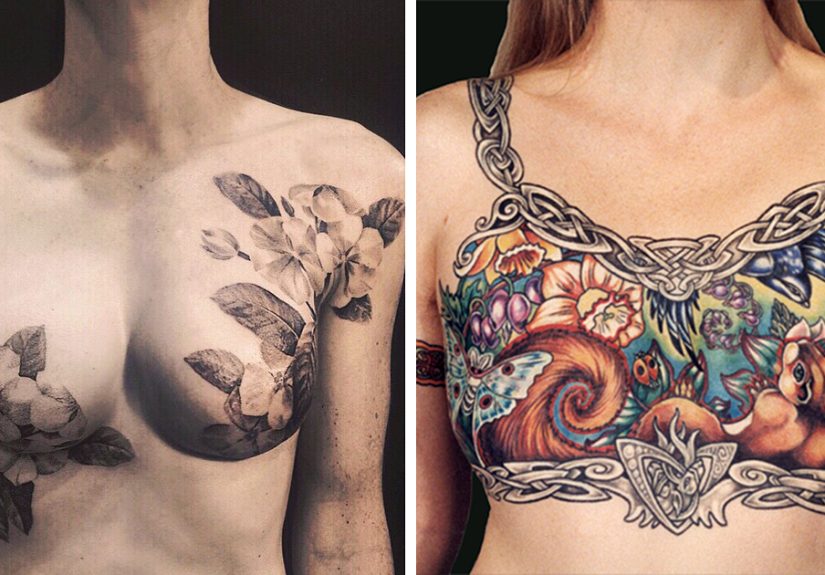
These are the tattoos that often capture public imagination, and for good reason. Decorative mastectomy tattoos can span the chest, collarbone, ribs, or reconstructed breast area. They may incorporate scars into vines, petals, feathers, mandalas, script, abstract shapes, or custom imagery tied to the survivor’s life story. Some are delicate and minimal. Some are bold enough to stop traffic, in a classy way. These tattoos are especially popular among people who choose aesthetic flat closure, but they can also work beautifully after reconstruction.
Neither route is “better.” They simply answer different needs. One person wants a realistic nipple tattoo because it helps them feel whole in a familiar way. Another wants a chest piece of peonies because familiar is overrated and healing looks like art now. Both choices are valid.
When Is It Safe to Get a Tattoo After Breast Cancer Surgery?
This is the part where art meets patience. Beautifully. Annoyingly. Necessarily.
Survivors usually need to wait until the skin is fully healed before any tattooing happens. That means no open areas, no active infection, no unresolved wound healing, and no guessing. Depending on the surgery and whether reconstruction was involved, the timeline may be several months. If there was nipple reconstruction, tattooing is often delayed even longer so the tissue can settle and scars can mature.
Radiation can complicate things further. Radiated skin may be thinner, more delicate, less elastic, and less predictable when it comes to pigment retention and healing. Scar tissue itself also behaves differently from non-scarred skin. It may take ink unevenly, need multiple sessions, or simply not be a good candidate for tattooing in certain areas. This is why experienced mastectomy tattoo artists do not breeze into consultations with “Sure, let’s do a giant sunflower tomorrow.” Good artists assess the skin first, ask detailed questions, and often want medical clearance.
That medical clearance matters. Survivors should talk with their surgical team, plastic surgeon, or oncology care team before booking a tattoo. The goal is not to make the process clinical and gloomy. It is to make sure the skin can safely handle the procedure. The chest has already been through enough drama.
What Makes a Good Post-Mastectomy Tattoo Artist?
Not every talented tattoo artist is automatically the right artist for compromised post-surgical skin. This is a specialty area. Scar tissue, numb tissue, reconstructed tissue, radiated tissue, and asymmetrical contours all require experience, judgment, and technique. A great traditional tattoo portfolio is nice. A portfolio that includes healed mastectomy work is far more useful.
Survivors should look for an artist who understands scar maturity, pigment behavior on altered skin, infection control, and realistic consultation practices. The best artists do not overpromise. They explain that one session may not be enough. They talk about placement honestly. They understand that some skin is too thin to tattoo safely. They know how to design around asymmetry instead of pretending it does not exist.
It also helps when the artist communicates with empathy rather than treating the consultation like a standard appointment. Post-mastectomy tattooing is intimate work. Survivors may arrive with grief, pride, anxiety, relief, excitement, or all five before lunch. An experienced artist knows the session is not just about image placement. It is about trust.
The Real Risks No One Should Gloss Over
As meaningful as these tattoos can be, they are still tattoos. That means there are real risks, including infection, allergic reactions, and irritation from contaminated inks or poor technique. This is not the moment for bargain-hunting based entirely on a cute Instagram feed. Sterile equipment, proper licensure, safe inks, and rigorous aftercare are non-negotiable.
There is also the issue of follow-up imaging. Tattoo pigment can sometimes show up in lymph nodes on scans or mammograms, which may confuse interpretation if clinicians do not know a patient has tattoos. That does not mean survivors should avoid tattoos altogether. It means they should tell their care team and imaging providers about them.
Another important point: decorative tattooing is not right for every survivor. If skin is extremely fragile, stretched thin, poorly healed, or still affected by ongoing treatment, the safest answer may be “not yet” or even “not on that area.” That answer can be disappointing, but it is still an act of care.
Do These Tattoos Help Emotionally? Many Survivors Say Yes
The emotional impact of mastectomy tattoos comes up again and again in survivor interviews, clinical ethics discussions, and emerging research. The language varies, but the themes are strikingly similar: reclaiming the body, restoring confidence, making peace with the mirror, and choosing what the chest means after treatment.
That does not mean a tattoo is therapy in a needle cartridge. It does not fix trauma by itself, and it is not a requirement for healing. But for many people, it can be a powerful complement to healing. The act of choosing an image, collaborating on a design, and returning to the body on one’s own terms can carry a symbolic weight that is hard to overstate.
In fact, one of the most consistent ideas in survivor stories is that the tattoo changes more than appearance. It changes posture. It changes the way someone dresses, the way they move through intimacy, the way they answer questions, and the way they understand the body that brought them through cancer. That is not vanity. That is recovery with a visual language.
Cost, Insurance, and Financial Help
Now for the practical question that tends to arrive right after inspiration: how much does this cost? The answer depends on the type of tattoo, the artist, the number of sessions, and whether the work is performed in a medical or traditional tattoo setting.
Restorative nipple-areola tattooing may be partially covered in some cases, especially when it is considered part of breast reconstruction. Decorative mastectomy tattoos, however, are often paid out of pocket. That gap can be frustrating because decorative work may be just as emotionally meaningful to the survivor as restorative work.
Still, financial help does exist. Nonprofits and advocacy groups have stepped in where insurance often falls short. Organizations such as P.ink, Pink Ink Fund, and Ink 4 Pink help connect survivors with experienced artists, donated services, or financial assistance for restorative and decorative work. In a healthcare system that sometimes acts surprised to learn emotions exist, that kind of support can be a big deal.
Why These Tattoos Are Also Changing the Conversation About Beauty
One reason these tattoos resonate so strongly online is that they push back against a very narrow idea of what a “recovered” body should look like. Breast cancer survivorship is often packaged in tidy slogans, but bodies after treatment are not tidy. They are scarred, altered, asymmetrical, numb, resilient, and deeply lived-in. Mastectomy tattoos do not erase that truth. They decorate it, honor it, or reinterpret it.
That matters culturally as much as personally. The more visible these tattoos become, the easier it is for survivors to imagine options beyond silence or concealment. A decorated chest can say many things at once: I survived. I chose this. I am still beautiful. I define beauty for myself now. Frankly, that is a far more interesting message than pretending cancer leaves no mark.
Conclusion
Tattoo artists who work with breast cancer survivors are doing something much larger than body art. They are helping people move from treatment into authorship. Sometimes that authorship looks like a perfectly shaded 3D areola tattoo. Sometimes it looks like a dramatic bouquet blooming across a flat chest. Sometimes it looks like a design that quietly turns a scar from a memory of damage into a mark of endurance.
The point is not that every survivor should get a tattoo. The point is that survivors deserve options that respect both safety and self-expression. For the people who choose this path, these tattoos can offer something medicine alone often cannot: a chance to see the body not merely as healed, but as beautiful on its own newly written terms.
Extended Experiences: What Survivors Often Describe After Getting These Tattoos
One of the most compelling parts of the conversation around breast cancer scar tattoos is how consistently survivors describe the experience in emotional, not just aesthetic, terms. They do talk about the artwork, of course. They talk about color, linework, placement, and how a talented artist can work around scars with almost architectural precision. But what tends to stay with them is the feeling that the body becomes theirs again.
Many survivors say there is a strange gap between being declared “done” with treatment and actually feeling finished. On paper, the worst may be over. In real life, the scars remain. Clothes fit differently. The mirror can feel unfamiliar. A nipple reconstruction may restore contour without restoring sensation. A flat closure may be physically comfortable but emotionally complicated at first. Survivors often describe this phase as being grateful to be alive while still grieving what changed. Human beings are inconveniently capable of feeling two opposite things at the same time.
That is where tattooing often enters as a self-directed next step. Survivors describe spending months researching artists, scrolling through portfolios, and saving images that felt more like possibility than decoration. The consultation itself can be emotional. For some, it is the first time they have sat with another professional who is not trying to remove, scan, inject, or medically evaluate the chest. Instead, the conversation becomes creative. What do you want to see? What feels like you? What do you want this area to say now? After a long season of being a patient, that shift can feel enormous.
Some survivors who choose realistic nipple-areola tattooing say the result helps them feel visually complete, especially after reconstruction. Others say decorative tattoos do something different but equally meaningful: they replace the language of injury with the language of intention. A scar that once felt abrupt or harsh may become the stem of a flower, the line of a wing, the center of a mandala, or part of an abstract piece that makes the entire chest feel composed rather than interrupted.
There is also the social piece. Survivors often mention feeling more comfortable with partners, more confident in certain clothes, and less startled by their own reflection. Some say they stop avoiding mirrors. Some feel freer at the beach, in a fitting room, or during intimacy. Others simply enjoy the fact that people now react to their chest art with admiration instead of pity. That may sound small, but it is not. Pity can flatten a person. Admiration can remind them they are still fully present in the world.
Most importantly, survivors tend to describe these tattoos not as a way to pretend cancer never happened, but as a way to decide what happens next. The scar remains part of the story. It just no longer gets the final word.