Table of Contents >> Show >> Hide
- A Cassini Photo That Looks Like a Space Postcard
- Why the Ring-Plane View Is So Striking
- Meet the Three Moons in the Cassini Frame
- What the Cassini Mission Revealed About Saturn
- How to Read the Image Like a Scientist
- Why This Cassini Photo Still Matters
- The Science Behind Saturnshine
- What Makes Cassini Images Different From Telescope Views
- Experience: Seeing Saturn’s Rings and Three Moons Through Cassini’s Eyes
- Conclusion
Note: This article is written for web publication in original wording and synthesizes real NASA/JPL Cassini mission information without source-link clutter.
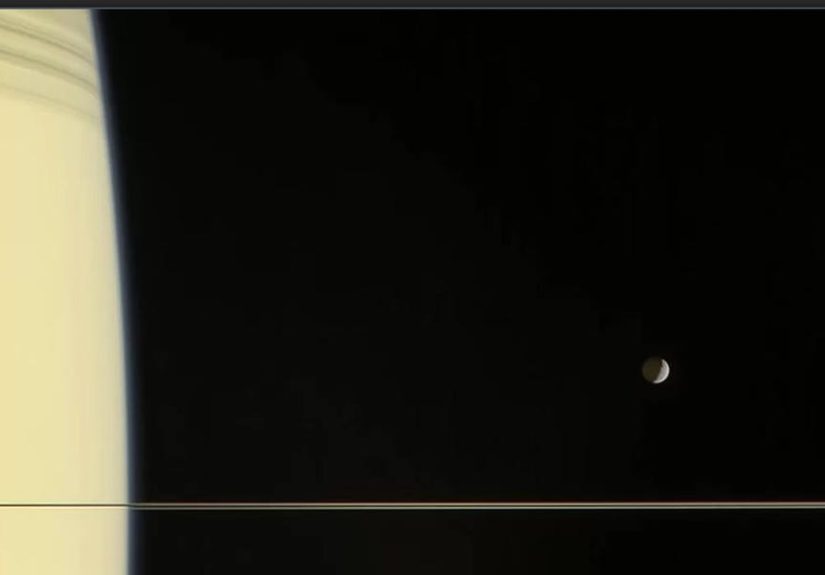
Saturn has never been shy about making an entrance. Give the planet a camera, a little sunlight, and a spacecraft with excellent timing, and suddenly the solar system looks like it hired a professional portrait photographer. One of the most quietly stunning examples is a Cassini image known as “Postcard from the Ring Plane,” a view showing Saturn’s rings nearly edge-on with three moonsMimas, Janus, and Tethyssharing the frame.
At first glance, the image looks simple: a pale golden Saturn, a razor-thin ring line, and a few tiny dots that seem almost too small to matter. But that is exactly the trick. This Cassini photo is not just pretty space wallpaper. It is a compressed lesson in orbital geometry, icy moons, reflected sunlight, and the astonishing patience of robotic exploration. It reminds us that Saturn is not a lonely planet wearing a fancy hat. It is a whole moving systemrings, moons, shadows, ice, dust, and gravity all doing choreography without missing a beat.
A Cassini Photo That Looks Like a Space Postcard
The image was captured by NASA’s Cassini spacecraft on March 13, 2006, using its narrow-angle camera. Cassini was about 1.7 million miles, or roughly 2.7 million kilometers, from Saturn when it took the view. The scene was later released through NASA’s Photojournal in 2018, long after Cassini had completed its mission, which proves that great space photography ages better than most vacation selfies.
In the frame, Saturn’s rings appear nearly edge-on. Instead of the broad, flat, dazzling disk people often imagine, the rings cut across the image like a thin glowing blade. Mimas and tiny Janus appear above the rings from Cassini’s point of view, while Tethys appears below them. That “above” and “below” wording is a matter of perspective, not a cosmic seating chart. The moons and rings orbit Saturn in roughly the same plane, but Cassini’s viewing angle makes them appear separated.
The photo is a natural-color view created by combining images taken through red, green, and blue spectral filters. That matters because natural color helps viewers experience the scene in a way that feels close to what human eyes might perceive, even though no astronaut was floating there with a camera saying, “Hold still, Saturn.” Cassini did the work from deep space, turning reflected sunlight into data and data into wonder.
Why the Ring-Plane View Is So Striking
Most famous pictures of Saturn show its rings spread wide, like a cosmic vinyl record. This Cassini photo is different because the rings are seen nearly edge-on. That angle makes the ring system look thin, sharp, and almost unreal. It also helps reveal how flat the main ring plane is compared with the huge scale of the planet and its moons.
Saturn’s rings are made of countless pieces of water ice and rock coated with dust and other materials. Some particles are as small as grains; others are far larger. Together, they form one of the most recognizable structures in the solar system. Yet the rings are not solid. They are more like a sparkling traffic jam of icy particles, all orbiting Saturn under the control of gravity, collisions, resonances, and the gentle bullying of nearby moons.
This is what makes the Cassini image so educational. The rings may look like one smooth line, but Cassini taught scientists that they are active and dynamic. Moons can shape ring edges, create waves, open gaps, disturb particles, and even contribute material. Saturn’s ring system is not a museum display. It is a laboratory, and gravity is the unpaid intern moving everything around.
Meet the Three Moons in the Cassini Frame
The three moons in the imageMimas, Janus, and Tethysmay appear tiny beside Saturn, but each has its own personality. They are not decorative dots. They are active clues to how the Saturn system formed and evolved.
Mimas: The Small Moon With a Big Reputation
Mimas is one of Saturn’s major moons and is famous for its enormous Herschel Crater, which gives it an uncanny resemblance to the Death Star from Star Wars. Science did not design it that way, but science does occasionally enjoy a dramatic visual gag.
Mimas has a mean diameter of about 245 miles, or 394 kilometers, and is heavily cratered. Its low density suggests that it is made mostly of water ice. In the Cassini photo, the night side of Mimas is softly lit by “Saturnshine,” sunlight reflected from Saturn’s cloud tops. Think of it as moonlight, but with Saturn acting as the lamp. This subtle illumination is one of the image’s most poetic details: even the dark side of a small icy moon is not entirely alone.
Janus: The Tiny Orbital Trickster
Janus is much smaller than Mimas and has a lumpy, potato-like shape. It orbits close to Saturn, in the region between the F and G rings, and it shares a remarkable orbital relationship with another moon, Epimetheus. The two moons occupy very similar paths around Saturn and periodically trade orbital positions in a gravitational dance that sounds like it should require a traffic officer.
Janus helps illustrate why Saturn’s moons are so important to understanding the rings. Small moons can shepherd ring material, maintain edges, and create subtle structures. They may look insignificant in a single photograph, but in orbital mechanics, tiny does not mean boring. Sometimes tiny means “quietly running the whole neighborhood.”
Tethys: The Bright, Icy Survivor
Tethys is Saturn’s fifth largest moon and appears below the rings in Cassini’s view. It is a cold, airless, heavily scarred world composed largely of water ice with a small amount of rock. Its surface includes giant impact features, including the huge Odysseus crater and a long canyon system known as Ithaca Chasma.
Tethys reflects a great deal of light because of its icy surface. It is also affected by material from Saturn’s E ring, which is supplied by the active moon Enceladus. That means even a moon not erupting plumes of its own can still carry evidence of activity elsewhere in the Saturn system. Around Saturn, nobody minds their own business for very long.
What the Cassini Mission Revealed About Saturn
Cassini launched in 1997 and entered orbit around Saturn in 2004, carrying ESA’s Huygens probe, which later landed on Titan. For more than 13 years in Saturn orbit, Cassini studied the planet, its rings, its magnetosphere, and its moons. It returned a massive archive of images and measurements that scientists continue to analyze.
The mission transformed Saturn from a distant telescope object into a detailed world system. Cassini revealed that Titan has lakes, seas, rivers, and rain made of methane and ethane. It discovered icy plumes erupting from Enceladus, leading scientists to conclude that the moon contains a global liquid-water ocean with conditions that may include heat and chemical energy. It also showed that Saturn’s rings are active, structured, and shaped by interactions with moons and particles.
In 2017, Cassini began its Grand Finale, a daring series of orbits that took the spacecraft between Saturn and its innermost rings. On September 15, 2017, Cassini plunged into Saturn’s atmosphere, sending data as long as it could before burning up like a meteor. NASA chose this ending to prevent any future accidental collision with potentially habitable moons such as Enceladus or Titan. It was both scientifically responsible and emotionally rude. After thirteen years of incredible postcards, Cassini did not even leave a forwarding address.
How to Read the Image Like a Scientist
To enjoy the Cassini photo, you do not need a degree in planetary science. But a few viewing tips can make it far richer.
First, notice the rings
The rings appear thin because Cassini is looking almost along the ring plane. That view compresses the ring system and emphasizes its flatness. The line may look simple, but it represents billions of icy particles orbiting at high speed around Saturn.
Second, look for the moons
Mimas and Janus appear above the ring line, while Tethys appears below it. Their positions are not stacked vertically in space the way they look in the image. The view is shaped by perspective. This is a good reminder that space photos are not just pictures; they are geometry lessons wearing glamorous lighting.
Third, think about scale
Saturn is enormous. Its moons are worlds, not specks, yet the planet makes them look small. Mimas is hundreds of kilometers across. Tethys is over a thousand kilometers wide. Janus is small compared with those moons, but still large enough to be a real geological object with craters, slopes, and history.
Why This Cassini Photo Still Matters
Images like this remain valuable because they combine beauty with data. Cassini’s cameras were scientific instruments, not just scenic tools. Each image helped researchers understand lighting angles, moon positions, ring structure, surface brightness, orbital motion, and the relationship between Saturn and its satellites.
The photo also matters culturally. It gives the public a way to connect with a mission that happened far beyond ordinary human experience. Saturn is so distant that sunlight there is far weaker than at Earth. Cassini had to travel for years, survive the outer solar system, enter orbit around a giant planet, and send information back across immense distances. The fact that we can casually open the image on a screen is almost absurd. Humanity built a machine, sent it to Saturn, and asked it to take pictures. The machine said, “Sure,” for more than a decade.
The Science Behind Saturnshine
One of the most charming details in the photo is Saturnshine on Mimas. The concept is simple: sunlight hits Saturn’s cloud tops, reflects outward, and gently illuminates the darker side of the moon. We see a similar effect on Earth when sunlight reflected from our planet lights the dark part of the Moon, often called Earthshine.
Saturnshine shows how connected the system is. A moon’s appearance depends not only on direct sunlight but also on light bouncing from the planet. In a photograph, that soft glow adds depth and drama. Scientifically, it helps reveal surfaces that would otherwise be hidden in darkness. Artistically, it makes Mimas look like it got a subtle studio-lighting package from Saturn, which is generous considering Saturn already has the rings.
What Makes Cassini Images Different From Telescope Views
From Earth, even powerful telescopes can show Saturn’s rings and sometimes its brightest moons. But Cassini was there. It orbited Saturn, changed angles, watched seasons shift, flew past moons, and looked at ring features from distances no Earth-based telescope could match.
This difference is crucial. Telescopes give us a distant view; spacecraft give us changing viewpoints. Cassini could look nearly edge-on at the rings, observe backlit particles, study shadows, and capture moons in unusual arrangements. That is why Cassini photos often feel intimate. They do not just show Saturn as an object in the sky. They show Saturn as a place.
Experience: Seeing Saturn’s Rings and Three Moons Through Cassini’s Eyes
The experience of looking at this Cassini photo is strangely quiet. It is not the kind of space image that shouts with explosive color or dramatic storms. Instead, it invites you to slow down. You start with the obvious feature: Saturn, huge and calm, crossed by those impossibly neat rings. Then, after a moment, the little moons appear. At first they seem like dust on the screen. Then your brain catches up and says, “Wait, those are worlds.” That is when the image becomes powerful.
For many readers, the photo recreates the feeling of seeing Saturn through a small backyard telescope for the first time. Through the eyepiece, Saturn is tiny, but the rings are unmistakable. People often laugh when they see it. Not because it is funny, exactly, but because it looks too perfect to be real. The Cassini image creates a similar reaction, only with more scientific detail and fewer mosquitoes in the backyard.
Imagine using the image in a classroom. A teacher points out the thin ring line, then asks students to find the moons. Suddenly the class is not just learning names; they are practicing observation. They learn that space is three-dimensional, that perspective can fool the eye, and that tiny points in a photo can represent entire landscapes of ice and craters. A simple image becomes a doorway into physics, geology, optics, and mission engineering.
The photo also gives amateur astronomers a deeper appreciation for what they see from Earth. When Saturn is visible in the night sky, it appears as a bright golden point. With a telescope, the rings emerge. With patience, Titan and other moons may become visible. Cassini adds the missing emotional layer: it shows what our machines saw after crossing the enormous distance we can only imagine from the ground.
There is also something moving about knowing the spacecraft is gone. Cassini ended its mission in 2017, but the images remain. That changes the experience of viewing them. The photo is not live, but it is alive with information. It is a preserved moment from a journey that cannot be repeated in exactly the same way. The spacecraft, the planet, the moons, and the viewing angle all lined up, and for a fraction of time, the solar system posed.
That is why this Cassini photo continues to matter. It turns distance into closeness. It turns dots into destinations. It turns a ringed planet into a living system of motion and light. And it reminds us that exploration is not only about landing somewhere. Sometimes it is about looking carefully enough that a thin line, three tiny moons, and a little reflected sunlight can make an entire world feel real.
Conclusion
The Cassini photo of Saturn’s rings with Mimas, Janus, and Tethys is more than a beautiful space image. It is a compact portrait of one of the solar system’s most fascinating neighborhoods. The nearly edge-on rings reveal the elegance of Saturn’s ring plane. The three moons show the diversity of icy satellites. The natural-color processing helps bring the scene closer to human experience. And the soft Saturnshine on Mimas adds a final poetic touch, proving that even in deep space, reflected light can steal the show.
Cassini may have ended its mission, but its images continue to teach, surprise, and inspire. This particular view reminds us that the Saturn system is not static. It is alive with motion: moons orbiting, rings shifting, particles colliding, shadows moving, and sunlight bouncing from planet to moon. Not bad for a postcard from 1.7 million miles away.